

Mario Bautista vs Vinicius Oliveira
Men's Bantamweight Bout • UFC Fight Night: Bautista vs Oliveira
Saturday, February 7, 2026 • 25ft Octagon (Small Cage)
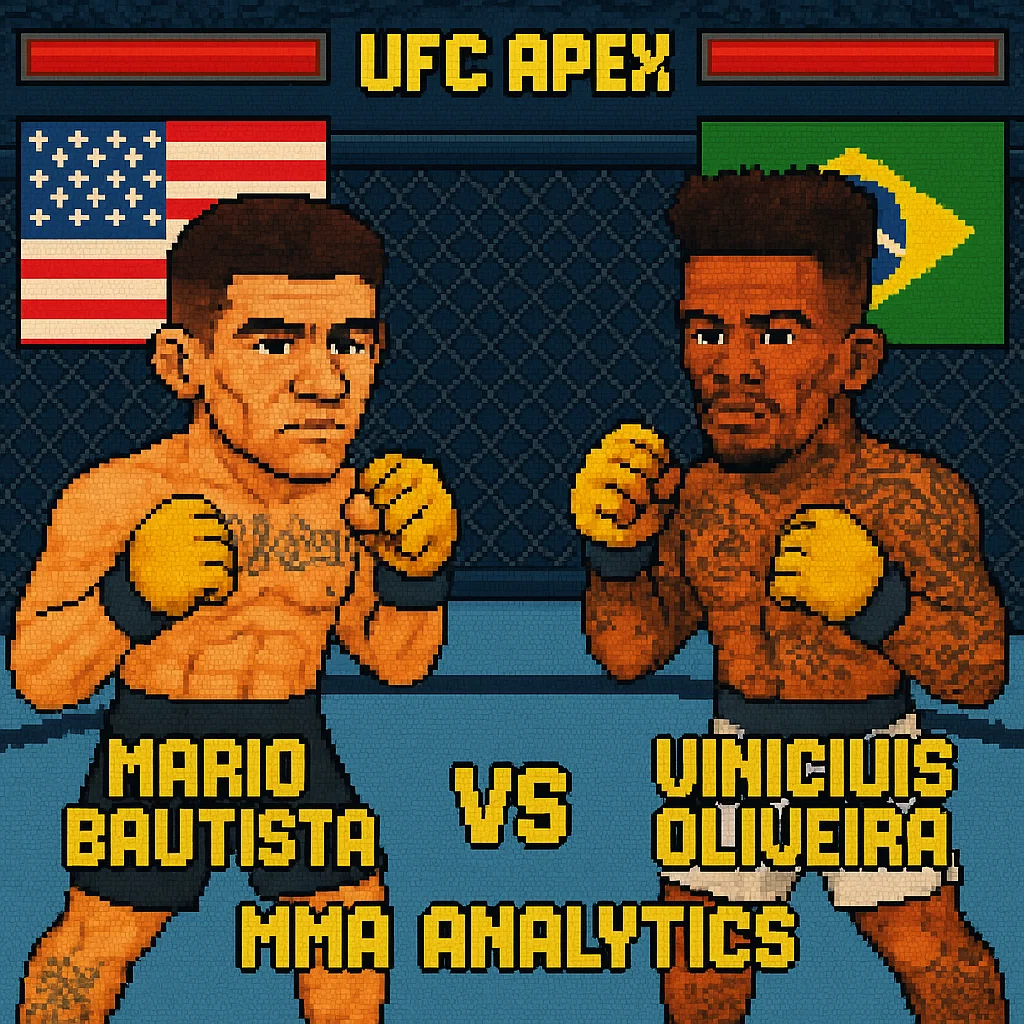
Explore Detailed Fighter Profiles
Click on either the fighter's name or profile image for each fighter to access comprehensive UFC statistics including striking metrics, grappling data, clinch performance, complete fight history, offensive & defensive analytics, and round-by-round breakdowns.

Mario Bautista
Fighter Metrics
Victory Methods
Win Round Distribution

Vinicius Oliveira
Fighter Metrics
Victory Methods
Win Round Distribution
📋 Last 5 Fights - Mario Bautista
| Date | Opponent | Result | Method |
|---|---|---|---|
| 2025-10-25 | Umar Nurmagomedov | L | Decision - Unanimous (3 Rounds, ) |
| 2025-06-07 | Patchy Mix | W | Decision - Unanimous (3 Rounds, ) |
| 2024-10-05 | José Aldo | W | Decision - Split (3 Rounds, ) |
| 2024-01-13 | Ricky Simón | W | Decision - Unanimous (3 Rounds, ) |
| 2023-08-19 | Da'Mon Blackshear | W | Decision - Unanimous (3 Rounds, ) |
📋 Last 5 Fights - Vinicius Oliveira
| Date | Opponent | Result | Method |
|---|---|---|---|
| 2025-07-19 | Kyler Phillips | W | Decision - Unanimous (3 Rounds, ) |
| 2025-02-01 | Said Nurmagomedov | W | Decision - Unanimous (3 Rounds, ) |
| 2024-06-29 | Ricky Simón | W | Decision - Unanimous (3 Rounds, ) |
| 2024-03-02 | Benardo Sopaj | W | KO/TKO - Flying Knee (R3, 4:41) |
| 2023-09-26 | Victor Madrigal | W | KO/TKO - Left Hook (R1, 3:02) |
Technical Analysis
Technical Score
Cardio Score
Overall Rating
📊 Technical Score
Calculated as the average of Striking Composite (66.0 vs 66.0) and Grappling Composite (78.0 vs 55.0). Balances overall striking effectiveness with grappling ability to measure complete technical skills.
💪 Cardio Score
Based on average fight duration, striking rate per minute, takedown rate, and finish rate. Measures cardiovascular endurance and ability to maintain pace throughout fights.
🎯 Overall Rating
Simple average of Technical Score and Cardio Score. Provides a holistic view of fighter capabilities combining skill level with physical conditioning and fight performance.
Striking Composite
Grappling Composite
📊 Technical Radar Comparison
📊 Metrics Legend
📊 Detailed Statistical Comparison
🥊 Fight Analysis Breakdown
🧩 Mario Bautista Key Advantages
Bautista's 0.8 submissions per 15 minutes represents one of the highest submission rates in the bantamweight division, creating real danger when he secures back control or dominant positions. His 6 career submissions (38% of wins) demonstrate finishing ability that Oliveira lacks (0.2 Sub/15, 2 career submissions). In the small cage, Bautista's ability to convert clinch work into back takes becomes increasingly valuable, especially when Oliveira's defensive scrambling creates opportunities. The American's submission threat forces Oliveira to be more cautious in exchanges, potentially limiting his offensive output. If Bautista can secure even one meaningful back control sequence, his finishing ability could change the entire fight dynamic.
Bautista's 5.58 strikes landed per minute with 48% accuracy creates significant volume advantages when fights remain upright. His pressure-heavy approach forces opponents into defensive positions, allowing him to rack up strike differentials that judges consistently reward. In the small cage, Bautista's ability to cut off angles and maintain forward pressure becomes increasingly valuable, especially when combined with his clinch work. The American's volume becomes particularly dangerous in early rounds when he's fresh and can sustain high output without fatigue. His ability to string together combinations while maintaining defensive positioning creates scoring opportunities that compound over five rounds.
The 25-foot octagon (small cage) amplifies Bautista's pressure-heavy approach, allowing him to cut off angles and force clinch exchanges more effectively than in larger cages. His ability to maintain forward pressure and trap opponents against the fence creates opportunities for takedowns, back takes, and control time that judges consistently reward. The reduced space limits Oliveira's ability to maintain distance and circle away from pressure, forcing him into exchanges where Bautista's clinch work becomes more valuable. This cage dynamic becomes particularly important in later rounds when Oliveira's movement becomes more limited and Bautista's pressure can accumulate control time and scoring opportunities.
⚠️ Unfavorable Scenarios
Oliveira's 80% takedown defense represents one of the highest rates in the bantamweight division, creating a massive conversion problem for Bautista's 32% takedown accuracy. The Brazilian's ability to stuff initial attempts and scramble out of bad positions means Bautista will struggle to convert clinch work into meaningful control time. Even in the small cage where pressure becomes more valuable, Oliveira's defensive mastery forces Bautista to work twice as hard for takedowns that may never materialize. If Bautista can't secure takedowns or back control, his primary path to victory becomes significantly narrower, forcing him to win rounds through striking volume alone—a scenario that favors Oliveira's superior damage economy.
Bautista's 4.19 strikes absorbed per minute (vs Oliveira's 2.89) creates a damage economy problem that compounds over five rounds. While Bautista can rack up volume with his 5.58 SLpM, Oliveira's superior defensive metrics (57% StrDef vs 55%) mean the Brazilian lands cleaner shots while absorbing less damage. This differential becomes particularly dangerous when combined with Oliveira's 24% KO/TKO probability—every clean counter carries fight-ending potential. Bautista's pressure-heavy approach requires walking through fire, and against a striker with Oliveira's efficiency and power, that becomes a dangerous proposition. The American's high absorption rate leaves him vulnerable to accumulative damage that could sway judges or create knockout opportunities.
📋 Likely Gameplan
Bautista should utilize volume pressure and clinch entries to force Oliveira into defensive positions, creating openings for takedown attempts and back control. His 48% striking accuracy and 5.58 SLpM suggest he can land setup strikes while maintaining forward pressure. The American's ability to mix striking entries with clinch work keeps Oliveira guessing and prevents him from settling into counter-striking rhythm. By varying his approach—sometimes pressuring with volume, sometimes committing to clinch—Bautista can exploit Oliveira's defensive positioning, creating opportunities for scrambles and subsequent back control sequences.
Once Bautista secures clinch control or takedowns, his priority should be establishing back control and hunting submissions. His BJJ background emphasizes back takes, rear-naked chokes, and submission threats rather than positional control alone. This approach maximizes finishing potential while creating danger—Bautista can threaten fight-ending submissions from dominant positions without exposing himself to reversals. The American's 0.8 SubPer15 suggests he can capitalize on back control opportunities, making this strategy both effective and potentially fight-ending if Oliveira's defensive scrambling fails.
🚀 Vinicius Oliveira Key Advantages
Oliveira's 80% takedown defense represents one of the highest rates in the bantamweight division, creating a massive conversion problem for Bautista's 32% takedown accuracy. The Brazilian's ability to stuff initial attempts, scramble out of bad positions, and maintain defensive positioning makes him extremely difficult to take down. His defensive mastery forces Bautista to work twice as hard for takedowns that may never materialize, draining the American's energy while Oliveira remains fresh. In the small cage, Oliveira's ability to defend takedowns without expending excessive energy becomes increasingly valuable as the fight progresses.
Oliveira's 2.89 strikes absorbed per minute (vs Bautista's 4.19) creates a damage economy advantage that compounds over five rounds. While Bautista can rack up volume with his 5.58 SLpM, Oliveira's superior defensive metrics (57% StrDef vs 55%) mean he lands cleaner shots while absorbing significantly less damage. This differential becomes particularly dangerous when combined with Oliveira's 24% KO/TKO probability—every clean counter carries fight-ending potential. The Brazilian's ability to minimize damage while maximizing offensive efficiency creates a scoring framework that judges consistently reward, especially in championship rounds where damage accumulation becomes visually apparent.
⚠️ Unfavorable Scenarios
Bautista's pressure and clinch work create a dangerous scenario for Oliveira—if the American secures back control, his 0.8 SubPer15 and 6 career submissions create real finishing potential. The Brazilian's 80% takedown defense suggests he can stuff most attempts, but Bautista's ability to chain clinch entries and create scrambles means back control opportunities will arise. Once Bautista secures the back, Oliveira's striking output drops to zero while the American hunts submissions and accumulates control time. This scenario becomes increasingly likely in the small cage where Bautista's pressure can trap Oliveira against the fence and create scrambling opportunities.
Oliveira's superior cardio score (72.5 vs Bautista's 52.5) suggests he can maintain his efficient striking approach over extended periods better than Bautista can sustain his pressure. While Bautista's 5.58 SLpM output creates volume, Oliveira's damage economy means he doesn't need to match that output to win rounds. The Brazilian's ability to maintain defensive positioning and counter-strike efficiently becomes particularly valuable in championship rounds where Bautista's pressure-heavy approach may begin to fade. Oliveira's tendency to land cleaner shots while absorbing less damage creates a scoring advantage that compounds over five rounds, especially when combined with his elite takedown defense that prevents Bautista from banking control time.
📋 Likely Gameplan
Oliveira's optimal strategy involves maintaining defensive positioning while threatening counter-strikes. His ability to defend takedowns (80% TDDef) should allow him to stay upright and punish Bautista's entries with clean counters. The Brazilian's switch-stance ability allows him to vary his attack angles and keep Bautista guessing. When Bautista commits to pressure or clinch entries, Oliveira should threaten explosive counters and uppercuts to deter entries and create scoring opportunities. The key is maintaining defensive efficiency while staying active enough to score points and prevent Bautista from establishing consistent pressure or securing back control.
Oliveira's best chance for victory lies in maintaining defensive efficiency throughout all five rounds while accumulating damage advantages through superior economy. The Brazilian should look to capitalize on his cardio advantage (72.5 vs 52.5) by maintaining consistent output and defensive positioning as Bautista's pressure-heavy approach begins to fade. His 2.89 SApM becomes most valuable when combined with clean counter-striking that lands while Bautista absorbs damage. By establishing early damage advantages and maintaining defensive mastery, Oliveira can force Bautista to take increasing risks to secure takedowns or submissions, creating opportunities for explosive counters and potential fight-ending sequences.
🎯 Fight Prediction Analysis
Data-driven prediction model based on statistical analysis
📊Detailed Analysis Summary
🏟️Cage Dynamics
The 25-foot octagon (small cage) creates a critical dynamic in this matchup—initially favoring Bautista's pressure and clinch game, but Oliveira's superior takedown defense (80% TDDef) and damage economy (2.89 SApM vs 4.19) create a counter-narrative. Bautista's pressure-heavy approach benefits from the reduced space, allowing him to cut off angles and force clinch exchanges more effectively. However, Oliveira's elite defensive metrics mean that even in the small cage, Bautista will struggle to convert clinch work into meaningful takedowns or control time. The Brazilian's ability to maintain distance with his +1" reach advantage and punish entries with clean counters becomes increasingly valuable as the fight progresses, especially when combined with his superior cardio score (72.5 vs 52.5). The small cage amplifies both fighters' strengths—Bautista's pressure and Oliveira's defensive efficiency—creating a fascinating tactical battle.
🎯Technical Breakdown
The statistical analysis reveals two primary battlefields where this fight will be decided: takedown conversion rate and damage economy. Bautista's 1.48 TD15 vs Oliveira's 1.67 represents similar volume, but Oliveira's 80% takedown defense vs Bautista's 32% takedown accuracy creates a massive conversion problem for the American. While Bautista's striking volume (5.58 SLpM, 48% accuracy) creates impressive output, Oliveira's damage economy (2.89 SApM vs Bautista's 4.19) means he absorbs significantly less damage while maintaining offensive efficiency. The Brazilian's 57% striking defense combined with his elite takedown defense forces Bautista into uncomfortable exchanges where his pressure-heavy approach becomes less effective. These differentials create a scoring framework where Oliveira's damage efficiency and defensive mastery consistently outweigh Bautista's volume and pressure in judges' eyes, especially over five rounds.
🧩Key Battle Areas
Three critical battle areas will determine the outcome: takedown conversion rate vs elite takedown defense, damage absorption differential, and submission threat vs defensive scrambling. Oliveira's 80% takedown defense suggests he can stuff most attempts, but Bautista's 0.8 SubPer15 creates real danger if he secures back control. The American's submission threat (6 career submissions) represents his most dangerous weapon against Oliveira's defensive game, but the Brazilian's ability to maintain distance and punish entries makes these opportunities rare. As the fight progresses, Oliveira's superior cardio (72.5 vs 52.5) and damage economy become increasingly decisive, especially when combined with his ability to defend takedowns without expending excessive energy. The key question is whether Bautista can convert clinch work into meaningful control time or submissions, or if Oliveira's defensive mastery and counter-striking will dominate the scoring.
🏁Final Prediction
The most likely outcome is Vinicius Oliveira by Decision (38% probability), achieved through superior damage economy, elite takedown defense, and efficient counter-striking over five rounds. Oliveira's KO/TKO path (24%) becomes viable if he consistently punishes Bautista's entries with clean counters, particularly as the American's pressure creates openings for explosive strikes. Bautista's upset lane centers on Decision (24%) via pressure and clinch control, or Submission (10%) if he can secure back control from scrambles. The American's KO/TKO path (3%) is less likely given Oliveira's defensive metrics, but volume accumulation could create opportunities in later rounds. The fight's outcome hinges on whether Bautista can convert his pressure into meaningful control time or submissions, or if Oliveira's defensive mastery and damage efficiency will dominate the scoring throughout five rounds.
💰 Betting Analysis: Model vs Market
Detailed value assessment in the betting market
📊Market Odds
🤖Analytical Model
💎Value Opportunities
MAXIMUM VALUE
GOOD VALUE
SLIGHT VALUE
⚠️Key Market Discrepancies
- • Overweights early KO volatility – Underprices five-round wrestling cycles.
- • Undervalues damage economy – Low SApM differential drives optics on cards.
- • Big-cage bias – Space helps early, but fence/rides erode it late.
🎯 Comprehensive Probabilistic Analysis
100 hypothetical fight simulation based on statistical data
🏆Outcome Distribution - Mario Bautista
Pressure and clinch control in small cage
Less likely; needs volume accumulation
Back-takes from clinch scrambles
💥Outcome Distribution - Vinicius Oliveira
Superior damage economy and efficiency
Punishing entries with explosive counters
Low historical submission profile
⏰Fight Timeline Analysis
⚡Window of Opportunity - Mario Bautista
- • Early rounds: Establish pressure and clinch before Oliveira settles.
- • Back control: Convert scrambles into submission opportunities.
- • Small cage: Use pressure to trap Oliveira against fence.
🎯Progressive Dominance - Vinicius Oliveira
- • Defensive mastery: Elite TDDef prevents Bautista's primary path.
- • Damage economy: Land cleaner shots while absorbing less.
- • Cardio advantage: Superior conditioning (72.5 vs 52.5) compounds late.
🎯 Final Confidence Assessment
Confidence level and uncertainty factors
Confidence Level
Strong edge via damage economy and elite takedown defense
✅Supporting Factors
- • Elite takedown defense (80% TDDef vs 32% TDAcc)
- • Superior damage economy (2.89 vs 4.19 SApM)
- • Higher cardio score (72.5 vs 52.5)
- • Undefeated in UFC with disciplined recent performances
⚠️Risk Factors
- • Bautista's submission threat (0.8 Sub/15)
- • Small cage amplifies pressure game
- • Bautista's volume advantage (5.58 vs 5.28 SLpM)
🏁Executive Summary
Vinicius Oliveira's systematic approach to defensive efficiency should steadily accumulate advantages through superior damage economy and elite takedown defense, while Mario Bautista's best equity centers on pressure, clinch control, and submission threats in the small cage. The statistical differentials heavily favor Oliveira: his 80% takedown defense vs Bautista's 32% takedown accuracy creates a massive conversion problem, while his 2.89 SApM vs Bautista's 4.19 represents superior damage economy that compounds over five rounds. Oliveira's 72.5 cardio score vs Bautista's 52.5 demonstrates exceptional conditioning, while his undefeated UFC record (4-0) with recent disciplined decision wins shows he can maintain efficiency over extended periods. The Brazilian's ability to minimize damage while maximizing offensive efficiency creates a scoring framework that judges consistently reward, especially in championship rounds where damage accumulation becomes visually apparent.
Prediction: Oliveira by Decision most likely (38% probability) through superior damage economy and defensive mastery; Oliveira's KO/TKO path (24%) becomes viable if he consistently punishes Bautista's entries with clean counters. Bautista's upset lane centers on Decision (24%) via pressure and clinch control, or Submission (10%) if he can secure back control from scrambles. The fight's outcome hinges on whether Bautista can convert his pressure into meaningful control time or submissions, or if Oliveira's defensive mastery and damage efficiency will dominate the scoring throughout five rounds.