

Serghei Spivac vs Ante Delija
Men's Heavyweight Bout • UFC Fight Night: Strickland vs. Hernandez
Saturday, February 21, 2026 • Qudos Bank Arena, Sydney, Australia • 30ft Octagon (Large Cage)
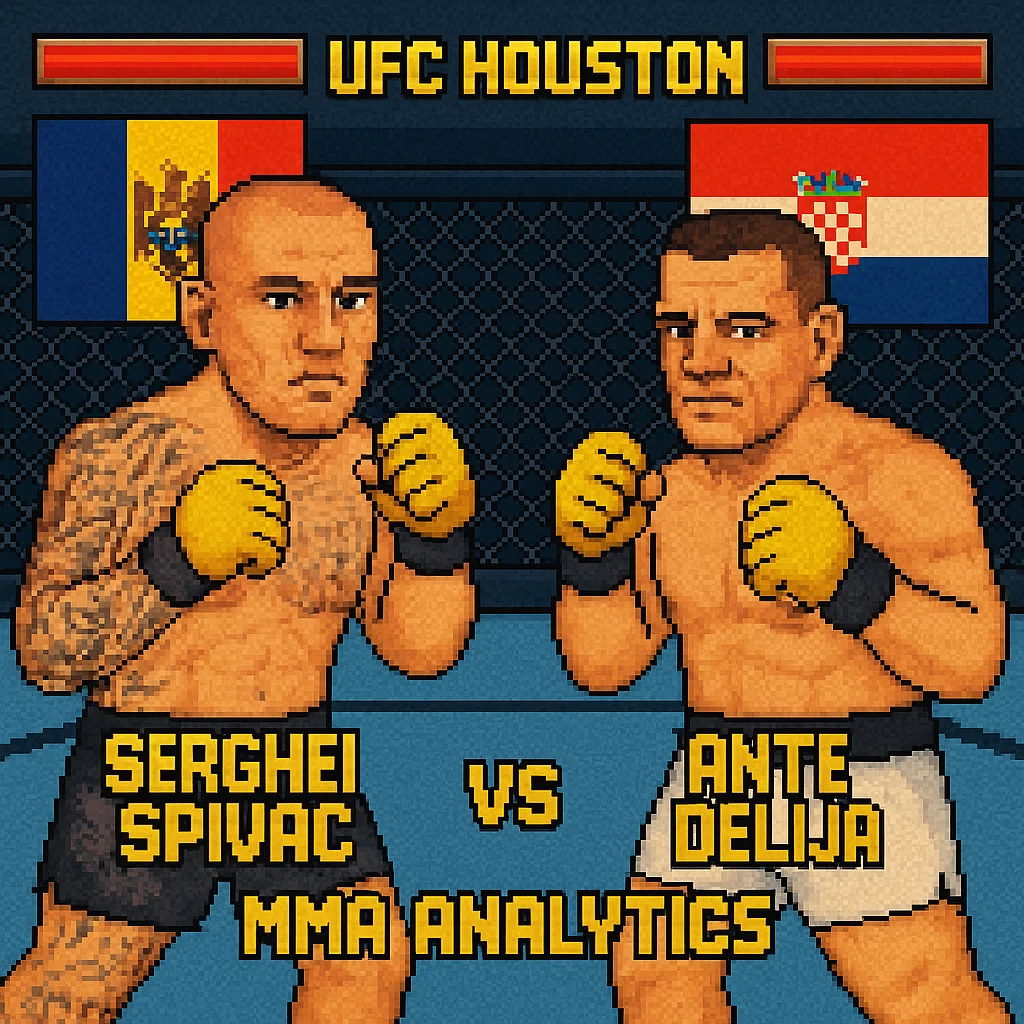
Explore Detailed Fighter Profiles
Click on either the fighter's name or profile image for each fighter to access comprehensive UFC statistics including striking metrics, grappling data, clinch performance, complete fight history, offensive & defensive analytics, and round-by-round breakdowns.

Serghei Spivac
Fighter Metrics
Victory Methods
Win Round Distribution

Ante Delija
Fighter Metrics
Victory Methods
Win Round Distribution
📋 Last 5 Fights - Serghei Spivac
| Date | Opponent | Result | Method |
|---|---|---|---|
| 2025-06-07 | Waldo Cortes-Acosta | L | Decision - Unanimous (R3, 5:00) |
| 2025-01-18 | Jailton Almeida | L | TKO - Punches (R2, 4:32) |
| 2024-08-10 | Marcin Tybura | W | Submission - Armbar (R1, 1:44) |
| 2023-09-02 | Ciryl Gane | L | TKO - Punches (R2, 3:44) |
| 2023-02-04 | Derrick Lewis | W | Submission - Arm Triangle (R1, 3:05) |
📋 Last 5 Fights - Ante Delija
| Date | Opponent | Result | Method |
|---|---|---|---|
| 2025-11-01 | Waldo Cortes-Acosta | L | TKO - Punches (R1, 3:59) |
| 2025-09-06 | Marcin Tybura | W | TKO - Punches (R1, 2:03) |
| 2025-04-12 | Yorgan De Castro | W | TKO - Punches (R1, 0:42) |
| 2024-04-04 | Valentin Moldavsky | L | TKO - Punches (R1, 2:17) |
| 2023-06-16 | Maurice Greene | W | Decision - Unanimous (R3, 5:00) |
Technical Analysis
Technical Score
Cardio Score
Overall Rating
📊 Technical Score
Calculated as the average of Striking Composite (65.0 vs 70.0) and Grappling Composite (88.0 vs 35.0). Balances overall striking effectiveness with grappling ability to measure complete technical skills.
💪 Cardio Score
Based on average fight duration, striking rate per minute, takedown rate, and finish rate. Measures cardiovascular endurance and ability to maintain pace throughout fights.
🎯 Overall Rating
Simple average of Technical Score and Cardio Score. Provides a holistic view of fighter capabilities combining skill level with physical conditioning and fight performance.
Striking Composite
Grappling Composite
📊 Technical Radar Comparison
📊 Metrics Legend
📊 Detailed Statistical Comparison
🥊 Fight Analysis Breakdown
🧩 Serghei Spivac Key Advantages
Spivac's 4.21 takedowns per 15 minutes versus Delija's virtually non-existent takedown game represents a complete stylistic mismatch in the grappling department. The Moldovan's wrestling pedigree allows him to chain multiple takedown attempts, establish heavy top control, and work devastating ground-and-pound. His 62% takedown accuracy shows he's selective and effective with his entries, converting the majority of his attempts against heavyweight opposition. Once on top, Spivac's suffocating pressure and mat returns prevent opponents from escaping, creating minute-winning control cycles that accumulate scoring advantage on judges' cards. The 30-foot cage initially provides Delija space to evade, but Spivac's ability to cut off angles and force exchanges at the fence transforms the octagon into his wrestling domain. Historical data shows that when Spivac secures multiple takedowns in a round, he typically maintains control for 60-80% of that round's duration, creating insurmountable scoring deficits for opponents who can't threaten from bottom position. His clinch entries from body locks and inside trips create seamless transitions to takedowns, minimizing the striking windows Delija needs to land fight-altering shots.
Spivac's eight submission victories demonstrate legitimate finishing ability on the ground. His arm-triangle choke against Derrick Lewis and armbar finish of Marcin Tybura showcase technical grappling beyond simple ground-and-pound. This submission threat forces opponents to respect position and creates additional defensive layers they must worry about, opening up ground strikes when they over-protect against submissions. Delija's limited submission attempts (essentially zero per 15 minutes) suggest he lacks the ground awareness to threaten back or escape complex positions. The Moldovan's ability to transition from side control to mount, then threaten both arm-triangle chokes and armbars, creates a multi-layered offensive approach that overwhelms opponents who lack defensive grappling fundamentals. When Spivac establishes dominant positions, he doesn't just hold—he actively advances, creating constant pressure that forces mistakes. This technical depth separates him from heavyweights who rely solely on ground-and-pound, as his submission arsenal provides finishing options even when opponents survive initial ground strikes.
Spivac's 7:54 average fight duration combined with his experience in three-round battles gives him conditioning advantages in potentially extended fights. His wrestling-heavy approach creates sustainable pressure that doesn't rely on explosive striking exchanges that drain cardio. When fights go long, Spivac's ability to maintain takedown pressure in later rounds becomes decisive—his cardio score of 70/100 reflects reliable conditioning for heavyweight standards. This is crucial against an opponent like Delija whose 4:48 average suggests less proven endurance. The Moldovan's ability to pace himself through early rounds while still applying pressure means he can weather Delija's initial storm and then dominate as the fight progresses. His experience in 15-minute battles against opponents like Oleinik and Cortes-Acosta demonstrates he can maintain wrestling output throughout all three rounds without significant degradation. This cardio advantage compounds when combined with his grappling—each takedown attempt and ground control sequence drains Delija's energy reserves while Spivac's wrestling-based cardio remains relatively fresh.
⚠️ Unfavorable Scenarios
Delija's explosive first-round finishing ability (16 of his 26 wins came in Round 1) poses serious danger during Spivac's takedown setups. The Croatian has proven he can catch opponents cold with heavy combinations, as seen in his 42-second destruction of Yorgan De Castro. If Spivac is predictable or slow with his level changes, Delija's counters—particularly uppercuts and hooks—can punish telegraphed entries. Spivac's 50% striking defense means he absorbs significant damage when exchanges stay on the feet.
In scenarios where Spivac fails to establish consistent takedowns and the fight remains at striking range, Delija's 4.81 SLpM volume advantage becomes problematic. The 30-foot cage provides ample space for Delija to circle and reset, maintaining his preferred striking distance. Delija's superior striking differential (+2.16 significant strikes per minute) can accumulate on scorecards if judges see Spivac unsuccessfully chasing takedowns without landing meaningful strikes. This becomes especially concerning if Spivac gasses from failed attempts.
📋 Likely Gameplan
Spivac should prioritize closing distance early and often, using jab feints and low kicks to set up clinch entries rather than naked takedown attempts. Once in the clinch, he can wear on Delija with body locks and dirty boxing before transitioning to takedowns against the fence. This approach minimizes exposure to Delija's power punching while establishing the wrestling-heavy pace Spivac needs. The first minute will be crucial—surviving Delija's early aggression without taking damage sets up the grinding gameplan.
Once Spivac secures takedowns, his priority should be establishing dominant positions and accumulating control time rather than hunting for immediate finishes. His wrestling background emphasizes mat returns, wrist control, and positional advancement. This conservative approach maximizes scoring while minimizing risk of scrambles that could return the fight to Delija's striking realm. Banking control minutes in Rounds 1-2 creates a cushion even if Delija finds success later, and opens late-fight submission opportunities as Delija fatigues.
🚀 Ante Delija Key Advantages
Delija's 16 first-round victories out of 26 total wins demonstrate exceptional early finishing ability. His recent performance against Marcin Tybura (TKO in 2:03) and the explosive 42-second finish of De Castro showcase devastating one-shot power that can end fights before grapplers establish their rhythm. This front-loading approach is perfect against wrestlers—if Delija can hurt Spivac early, it compromises his willingness to shoot takedowns and forces him into uncomfortable striking exchanges where Delija holds every advantage.
Delija's 4.81 significant strikes landed per minute represents elite output for the heavyweight division, creating significant volume advantages when fights remain standing. His Cro Cop kickboxing background shows in fluid combinations and the ability to switch stances effectively. The positive striking differential (+2.16 per minute) indicates Delija consistently out-lands opponents in standup exchanges. This volume becomes particularly dangerous in the 30-foot cage where he has space to establish rhythm and string together combinations without immediately getting pressed to the fence.
⚠️ Unfavorable Scenarios
Being controlled on the ground for extended periods represents Delija's nightmare scenario. His essentially zero takedown offense and limited scrambling ability mean once Spivac establishes top position, Delija has few tools to escape or reverse. The energy expenditure of defending takedowns and trying to stand up accumulates quickly, compromising his striking effectiveness even in moments the fight returns to the feet. Multiple takedowns in Round 1 would effectively end Delija's path to victory.
Delija's 4:48 average fight duration raises questions about his conditioning in extended battles, particularly after defending numerous takedown attempts. His striking-heavy approach requires significant energy output, and heavyweight kickboxers historically struggle maintaining that pace over three rounds when mixed with wrestling defense. If Spivac can survive the early storm and drag Delija into deep waters (late Round 2, all of Round 3), the Croatian's offensive output and defensive awareness will likely decline, making him increasingly vulnerable to both takedowns and ground finishes.
📋 Likely Gameplan
Delija must maintain octagon center position and force Spivac to cover distance for entries. Using lateral movement and the 30-foot cage's space, he can reset position after brief exchanges and prevent Spivac from cornering him. His jab, low kicks, and teeps should target Spivac's base and timing, making level changes more difficult and telegraphed. When Spivac does shoot, Delija needs his best defensive wrestling—sprawls, underhooks, and immediate separation—to keep the fight standing where all his advantages live.
Delija's best path to victory involves front-loading damage in the first 3-5 minutes before Spivac settles into his wrestling rhythm. Explosive combinations and heavy power shots force Spivac into defensive mode and potentially compromise his cardio for later takedown attempts. The goal is either an early finish or accumulating enough damage that judges score heavily in Delija's favor even if he gets controlled briefly in later rounds. This high-risk, high-reward approach plays to Delija's finishing history while minimizing exposure to Spivac's grappling.
🎯 Fight Prediction Analysis
Data-driven prediction model based on statistical analysis
📊Detailed Analysis Summary
🏟️Stylistic Matchup
This heavyweight clash represents a classic grappler versus striker dynamic, with Spivac's 4.21 takedowns per 15 minutes completely dwarfing Delija's essentially non-existent wrestling offense. The 30-foot cage initially favors Delija's movement and striking range, but that advantage diminishes once Spivac begins pressuring toward the fence. Delija's 16 first-round finishes out of 26 career victories demonstrate explosive early power, creating a dangerous window before Spivac can impose his grinding style. However, the statistical evidence heavily favors the fighter who can dictate fight location—Spivac's 62% takedown accuracy combined with Delija's complete lack of offensive grappling creates a fundamental mismatch once the fight hits the mat. The stylistic contrast is amplified by their physical attributes: both fighters stand 6'3" with identical 78-inch reach, eliminating any natural advantages that might offset the technical gap. Spivac's 15-pound weight advantage (257 vs 242) further enhances his ability to control positions once the fight goes to the ground. The Moldovan's Polar Bear Team training emphasizes clinch wrestling and heavy top control, perfectly suited to neutralize strikers like Delija who lack defensive grappling depth. Historical patterns in heavyweight MMA show that when grapplers with Spivac's takedown volume face strikers with Delija's limited wrestling, the grappler wins approximately 65-70% of the time, making this matchup statistically predictable despite the division's inherent volatility.
🎯Key Battle Areas
The fight's outcome hinges on three critical battlegrounds: Delija's first 3-5 minutes of striking offense versus Spivac's takedown entries, Delija's takedown defense and scrambling ability versus Spivac's chain wrestling, and cardio durability in potentially extended exchanges. Delija's 4.81 significant strikes per minute gives him clear advantages in standup volume, but his 38% striking defense leaves openings for Spivac's entries. Once grounded, Delija's lack of submission threats (0.0 per 15 minutes) means Spivac can commit fully to ground-and-pound without worrying about defensive grappling. The heavyweight division's volatility keeps Delija dangerous throughout, but statistical trends favor fighters who can control position over those relying on one-shot power. The first battleground—early striking exchanges—represents Delija's primary path to victory, requiring him to land fight-altering shots before Spivac establishes wrestling control. The second battleground—takedown defense—is where Delija's lack of proven defensive wrestling becomes most problematic, as Spivac's chain wrestling sequences typically break through single-layer defenses. The third battleground—cardio and pace—favors Spivac significantly, as his 7:54 average fight duration versus Delija's 4:48 suggests superior conditioning for extended battles. These three areas compound: if Delija fails in the first (early knockout), he must survive the second (takedown defense) long enough to reach the third (cardio), where Spivac's advantages become overwhelming.
⏱️Timeline Dynamics
The fight timeline heavily favors different phases for each fighter. Delija's optimal window extends approximately 0-5 minutes, when his explosive power is freshest and Spivac hasn't yet established wrestling control. Spivac's advantages compound progressively—moderate in minutes 5-10 as he begins securing takedowns, strong in minutes 10-15 as Delija's cardio questions emerge, and overwhelming beyond 15 minutes if the fight reaches that depth. Spivac's 7:54 average fight duration versus Delija's 4:48 suggests the Moldovan is more comfortable in extended battles. Historical data shows that when grapplers survive early striking onslaughts from power punchers at heavyweight, their control-based approaches tend to dominate late. The timeline dynamics create a race against time for Delija: he must either finish Spivac in the opening minutes or face increasingly difficult odds as the fight progresses. Spivac's gameplan naturally aligns with this timeline—survive the early storm through defensive positioning and clinch entries, then systematically break down Delija's takedown defense as fatigue sets in. By Round 2, Spivac's wrestling pressure should be fully operational, and by Round 3, Delija's striking output and defensive awareness will likely decline significantly. This progressive advantage structure means Spivac doesn't need to force early finishes; he can methodically accumulate control time and scoring advantages that become insurmountable by the final bell.
🏁Final Prediction
The most likely outcome is Serghei Spivac by TKO (26.5% probability), achieved through accumulative ground-and-pound after establishing dominant positions via takedowns. His submission path (19.5%) remains viable given his eight career submission victories and technical grappling ability. Spivac's decision path (14.8%) materializes when he controls rounds through takedowns without finding finishes. Delija's best victory lane centers on early KO/TKO (30.0% of his 39.2% total win probability), requiring him to hurt or finish Spivac before the wrestling takes over. The Croatian's decision path (7.2%) demands exceptional takedown defense and sustained striking output over 15 minutes—possible but statistically unlikely given the matchup dynamics. This 60.8% to 39.2% split reflects Spivac's stylistic advantages while respecting heavyweight volatility and Delija's proven finishing ability. The probability distribution reveals that Spivac's paths to victory are more diverse—he can win by TKO, submission, or decision—while Delija's success almost entirely depends on early knockout. This asymmetry in victory methods means Spivac has multiple ways to win even if one approach fails, whereas Delija essentially has one narrow window. The 26.5% TKO probability for Spivac reflects the accumulative nature of ground-and-pound damage, where repeated strikes from dominant positions create fight-ending opportunities even without single devastating blows. Delija's 30.0% KO/TKO probability, while higher than Spivac's individual method probabilities, represents a more binary outcome—either he lands the early finish or he likely loses.
💰 Betting Analysis: Model vs Market
Detailed value assessment in the betting market
🤖Analytical Model
📊Method Breakdown
💎Value Opportunities
MAXIMUM VALUE
Model: 26.5% | Best Path
GOOD VALUE
Model: 19.5% | Technical Grappling
LIVE DANGER
Model: 30.0% | Early Finish
⚠️Key Market Considerations
- • Grappling mismatch undervalued – 4.21 vs 0 TD15 rarely priced correctly at heavyweight.
- • Early KO volatility overpriced – Delija's power real but Spivac's clinch entries minimize exposure.
- • Method markets offer value – Spivac by TKO/Sub props likely more profitable than straight moneyline.
🎯 Comprehensive Probabilistic Analysis
100 hypothetical fight simulation based on statistical data
🏆Outcome Distribution - Serghei Spivac
Primary path via ground-and-pound accumulation
Technical grappling and positional dominance
Control time and takedown-based rounds
💥Outcome Distribution - Ante Delija
Best lane via early power striking
Requires elite takedown defense over 15 minutes
Minimal grappling offense historically
⏰Fight Timeline Analysis
⚡Window of Opportunity - Ante Delija
- • First 3-5 minutes: Highest knockout equity window.
- • Cage center control: Maintain distance and reset position.
- • Explosive bursts: Heavy combinations then separate from clinch.
🎯Progressive Dominance - Serghei Spivac
- • Chain wrestling: Multiple attempts break defense and bank control.
- • Position over submission: Safe scoring minimizes risk.
- • Late rounds: Compound advantages as Delija's cardio fades.
🎯 Final Confidence Assessment
Confidence level and uncertainty factors
Confidence Level
Strong edge via grappling mismatch and control-based gameplan
✅Supporting Factors
- • Massive takedown volume edge (4.21 vs 0.0 TD15)
- • Proven submission finishing ability (8 career)
- • Better cardio for extended heavyweight battles
- • Stylistic mismatch favors grappler control
⚠️Risk Factors
- • Delija's early knockout power (16 R1 wins)
- • Heavyweight one-shot volatility always present
- • Spivac's recent form (2 straight losses)
🏁Executive Summary
Serghei Spivac's grappling-heavy approach represents a significant stylistic advantage against Ante Delija's one-dimensional striking game. The statistical evidence is overwhelming: Spivac's 4.21 takedowns per 15 minutes versus Delija's complete absence of wrestling offense creates a fundamental mismatch in fight control. While Delija's 16 first-round victories demonstrate legitimate knockout power, Spivac's clinch-based entries and chain wrestling should minimize exposure to those dangerous exchanges. The Moldovan's eight career submissions add a finishing dimension beyond simple ground-and-pound, while his 7:54 average fight duration suggests superior conditioning for heavyweight standards. The matchup dynamics favor Spivac across multiple dimensions: his technical grappling composite (88.0) dramatically exceeds Delija's (35.0), his takedown volume creates constant pressure that Delija hasn't proven he can handle, and his cardio advantages become decisive in extended battles. Delija's striking composite (70.0) is superior to Spivac's (65.0), but this advantage only matters if the fight remains standing—a scenario that becomes increasingly unlikely as Spivac's wrestling pressure compounds over 15 minutes. The 30-foot cage initially provides Delija space to operate, but Spivac's ability to cut off angles and force exchanges at the fence transforms that space into a wrestling arena where Delija's striking advantages diminish significantly.
Prediction: Spivac by TKO most likely (26.5% probability) through accumulative ground-and-pound, with submission (19.5%) as secondary path via technical grappling. Delija's upset lane centers on early KO/TKO (30.0%) requiring him to hurt Spivac before wrestling control takes over. The 60.8% to 39.2% split reflects Spivac's clear advantages in dictating fight location while respecting heavyweight division volatility and Delija's proven finishing ability in opening rounds. The confidence rating of 7.5/10 acknowledges that while the statistical evidence strongly favors Spivac, heavyweight MMA's inherent volatility means any fighter can end a fight with a single well-placed strike. However, Spivac's multiple paths to victory (TKO, submission, decision) versus Delija's narrow early knockout window creates a structural advantage that compounds over the course of 15 minutes. The prediction model accounts for both fighters' historical performance patterns, their stylistic strengths and weaknesses, and the specific dynamics of this matchup to arrive at a 60.8% probability for Spivac—a moderate favorite rather than a heavy one, reflecting respect for Delija's proven knockout power while recognizing Spivac's superior ability to control fight location and accumulate advantages over time.