

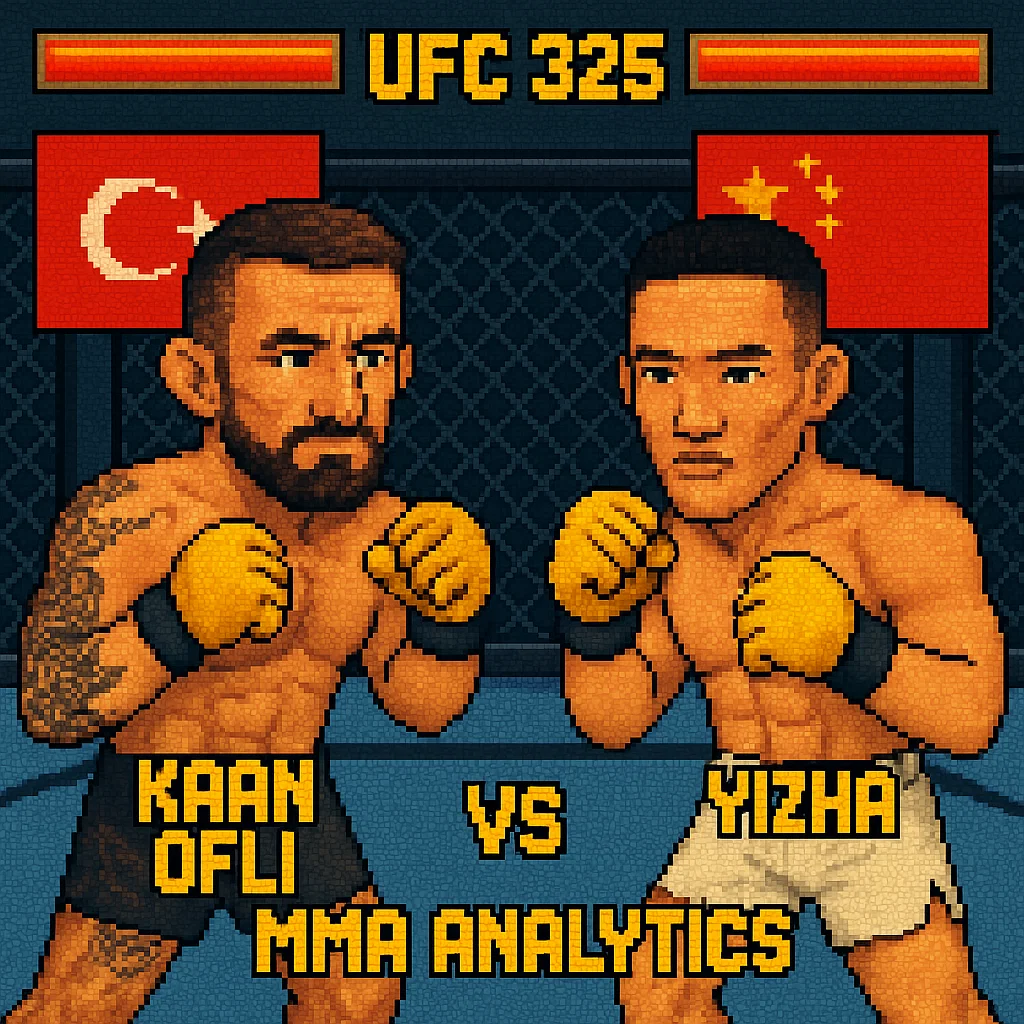
Kaan Ofli vs Yizha
Men's Featherweight Bout • UFC 325: Volkanovski vs Lopes 2
Saturday, January 31, 2026 • Qudos Bank Arena, Sydney, Australia • 30ft Octagon (Large Cage)
Explore Detailed Fighter Profiles
Click on either the fighter's name or profile image for each fighter to access comprehensive UFC statistics including striking metrics, grappling data, clinch performance, complete fight history, offensive & defensive analytics, and round-by-round breakdowns.

Kaan Ofli
Fighter Metrics
Victory Methods
Win Round Distribution

Yizha
Fighter Metrics
Victory Methods
Win Round Distribution
📋 Last 5 Fights - Kaan Ofli
| Date | Opponent | Result | Method |
|---|---|---|---|
| 2025-10-11 | Ricardo Ramos | W | SUB - Rear Naked Choke (R1, 3:02) |
| 2025-02-01 | Muhammad Naimov | L | Decision - Unanimous (R3, 5:00) |
| 2024-08-24 | Mairon Santos | L | TKO - Strikes (R2, 1:30) |
| 2023-02-24 | Jarrett Wilbraham | W | SUB - Rear Naked Choke (R3, 2:36) |
| 2022-11-18 | Ernie Braca | W | SUB - Guillotine Choke (R1, 3:55) |
📋 Last 5 Fights - Yizha
| Date | Opponent | Result | Method |
|---|---|---|---|
| 2025-08-23 | Westin Wilson | W | TKO - Strikes (R1, 0:37) |
| 2024-09-07 | Gabriel Santos | L | Decision - Unanimous (R3, 5:00) |
| 2024-02-03 | Kaiwen Li | W | SUB - Armbar (R1, 3:03) |
| 2023-08-27 | Sang Won Kim | W | Decision - Unanimous (R3, 5:00) |
| 2023-05-27 | Wuziazibieke Jiahefu | W | SUB - Armbar (R1, 2:28) |
Technical Analysis
Technical Score
Cardio Score
Overall Rating
📊 Technical Score
Calculated as the average of Striking Composite (65.0 vs 67.0) and Grappling Composite (12.0 vs 66.0). Balances overall striking effectiveness with grappling ability to measure complete technical skills.
💪 Cardio Score
Based on average fight duration, striking rate per minute, takedown rate, and finish rate. Measures cardiovascular endurance and ability to maintain pace throughout fights.
🎯 Overall Rating
Simple average of Technical Score and Cardio Score. Provides a holistic view of fighter capabilities combining skill level with physical conditioning and fight performance.
Striking Composite
Grappling Composite
📊 Technical Radar Comparison
📊 Metrics Legend
📊 Detailed Statistical Comparison
🥊 Fight Analysis Breakdown
🧩 Kaan Ofli Key Advantages
Ofli's Brazilian Jiu-Jitsu credentials are proven with 7 submission victories, including multiple rear-naked chokes and guillotines. His recent victory over Ricardo Ramos via RNC demonstrates his ability to capitalize on transitions and scrambles. Against Yizha's aggressive wrestling approach, Ofli's submission defense and offensive BJJ create dangerous counter-opportunities whenever the fight hits the ground. The German's ability to transition from defensive positions to offensive submission threats is particularly dangerous during takedown attempts, where he can catch guillotines on entries or secure back control during failed shots. His pattern of finishing fights in Round 1 and Round 3 suggests he's most dangerous when opponents are either fresh and aggressive (early mistakes) or fatigued and sloppy (late opportunities). Against a high-volume wrestler like Yizha, the increased grappling exchanges create more windows for Ofli to find his signature finishing techniques.
With 60% striking defense compared to Yizha's 47%, Ofli demonstrates superior defensive awareness and head movement. His ability to see punches coming and minimize damage taken (2.61 SApM vs 2.81) provides defensive efficiency in exchanges. This technical striking defense could allow him to stay competitive in standup exchanges despite lower output. The 13% defensive differential is significant in a three-round fight where damage accumulation matters. Ofli's defensive shell allows him to weather Yizha's volume while looking for clean counter opportunities. His lower absorption rate means he takes less damage per exchange, which becomes increasingly important as the fight progresses. This defensive efficiency also allows him to maintain composure and technique even when under pressure, creating opportunities for well-timed counters that could disrupt Yizha's rhythm or create openings for takedown defense.
Ofli's technical striking approach prioritizes quality over quantity, with 46% accuracy matching Yizha's 45% despite lower volume. His ability to land clean shots in exchanges could accumulate scoring opportunities and potentially find a finish if Yizha becomes reckless in his wrestling entries. The German's timing and precision create counter-striking opportunities against aggressive opponents. His ability to maintain accuracy while throwing fewer strikes suggests excellent shot selection and timing. When Yizha commits to takedown attempts, Ofli's counter-striking becomes particularly dangerous—he can land clean shots on entries or use strikes to set up defensive sprawls. The precision approach also conserves energy, allowing him to maintain technique and power throughout three rounds. While volume matters for scoring, clean, visible strikes often carry more weight with judges, especially when combined with defensive efficiency.
⚠️ Unfavorable Scenarios
Ofli's 0% takedown defense in UFC represents his most critical vulnerability. Against Yizha's 3.51 TD/15min pressure, he'll face constant wrestling that could neutralize his striking and force defensive BJJ rather than offensive opportunities. Extended periods on his back defending position could lead to lost rounds. The statistical mismatch is stark: Yizha attempts nearly 6x more takedowns per 15 minutes, and with Ofli's complete inability to stuff shots in his UFC career, the Chinese wrestler should find success through volume alone. Once on the ground, Ofli's BJJ becomes dangerous, but judges heavily favor top control and ground-and-pound. If Yizha can maintain positional dominance without getting caught in submissions, he'll accumulate control time that overwhelms Ofli's occasional submission threats. The German's path to victory requires creating scrambles, but if Yizha maintains disciplined top control, those opportunities become limited.
Ofli's 1.79 SLpM is significantly lower than Yizha's 2.97, creating a volume deficit that makes rounds harder to win on the scorecards. If he can't find finishing opportunities and the fight stays standing, his lower output combined with wrestling threats could result in losing close rounds to a more active opponent. The 1.18 SLpM differential represents approximately 40% less striking output, which becomes problematic when judges are scoring activity and volume. While Ofli's strikes may be cleaner and more accurate, the sheer volume difference can sway close rounds, especially in early frames where both fighters are fresh. The volume gap becomes even more pronounced when considering that Yizha's wrestling threats force Ofli to be more conservative with his striking, further reducing his already low output. In a three-round fight where every round matters, this volume deficit could prove decisive if the fight goes to the scorecards.
📋 Likely Gameplan
Ofli should utilize his superior striking defense to stay patient in exchanges while looking for counter opportunities. His 60% strike defense allows him to weather Yizha's volume while landing cleaner shots. When wrestling entries come, he must attempt sprawls and create scrambles where his BJJ becomes most dangerous. The key is maintaining defensive positioning while staying active enough to score points. Ofli should use his jab and straight punches to maintain distance and disrupt Yizha's rhythm, while being ready to sprawl immediately on any level changes. His defensive efficiency means he can afford to be patient and wait for clean counter opportunities rather than forcing exchanges. When sprawls are successful, he should immediately look for front headlock positions or back-takes rather than simply disengaging, as these positions create submission opportunities. The goal is to make Yizha pay for every takedown attempt, either through counter-strikes or submission threats.
Rather than accepting bottom position, Ofli must actively hunt for submission opportunities during transitions and scrambles. His recent RNC victory over Ramos shows his ability to capitalize on these moments. Creating chaos in grappling exchanges plays to his BJJ strength while minimizing Yizha's positional control advantage. Once taken down, Ofli should immediately look for sweeps, reversals, or submission entries rather than playing a defensive guard game. His guillotine and RNC are his most proven weapons, so he should prioritize positions that lead to these submissions. During scrambles, he must be aggressive in seeking back control or front headlock positions where his finishing ability is highest. The key is to never accept static bottom position—constant movement and submission threats force Yizha to defend rather than advance position, creating more opportunities for Ofli to find his game-changing submissions.
🚀 Yizha Key Advantages
Yizha's 3.51 takedowns per 15 minutes with 30% accuracy represents overwhelming wrestling volume that should dominate cage control and round scoring. Against Ofli's 0% takedown defense, his persistent chain wrestling creates multiple scoring opportunities per round. His 54% TD defense provides solid counter-wrestling to prevent reversals. The volume advantage is nearly 6x greater than Ofli's 0.61 TD/15, meaning Yizha will attempt takedowns at a rate that Ofli has never successfully defended in his UFC career. Even with only 30% accuracy, the sheer volume ensures multiple successful takedowns per round. Yizha's chain wrestling ability means failed attempts often lead to re-shots or clinch positions that still score points. His 54% takedown defense provides insurance against Ofli's occasional offensive wrestling, ensuring he maintains control of the fight's location. This wrestling dominance fundamentally shifts the fight's scoring framework, forcing Ofli to find finishes rather than compete in a control-time battle.
Yizha's 2.97 SLpM significantly outpaces Ofli's 1.79, creating clear volume advantages in standup exchanges. Combined with his 5-inch reach advantage (71" vs 66"), he can control distance and accumulate strike volume while staying outside Ofli's counter range. This reach disparity in the large 30ft cage maximizes his striking opportunities. The 5-inch reach advantage is substantial in featherweight, allowing Yizha to land strikes while remaining outside Ofli's effective range. In the large 30-foot octagon, this reach advantage becomes even more pronounced as there's more space to maintain distance. Yizha can use his jab and straight punches to score points while circling away from Ofli's counters. The volume advantage compounds over three rounds, creating significant strike differentials that judges consistently reward. Even if Ofli lands cleaner shots, the volume and activity advantage often sways close rounds, especially when combined with takedown threats that keep Ofli defensive.
With 77% finish rate and 17 first-round victories, Yizha brings explosive finishing threat from both striking and grappling. His 1.1 submission attempts per 15 minutes (including multiple armbars) combined with TKO power creates multi-faceted danger. Recent TKO of Westin Wilson in 37 seconds shows his ability to capitalize early. Yizha's finishing ability creates multiple paths to victory beyond decision. His 14 career submission victories (including multiple armbars) show he's dangerous from top position, while his 6 KO/TKO victories demonstrate striking power. The 1.1 submission attempts per 15 minutes means he's actively hunting finishes, not just controlling position. Against Ofli's 0% takedown defense, Yizha should find himself in top position frequently, where his ground-and-pound and submission threats become most dangerous. His ability to finish fights early (17 R1 victories) means he can capitalize on openings before Ofli finds his rhythm, particularly in the first round when both fighters are fresh and aggressive.
⚠️ Unfavorable Scenarios
Yizha's aggressive wrestling could create scramble opportunities where Ofli's elite BJJ becomes most dangerous. Failed takedown attempts or overcommitment to submissions from top position could expose his neck to guillotines or create back-take opportunities for rear-naked chokes—Ofli's most proven finishing method. The high volume of takedown attempts increases the likelihood of failed shots that create scramble situations. If Yizha overcommits to takedowns or becomes sloppy with his entries, Ofli's guillotine becomes a real threat. Similarly, if Yizha becomes too aggressive with submission attempts from top position, he could expose his back during transitions, giving Ofli opportunities for his signature rear-naked choke. The key risk is that Yizha's aggressive style, while effective for control and volume, creates more opportunities for Ofli's BJJ than a more conservative approach would. Every takedown attempt and every transition is a potential submission window for Ofli.
Yizha's 47% striking defense leaves him hittable in exchanges, especially against Ofli's technical precision. His tendency to walk forward with wrestling intent could expose him to counter strikes and timed shots that accumulate damage. Extended standup exchanges where he can't establish control favor Ofli's defensive efficiency. The 13% defensive gap means Yizha absorbs significantly more strikes per exchange, which compounds over three rounds. When he's unable to secure takedowns and forced into extended standup exchanges, Ofli's superior defense and precision could allow him to outscore Yizha despite lower volume. Yizha's forward pressure and wrestling entries also create predictable patterns that Ofli can time with counters. If Yizha becomes too focused on takedowns and neglects his striking defense, he could find himself eating clean shots that disrupt his rhythm and potentially create openings for Ofli's submissions if he becomes dazed or off-balance.
📋 Likely Gameplan
Yizha should establish early wrestling pressure with consistent shot attempts to exploit Ofli's poor takedown defense. His volume approach (3.51 TD/15) allows him to land takedowns through persistence even against defensive attempts. Mixing strikes with level changes keeps Ofli guessing and prevents counter-striking rhythm. The key is maintaining constant pressure and never allowing Ofli to settle into a striking rhythm. Yizha should use his reach advantage to land jabs and straight punches that set up level changes, making his takedown attempts less predictable. By mixing striking and wrestling, he forces Ofli to defend both threats simultaneously, creating openings for both. The volume approach means even if some takedown attempts fail, the constant pressure wears down Ofli's defensive energy and eventually breaks through. Early takedowns establish control and set the tone for the fight, making Ofli more defensive and less likely to take risks with his own offense.
Once takedowns are secured, Yizha must prioritize positional control over submission attempts. His 1.1 sub attempts per 15 minutes provide finishing opportunities, but against Ofli's BJJ he should favor ground-and-pound and positional dominance. Avoiding reckless submission attempts minimizes exposure to counter-grappling. The priority should be maintaining top position and accumulating control time rather than hunting high-risk submissions that could expose his back or create scramble opportunities. Ground-and-pound from dominant positions scores points and creates damage without the risk of submission reversals. Yizha should focus on half-guard and side control positions where he can land strikes while maintaining control, rather than advancing to mount or back positions where Ofli's BJJ becomes more dangerous. If submission opportunities present themselves naturally (like armbars from top), he should take them, but forcing submissions against a BJJ specialist like Ofli is unnecessarily risky when control time alone can win rounds decisively.
🎯 Fight Prediction Analysis
Data-driven prediction model based on statistical analysis
📊Detailed Analysis Summary
🏟️Cage Dynamics
The 30-foot octagon at Qudos Bank Arena creates a fascinating dynamic for this featherweight clash. The large cage initially favors Yizha's range weapons and movement, allowing him to utilize his 5-inch reach advantage while circling and resetting. However, his aggressive wrestling pressure gradually compresses available space, forcing Ofli into defensive positions against the fence. The German's best opportunities come from creating scrambles and chaos in these compressed spaces where his BJJ becomes most dangerous, but Yizha's volume and control should dictate the majority of the fight's geography. In the early rounds, the large cage provides Yizha with ample space to maintain distance and utilize his reach advantage. He can circle away from Ofli's counters while landing jabs and straight punches from outside range. However, as the fight progresses and Yizha's wrestling pressure intensifies, the cage gradually becomes smaller. His takedown attempts and forward pressure force Ofli toward the fence, where the German's movement becomes limited. These fence positions are where Ofli's BJJ becomes most dangerous—he can use the cage to create angles for sweeps or submissions, but they're also where Yizha's control time accumulates most effectively. The large cage paradoxically helps both fighters: Yizha early for range control, Ofli late for scramble opportunities, but Yizha's pressure should control the fight's geography more consistently.
🎯Technical Breakdown
The statistical analysis reveals two primary battlefields: grappling activity and striking volume. Yizha's 3.51 TD15 against Ofli's 0% takedown defense represents a critical mismatch that fundamentally alters fight control. While Ofli's 60% striking defense (vs 47%) provides technical superiority in standup, his 1.79 SLpM output is insufficient to control rounds against Yizha's 2.97 SLpM pressure combined with constant wrestling threats. The Chinese fighter's ability to mix volume striking with takedown attempts creates a scoring framework where Ofli must find finishes rather than win decisions. The grappling differential is the fight's most significant statistical mismatch: Yizha attempts nearly 6x more takedowns per 15 minutes, and with Ofli's complete inability to defend takedowns in his UFC career, the Chinese wrestler should find success through volume alone. This wrestling dominance creates a scoring framework where control time and ground-and-pound accumulate points faster than Ofli's precision striking can counter. The striking battle is more nuanced: Ofli's superior defense and accuracy provide technical advantages, but Yizha's volume and reach create activity advantages that judges often favor. The combination of wrestling pressure and striking volume creates a multi-layered attack that's difficult for Ofli to counter without finding finishing opportunities.
🧩Key Battle Areas
Three critical battle areas will determine the outcome: wrestling pressure vs submission defense, volume striking vs defensive efficiency, and positional control vs scramble chaos. Ofli's 7 career submission victories (including recent RNC over Ramos) provide his primary path to victory, but require creating scramble opportunities against Yizha's positional control. Yizha's 54% takedown defense combined with 30% accuracy on his own attempts suggests he can maintain top position once established. The fight becomes a race between Yizha accumulating control time for decision victory versus Ofli finding submission windows in transitions. The first battle area—wrestling pressure vs submission defense—is where Yizha's volume creates constant threats that Ofli must defend. Each takedown attempt is both a scoring opportunity for Yizha and a potential submission window for Ofli. The second area—volume striking vs defensive efficiency— sees Yizha's output competing against Ofli's precision, with judges potentially favoring activity over accuracy. The third area—positional control vs scramble chaos—is where the fight will be decided. If Yizha maintains disciplined top control, he accumulates points and minimizes submission risk. If Ofli can create scrambles and transitions, his BJJ becomes dangerous. The outcome depends on which fighter controls these battle areas more consistently across three rounds.
🏁Final Prediction
The most likely outcome is Yizha by Decision (28% probability), achieved through consistent wrestling pressure, cage control, and superior strike volume across three rounds. His finishing paths include Submission (20%) via armbars from top position and KO/TKO (16%) through accumulated ground-and-pound or early striking aggression. Ofli's primary upset lane centers on Submission (20%) via rear-naked chokes or guillotines during scrambles, particularly if Yizha becomes reckless with takedown entries. The German's KO/TKO path (6%) requires precise counter-striking, while decision victory (10%) demands neutralizing wrestling and winning standup exchanges—scenarios that become increasingly unlikely as the fight progresses. Yizha's decision path is most likely because his wrestling volume and control time create consistent scoring advantages that accumulate over three rounds. Even if he doesn't find finishes, his ability to secure takedowns and maintain top position should win rounds decisively. His submission path (20%) becomes viable when he can advance to dominant positions and find armbars or other submissions from top control. His KO/TKO path (16%) requires either early aggression catching Ofli off-guard or accumulated ground-and-pound creating fight-ending damage. Ofli's submission path (20%) is his most realistic route to victory, requiring him to capitalize on scramble opportunities and find his signature chokes. His decision path (10%) is unlikely because it requires neutralizing Yizha's wrestling while winning standup exchanges—a difficult combination given the statistical matchups. His KO/TKO path (6%) is least likely, requiring perfect counter-striking that catches Yizha cleanly.
💰 Betting Analysis: Model vs Market
Detailed value assessment in the betting market
🤖Analytical Model
💎Value Opportunities
MAXIMUM VALUE
Model: 20% | Fair: +400
GOOD VALUE
Model: 28% | Fair: +257
SLIGHT VALUE
Model: 58% | Fair: -138
⚠️Key Market Discrepancies
- • Undervalues submission threat – Ofli's BJJ credentials and recent finishes create higher sub equity.
- • Overweights wrestling control – Market prices Yizha's grappling but underestimates scramble danger.
- • Finish-rate bias – Both fighters have high finish rates; decision path less likely than market suggests.
🎯 Comprehensive Probabilistic Analysis
100 hypothetical fight simulation based on statistical data
🏆Outcome Distribution - Kaan Ofli
Primary path via RNC or guillotine in scrambles
Requires neutralizing wrestling and winning standup
Requires precise counter-striking on entries
💥Outcome Distribution - Yizha
Most likely via wrestling control and volume
Armbars and ground-based submissions from top
Early aggression or accumulated GNP
⏰Fight Timeline Analysis
⚡Window of Opportunity - Kaan Ofli
- • Scramble situations: Creates BJJ finishing opportunities.
- • Transition moments: RNC and guillotine windows appear.
- • Counter-striking: Capitalize on reckless TD entries.
🎯Progressive Dominance - Yizha
- • Wrestling pressure: Constant TD threats accumulate control.
- • Volume striking: Reach advantage creates scoring margin.
- • Positional control: Top position limits Ofli's offense.
🎯 Final Confidence Assessment
Confidence level and uncertainty factors
Confidence Level
Clear wrestling advantage but submission threat creates variance
✅Supporting Factors
- • Massive wrestling volume edge (3.51 vs 0.61 TD/15min)
- • Superior takedown defense (54% vs 0%)
- • Significant reach advantage (+5 inches)
- • Higher strike output and finish rate
⚠️Risk Factors
- • Ofli's elite BJJ and submission credentials
- • Yizha's lower striking defense (47%)
- • Small UFC sample size for both (3 fights each)
🏁Executive Summary
Yizha's comprehensive wrestling advantage combined with superior reach and volume striking creates a clear path to victory through decision or ground-based finishing. His 3.51 takedowns per 15 minutes against Ofli's 0% takedown defense represents the fight's most significant statistical mismatch, allowing him to control cage geography and dictate engagement terms. The Chinese wrestler's 5-inch reach advantage in the large 30-foot cage maximizes his striking opportunities while minimizing counter-strike risk. However, Ofli's proven Brazilian Jiu-Jitsu credentials (7 career submission victories including recent RNC over Ramos) provide a dangerous counter-threat during transitions and scrambles. The statistical analysis reveals a clear favorite in Yizha, whose wrestling volume and control should dominate the majority of fight scenarios. His ability to mix striking and grappling creates a multi-dimensional attack that's difficult for Ofli to counter without finding finishing opportunities. However, the submission threat from Ofli creates meaningful variance, particularly in scramble situations where his BJJ becomes most dangerous. The fight's outcome will largely depend on Yizha's ability to maintain disciplined positional control while avoiding the chaos that plays to Ofli's strengths.
Prediction: Yizha by Decision most likely (28% probability) through consistent wrestling control and volume accumulation; Submission victories equally possible for both fighters (20% each) with Yizha favoring armbars from top and Ofli hunting rear-naked chokes in scrambles. The fight's outcome hinges on whether Yizha can maintain positional control without creating scramble opportunities where Ofli's BJJ becomes most dangerous. Ofli's path to victory requires either catching submissions during transitions or somehow neutralizing wrestling pressure to win standup exchanges—scenarios that become increasingly unlikely given the statistical matchups. Yizha's decision victory becomes most probable when he can establish early wrestling control and maintain it throughout three rounds, accumulating control time and ground-and-pound that overwhelms Ofli's precision striking. His submission path requires advancing to dominant positions where his armbar and other top-position submissions become viable. Ofli's submission path depends on creating scramble opportunities where his guillotines and rear-naked chokes can find their mark. The fight's key variable is whether Yizha's aggressive wrestling creates enough chaos for Ofli's BJJ to capitalize, or whether his volume and control overwhelm Ofli's finishing threats. Given the statistical advantages, Yizha should control the majority of scenarios, but Ofli's submission threat provides meaningful upset potential.