

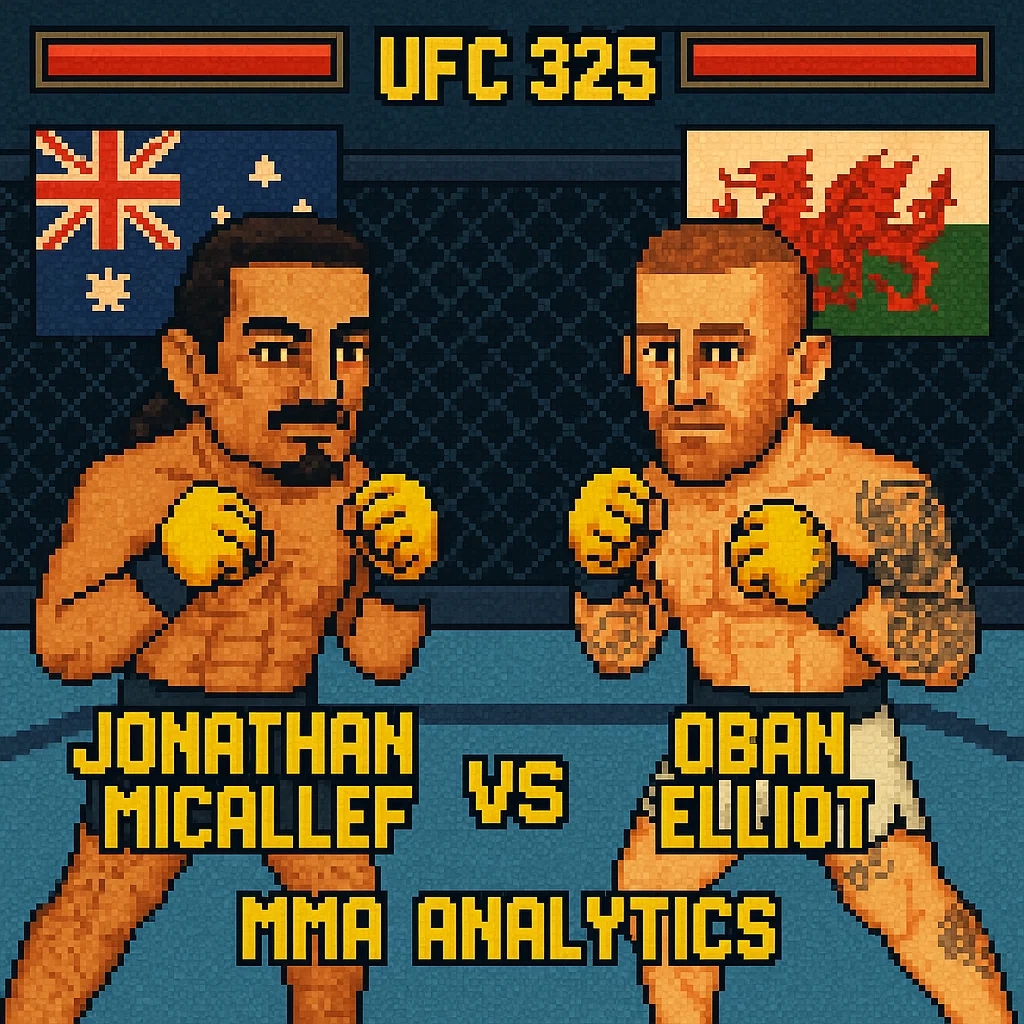
Jonathan Micallef vs Oban Elliott
Men's Welterweight Bout • UFC 325: Volkanovski vs Lopes 2
Saturday, January 31, 2026 • Qudos Bank Arena, Sydney, Australia • 30ft Octagon (Large Cage)
Explore Detailed Fighter Profiles
Click on either the fighter's name or profile image for each fighter to access comprehensive UFC statistics including striking metrics, grappling data, clinch performance, complete fight history, offensive & defensive analytics, and round-by-round breakdowns.
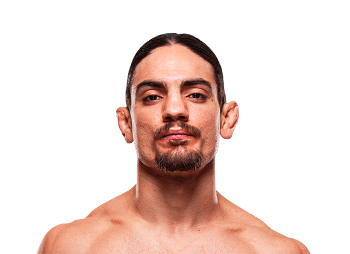
Jonathan Micallef
Fighter Metrics
Victory Methods
Win Round Distribution
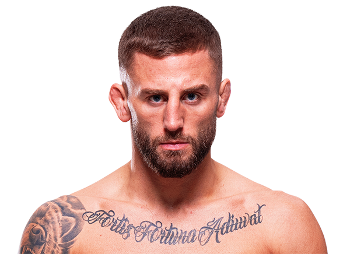
Oban Elliott
Fighter Metrics
Victory Methods
Win Round Distribution
📋 Last 5 Fights - Jonathan Micallef
| Date | Opponent | Result | Method |
|---|---|---|---|
| 2025-02-08 | Kevin Jousset | W | Decision - Unanimous (R3, 5:00) |
| 2024-10-15 | Mohamed Ado | W | Submission - Triangle Choke (R1, 3:01) |
| 2024-09-07 | Matt Vaile | W | Submission - Rear-Naked Choke (R1, 4:30) |
| 2024-03-02 | Aldin Bates | L | TKO - Punches (R4, 3:00) |
| 2023-11-18 | Joseph Luciano | W | Decision - Unanimous (R5, 25:00) |
📋 Last 5 Fights - Oban Elliott
| Date | Opponent | Result | Method |
|---|---|---|---|
| 2025-06-21 | Seok Hyeon Ko | L | Decision - Unanimous (R3, 5:00) |
| 2024-11-16 | Bassil Hafez | W | TKO - Punches (R3, 4:30) |
| 2024-07-27 | Preston Parsons | W | Decision - Unanimous (R3, 5:00) |
| 2024-02-17 | Val Woodburn | W | Decision - Unanimous (R3, 5:00) |
| 2023-08-22 | Kaik Brito | W | Decision - Majority (R3, 5:00) |
Technical Analysis
Technical Score
Cardio Score
Overall Rating
📊 Technical Score
Calculated as the average of Striking Composite (51.0 vs 55.0) and Grappling Composite (37.0 vs 35.0). Balances overall striking effectiveness with grappling ability to measure complete technical skills.
💪 Cardio Score
Based on average fight duration, striking rate per minute, takedown rate, and finish rate. Measures cardiovascular endurance and ability to maintain pace throughout fights.
🎯 Overall Rating
Simple average of Technical Score and Cardio Score. Provides a holistic view of fighter capabilities combining skill level with physical conditioning and fight performance.
Striking Composite
Grappling Composite
📊 Technical Radar Comparison
📊 Metrics Legend
📊 Detailed Statistical Comparison
🥊 Fight Analysis Breakdown
🧩 Jonathan Micallef Key Advantages
Micallef's 77-inch reach combined with southpaw stance creates significant problems for Elliott's orthodox approach. The 5-inch reach differential allows Micallef to work his jab from outside Elliott's counter range while threatening the straight left down the pipe. In the 30-foot cage, he has ample space to pivot and maintain optimal distance for his long-range tools. His ability to control the lead-leg battle with low kicks while working the straight left to body and head creates a layered offensive system that Elliott must navigate carefully. The southpaw-orthodox dynamic means Micallef's lead hand (right jab) and power hand (left straight) align perfectly with Elliott's open side, creating natural angles for clean connections. Micallef's 4.77 SLpM output becomes particularly dangerous when he can establish this distance early, forcing Elliott to cover more ground to close distance and exposing him to intercept strikes during entries.
With recent finishes via triangle choke and rear-naked choke, Micallef represents a genuine submission threat from bottom position. His 0.8 submissions per 15 minutes versus Elliott's 0.0 creates a dangerous dynamic if the Welsh fighter commits to extended top control. Micallef's guard work allows him to threaten triangles, guillotines, and arm bars, forcing Elliott to fight more cautiously from top position rather than pursuing aggressive ground-and-pound sequences. The triangle finish against Mohamed Ado and RNC against Matt Vaile demonstrate Micallef's ability to capitalize on positional transitions, particularly when opponents overcommit to passing or ground strikes. This submission threat fundamentally alters Elliott's risk-reward calculation—he cannot simply bank control time through safe top rides but must remain vigilant against opportunistic submissions during scrambles or when attempting to improve position.
Micallef's 4.77 strikes landed per minute significantly outpaces Elliott's 3.5 SLpM, creating a volume advantage when fights remain in striking range. This output differential becomes particularly important in early rounds when both fighters are fresh and Micallef can establish his rhythm without grappling interruptions. His ability to string together combinations—jab to straight left, low kick to body shot, lead hook to uppercut—allows him to accumulate significant strike differentials in rounds where Elliott struggles to close distance. The volume edge also creates scoring opportunities in close rounds where judges may favor activity over control time, especially if Micallef's strikes land cleanly while Elliott's takedown attempts are stuffed or result in minimal control.
⚠️ Unfavorable Scenarios
If Elliott successfully establishes consistent fence pressure and cage wrestling, Micallef's reach advantage becomes neutralized. Elliott's 1.7 TD/15 rate against Micallef's 50% takedown defense suggests he can find success driving to the fence and securing takedowns. Once on the ground, Elliott's experience in control positions allows him to accumulate minutes while Micallef's striking output drops to near zero. Extended periods with back to the cage defending takedowns drain Micallef's energy and prevent him from establishing his preferred striking distance, creating a scenario where Elliott can grind out rounds through control time and positional dominance.
Micallef's 4.0 strikes absorbed per minute versus Elliott's 2.24 SApM represents a significant defensive gap. His 59% striking defense, while only slightly below Elliott's 60%, becomes problematic when combined with his high-volume approach that sometimes leaves openings for counters. Elliott's more efficient striking (48% accuracy vs 44%) means he can land clean shots even with lower output, particularly when Micallef overcommits to combinations or fails to maintain proper defensive positioning. The absorption rate differential compounds over three rounds, potentially creating visible damage accumulation that influences judges' scoring even in close rounds.
📋 Likely Gameplan
Micallef should prioritize maintaining center-cage positioning and utilizing lateral movement to prevent Elliott from establishing fence pressure. His jab-straight left combination should target Elliott's lead leg and body, creating cumulative damage while keeping Elliott at range. When Elliott attempts to close distance, Micallef should pivot off the cage rather than retreating straight back, using the 30-foot cage's space to reset and reestablish his preferred distance. Low kicks to Elliott's lead leg serve dual purposes—damaging Elliott's base for takedown entries while scoring points and slowing Elliott's forward pressure.
If taken down, Micallef should not panic or immediately attempt explosive stand-ups. Instead, he should utilize his guard to threaten submissions—triangles when Elliott attempts to pass, guillotines during takedown transitions, and arm bars if Elliott overextends on ground strikes. Active guard work with submission threats forces Elliott to fight more cautiously, potentially creating scrambles that allow Micallef to return to his feet or secure dominant positions. The submission threat also serves as a deterrent, making Elliott less likely to commit fully to ground-and-pound sequences that might expose him to submission attempts.
🚀 Oban Elliott Key Advantages
Elliott's 1.7 takedowns per 15 minutes more than doubles Micallef's 0.83 rate, creating a significant grappling differential. His cage wrestling and clinch control allow him to dictate where fights occur, particularly important against a longer fighter. Against Micallef's 50% takedown defense, Elliott should find consistent success driving to the fence and establishing control sequences. His experience grinding through three-round decisions gives him a template for controlling volume-oriented prospects. Elliott's ability to chain takedown attempts—single leg to double leg, outside trip to body lock—creates persistent pressure that forces opponents to constantly defend rather than counter. His 44% takedown accuracy, while not elite, becomes effective when combined with his volume and ability to re-shoot after initial attempts are stuffed. The cage wrestling approach is particularly valuable against Micallef, as it neutralizes the reach advantage by forcing close-quarters exchanges where Elliott's pressure and control time accumulate scoring advantages.
Elliott's defensive metrics demonstrate superior fundamentals compared to Micallef. His 60% striking defense versus Micallef's 59% may seem marginal, but the real advantage lies in his dramatically lower absorption rate—2.24 SApM versus Micallef's 4.0 SApM represents a 44% reduction in damage taken. This defensive efficiency stems from Elliott's disciplined guard, head movement, and ability to control distance through footwork and clinch entries. The lower absorption rate means Elliott maintains cleaner optics throughout fights, with less visible damage accumulation that could influence judges' scoring. His defensive habits also allow him to counter more effectively, as he spends less energy absorbing strikes and more energy creating offensive opportunities. This efficiency compounds over three rounds, creating increasingly apparent advantages as Micallef's high-volume approach potentially leads to defensive lapses.
Elliott's four UFC appearances versus Micallef's single fight represents a significant experience gap at this level. He's navigated diverse stylistic challenges—from volume strikers like Val Woodburn to grapplers like Bassil Hafez—and proven he can execute gameplans over full 15-minute battles. His 14:08 average fight duration demonstrates exceptional cardio management, as he's consistently maintained output and wrestling pressure through complete three-round wars. This experience edge manifests in several ways: better cage awareness to avoid being trapped against the fence, more refined timing on takedown entries, and superior ability to adjust mid-fight when initial gameplans require modification. Elliott's proven cardio also means he can maintain his wrestling output throughout all three rounds, while Micallef's limited UFC experience creates uncertainty about his ability to sustain high-volume striking when combined with takedown defense over extended periods.
⚠️ Unfavorable Scenarios
If Micallef successfully maintains distance and prevents Elliott from establishing fence pressure, the reach and southpaw advantages become decisive. Micallef's 4.77 SLpM output can accumulate significant volume advantages when he has space to work his jab-straight left combination and low kicks. Elliott's 3.5 SLpM rate becomes insufficient to compete in pure striking exchanges, especially when Micallef's southpaw stance creates natural angles for clean connections. The 30-foot cage provides ample space for Micallef to pivot and reset, making it difficult for Elliott to cut off angles and force close-quarters exchanges. In this scenario, Elliott's wrestling becomes less effective because he cannot close distance without absorbing significant strikes, creating a dangerous cycle where failed takedown attempts lead to counter-striking opportunities for Micallef.
Micallef's 0.8 Sub/15 rate and recent finishes via triangle and RNC create genuine danger for Elliott's top-control approach. If Elliott secures takedowns but cannot pass Micallef's guard effectively, he risks being caught in submission attempts during scrambles or transitions. Elliott's lack of submission attempts (0.0 Sub/15) suggests he's not comfortable working from bottom position, meaning if Micallef secures a takedown or creates a scramble, Elliott could find himself in unfamiliar territory. The submission threat also forces Elliott to fight more cautiously from top position, potentially reducing his ground-and-pound effectiveness and allowing Micallef to create space for stand-ups or submission attempts. Elliott's recent loss to Seok Hyeon Ko demonstrated vulnerability when facing superior grapplers, creating concern about his ability to navigate Micallef's guard work safely.
📋 Likely Gameplan
Elliott should prioritize closing distance and driving Micallef toward the fence within the first 90 seconds of each round. His jab and body kicks can serve as setup strikes to close distance, but the primary goal should be establishing clinch control and cage wrestling. Once at the fence, Elliott should mix levels—threatening takedowns while occasionally breaking to land short punches and elbows that score points and create openings for takedown entries. His 1.7 TD/15 rate suggests he can find success against Micallef's 50% takedown defense, particularly when combining multiple attempts and using the cage to prevent Micallef from sprawling effectively. The key is maintaining constant pressure rather than allowing Micallef to reset and reestablish his preferred striking distance.
When Elliott secures takedowns, he must balance control time accumulation with submission defense. Rather than aggressively pursuing ground-and-pound that might expose him to triangles or arm bars, Elliott should prioritize safe control positions—half guard, side control, and back control when available. Short, controlled ground strikes can score points without overcommitting to power shots that create submission opportunities. If Micallef threatens submissions, Elliott should prioritize position over damage, using mat returns and positional control to bank minutes while minimizing risk. His experience in three-round decisions gives him the patience to accumulate control time methodically rather than forcing finishes that might backfire against a submission threat like Micallef.
🎯 Fight Prediction Analysis
Data-driven prediction model based on statistical analysis
📊Detailed Analysis Summary
⚖️Stylistic Matchup & Cage Dynamics
This welterweight bout presents a classic striker-grappler dynamic with added complexity from Micallef's southpaw stance and 5-inch reach advantage. The 30-foot cage benefits Micallef's long-range striking game early but provides less escape room once Elliott establishes fence pressure. Micallef's 4.77 SLpM output versus Elliott's 3.5 suggests he can win volume battles if the fight stays at range, but Elliott's superior striking defense (60% vs 59%) and dramatically lower absorption rate (2.24 vs 4.0 SApM) indicate better defensive fundamentals. The submission threat from Micallef's guard (0.8 Sub/15) creates genuine danger for Elliott's top control approach, forcing more cautious grappling exchanges rather than aggressive finish attempts.
The southpaw-orthodox dynamic creates natural angles for Micallef's power hand (left straight) to find Elliott's open side, while Elliott's orthodox stance means his right hand must travel further to reach Micallef. This angle advantage becomes particularly important in early exchanges when both fighters are fresh and Micallef can establish his rhythm. However, the 30-foot cage's size initially favors Micallef's movement and pivoting, but once Elliott establishes fence pressure, the space compresses and Micallef's reach advantage becomes less effective. Elliott's cage wrestling experience allows him to use the fence as a weapon, cutting off escape routes and creating takedown opportunities that wouldn't exist in open space. The submission threat from Micallef's guard adds another layer of complexity—Elliott cannot simply bank control time through safe top rides but must remain vigilant against opportunistic submissions during scrambles or when attempting to improve position.
🔑Key Decision Points & Round-by-Round Dynamics
The fight's outcome hinges on whether Micallef can maintain distance and utilize his reach advantage consistently, or if Elliott can close distance and establish his wrestling-based control game. Micallef's striking volume gives him early round equity, particularly if he can establish his jab-straight left combination and attack Elliott's lead leg. However, Elliott's proven cardio (14:08 average fight duration) and experience navigating full 15-minute battles creates increasing advantages as the fight progresses. Elliott's 1.7 TD/15 rate against Micallef's 50% takedown defense suggests consistent success driving to the fence, but the submission threat from bottom position prevents Elliott from simply grinding out safe control time.
Round 1 likely favors Micallef if he can establish his distance early and prevent Elliott from closing. The southpaw stance and reach advantage create natural angles for clean connections, and Micallef's 4.77 SLpM output can accumulate significant volume advantages when he has space to work. However, if Elliott successfully establishes fence pressure within the first two minutes, he can neutralize Micallef's reach and begin accumulating control time. Round 2 becomes crucial—if Elliott's wrestling pressure has created fatigue in Micallef's takedown defense, he can increase his success rate and control more minutes. If Micallef maintains distance, his volume advantage compounds and he can build a lead on the scorecards. Round 3 favors Elliott due to his proven cardio and experience in three-round decisions, but Micallef's submission threat means Elliott cannot coast—he must remain active and cautious even when ahead. The submission danger creates genuine finish equity for Micallef even in later rounds, particularly if Elliott becomes overconfident in top control or attempts to force ground-and-pound sequences.
📊Statistical Breakdown & Win Paths
The statistical analysis reveals several critical differentials that shape the fight's likely outcomes. Elliott's defensive efficiency (2.24 SApM vs 4.0 SApM) represents a 44% reduction in damage taken, creating cleaner optics throughout fights and reducing visible damage accumulation that influences judges. His wrestling volume (1.7 TD/15 vs 0.83 TD/15) more than doubles Micallef's rate, suggesting consistent success in establishing control sequences. However, Micallef's striking volume (4.77 SLpM vs 3.5 SLpM) and submission threat (0.8 Sub/15 vs 0.0) create legitimate paths to victory that Elliott must navigate carefully.
Elliott's most likely path to victory is Decision (40% probability), achieved through consistent wrestling pressure, cage control, and superior defensive habits accumulating advantages over three rounds. His experience edge and proven ability to execute patient gameplans gives him slight favorability in a close fight. Elliott's KO/TKO path (9%) becomes viable if his ground-and-pound accumulates damage through safe top control, particularly in later rounds when Micallef's takedown defense may fatigue. Micallef's best lanes involve early finish via submission (14%) exploiting Elliott's guard passing or late finish via strikes (14%) if Elliott's wrestling output drops in the third round. Micallef's decision path (15%) requires maintaining extended range control throughout three rounds—a scenario that becomes increasingly difficult as Elliott's pressure escalates and the cage space compresses.
🏁Most Likely Outcome & Upset Scenarios
Elliott by Decision (40% probability) represents the most likely path, achieved through consistent wrestling pressure, cage control, and superior defensive habits accumulating advantages over three rounds. His experience edge and proven ability to execute patient gameplans gives him slight favorability in a close fight. The statistical profile supports this outcome—Elliott's defensive efficiency, wrestling volume, and UFC experience create a reliable path to victory that doesn't require finishes or dramatic moments. His ability to accumulate control time while minimizing risk makes decision victories his most reproducible outcome.
However, Micallef's upset potential should not be underestimated. His submission threat (14% probability) creates genuine finish equity, particularly if Elliott becomes overconfident in top control or attempts aggressive guard passing. The triangle and RNC finishes in Micallef's recent fights demonstrate his ability to capitalize on positional transitions, and Elliott's lack of submission attempts (0.0 Sub/15) suggests he may not recognize danger until it's too late. Micallef's striking finish path (14%) becomes viable if he can maintain distance and accumulate damage over extended periods, particularly if Elliott's takedown attempts become less frequent in later rounds due to fatigue or submission concerns. The fight projects as competitive with narrow margins—Elliott's reliability and experience versus Micallef's physical tools and submission threat creating genuine uncertainty over 15 minutes.
💰 Betting Analysis: Model vs Market
Detailed value assessment in the betting market
📊Market Odds
🤖Analytical Model
💎Value Opportunities
BEST VALUE
Model: 40% | Fair: +150
GOOD VALUE
Model: 14% | Fair: +615
SLIGHT VALUE
Model: 60% | Fair: -150
⚠️Key Market Insights
- • Experience Premium – Market slightly undervalues Elliott's UFC-level consistency.
- • Submission Threat Discount – Micallef's guard danger creates upset equity overlooked by casual money.
- • Decision Path Value – Both fighters project to full distance more often than market suggests.
🎯 Final Confidence Assessment
Confidence level and uncertainty factors
Confidence Level
Moderate confidence - experience vs physical tools creates genuine uncertainty
✅Supporting Factors
- • UFC experience advantage (4 vs 1 fights)
- • Better defensive metrics (60% def, 2.24 SApM)
- • Wrestling volume edge (1.7 vs 0.83 TD/15)
- • Proven cardio in full 15-minute battles
⚠️Risk Factors
- • Micallef's reach and southpaw stance advantages
- • Submission threat from guard (0.8 Sub/15)
- • Elliott's recent loss to Ko via grappling
- • Limited UFC sample size for Micallef
🏁Executive Summary
Oban Elliott's UFC experience, superior defensive fundamentals, and wrestling-based pressure system create slight favorability in this welterweight matchup, but Jonathan Micallef's reach advantage, southpaw stance, and genuine submission threat from bottom position provide legitimate paths to victory. Elliott's statistical profile—60% striking defense, 2.24 SApM absorption, and 1.7 TD/15 wrestling rate—suggests he can navigate Micallef's range weapons and establish control sequences. However, Micallef's recent triangle and RNC finishes combined with his 0.8 Sub/15 rate mean Elliott must grapple cautiously rather than pursuing aggressive top control.
The stylistic matchup presents a fascinating contrast between Elliott's methodical, experience-driven approach and Micallef's dynamic, tool-rich skill set. Elliott's four UFC appearances versus Micallef's single fight represents a significant experience gap, but Micallef's physical advantages—5-inch reach edge, southpaw stance, and submission threat—create genuine uncertainty about the outcome. The 30-foot cage initially favors Micallef's movement and long-range striking, but Elliott's cage wrestling expertise allows him to compress space and neutralize reach advantages once he establishes fence pressure. The submission threat from Micallef's guard fundamentally alters Elliott's risk-reward calculation, preventing him from simply banking control time through safe top rides and forcing more cautious grappling exchanges.
Statistical analysis reveals critical differentials that shape the fight's likely outcomes. Elliott's defensive efficiency (2.24 SApM vs 4.0 SApM) represents a 44% reduction in damage taken, creating cleaner optics throughout fights and reducing visible damage accumulation that influences judges. His wrestling volume (1.7 TD/15 vs 0.83 TD/15) more than doubles Micallef's rate, suggesting consistent success in establishing control sequences against Micallef's 50% takedown defense. However, Micallef's striking volume (4.77 SLpM vs 3.5 SLpM) and submission threat (0.8 Sub/15 vs 0.0) create legitimate paths to victory that Elliott must navigate carefully. The southpaw-orthodox dynamic creates natural angles for Micallef's power hand to find Elliott's open side, while Elliott's cage wrestling experience allows him to use the fence as a weapon, cutting off escape routes and creating takedown opportunities.
Round-by-round dynamics suggest Round 1 favors Micallef if he can establish distance early, Round 2 becomes crucial for determining control patterns, and Round 3 favors Elliott due to his proven cardio and experience in three-round decisions. However, Micallef's submission threat means Elliott cannot coast even when ahead—he must remain active and cautious throughout all 15 minutes. The fight's competitive nature means small margins determine outcomes—a single successful takedown, a well-timed submission attempt, or a clean counter-strike can shift momentum and alter the final result. Elliott's reliability and experience create slight favorability, but Micallef's physical tools and submission threat ensure genuine uncertainty over the full duration of the fight.
Prediction: Elliott by Decision most likely (40% probability) through consistent wrestling pressure and superior defensive habits accumulating over three rounds; Micallef's upset lane is submission from bottom (14%) or late striking finish (14%) if Elliott's output drops. The narrow 57-43 split reflects genuine competitive balance—Elliott's reliability versus Micallef's physical tools and submission threat creating a compelling stylistic puzzle over 15 minutes. Elliott's experience edge and proven ability to execute patient gameplans give him slight favorability in a close fight, but Micallef's reach advantage, southpaw stance, and genuine submission threat from bottom position provide legitimate paths to victory that cannot be overlooked. The fight projects as competitive with narrow margins, where small tactical adjustments and well-timed moments can determine the outcome.