

Josh Hokit vs Denzel Freeman
Men's Heavyweight Bout • UFC 324
Saturday, January 24, 2026 • T-Mobile Arena, Las Vegas • 30ft Octagon (Large Cage)
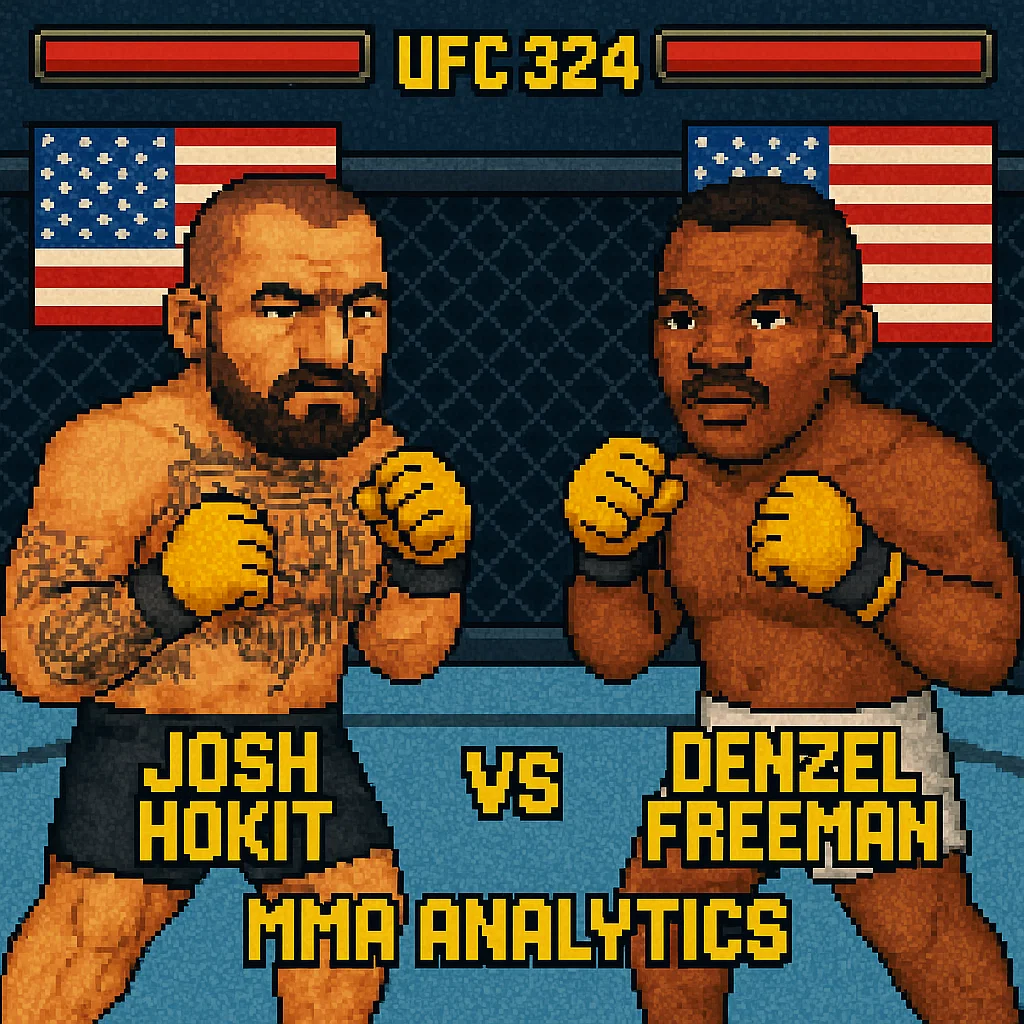
Explore Detailed Fighter Profiles
Click on either the fighter's name or profile image for each fighter to access comprehensive UFC statistics including striking metrics, grappling data, clinch performance, complete fight history, offensive & defensive analytics, and round-by-round breakdowns.
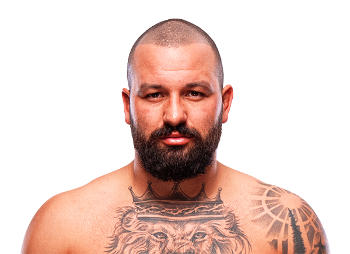
Josh Hokit
Fighter Metrics
Victory Methods
Win Round Distribution
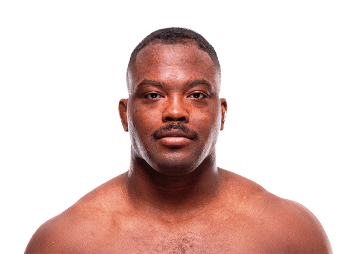
Denzel Freeman
Fighter Metrics
Victory Methods
Win Round Distribution
📋 Last 5 Fights - Josh Hokit
| Date | Opponent | Result | Method |
|---|---|---|---|
| 2025-01-11 | Max Gimenis | W | KO/TKO - Punches (R1, 0:56) |
| 2024-08-20 | Guilherme Uriel | W | KO/TKO - Punches (R2, 1:06) |
| 2024-04-19 | Eric Lunsford | W | KO/TKO - Punches (R1, 2:00) |
| 2023-12-01 | Ezekiel Latu | W | Submission - RNC (R1, 0:42) |
| 2023-08-18 | John Lopez | W | TKO - Punches (R1, 2:53) |
📋 Last 5 Fights - Denzel Freeman
| Date | Opponent | Result | Method |
|---|---|---|---|
| 2024-11-16 | Marek Bujło | W | Decision - Unanimous (R3, 5:00) |
| 2024-06-14 | Hugo Cunha | W | TKO - GNP (R2, 2:10) |
| 2024-02-23 | Steven Asplund | W | Submission - RNC (R2, 1:17) |
| 2023-06-09 | Isaiah Pinson | L | Decision - Split (R3, 5:00) |
| 2023-03-17 | Raiden Kovacs | W | TKO - Head Kick + GNP (R1, 0:27) |
Technical Analysis
Technical Score
Cardio Score
Overall Rating
📊 Technical Score
Calculated as the average of Striking Composite (85.0 vs 70.0) and Grappling Composite (87.0 vs 60.0). Balances overall striking effectiveness with grappling ability to measure complete technical skills.
💪 Cardio Score
Based on average fight duration, striking rate per minute, takedown rate, and finish rate. Hokit's short average fight duration (~2:30) leaves cardio untested, while Freeman has proven durability over 3-round wars.
🎯 Overall Rating
Simple average of Technical Score and Cardio Score. Provides a holistic view of fighter capabilities combining skill level with physical conditioning and fight performance.
Striking Composite
Grappling Composite
📊 Technical Radar Comparison
📊 Metrics Legend
📊 Detailed Statistical Comparison
🥊 Fight Analysis Breakdown
🧩 Josh Hokit Key Advantages
Hokit's 12.8 takedowns per 15 minutes is an absurdly high rate, especially for heavyweight. His All-American wrestling background and Jackson-Wink training translate to relentless chain-wrestling, double-leg entries, and devastating ground-and-pound from crucifix and back mount positions. Freeman has never faced a takedown threat of this magnitude at UFC level.
Hokit's 69% striking accuracy is elite, especially combined with 5.12 SLpM output. He doesn't just wrestle—he uses striking as a setup tool, throwing accurate power shots to open takedown entries. His compact frame (236 lb at 6'1") gives him a dense, powerful striking base that translates to explosive finishes when opponents focus on defending the takedown.
7 fights, 7 finishes—Hokit has never seen the judges' scorecards. His ability to recognize when opponents are hurt and immediately capitalize with ground-and-pound or submissions shows a killer instinct rare in prospects. The average fight duration of 2:30 demonstrates explosive finishing power that could end this fight at any moment.
⚠️ Unfavorable Scenarios
Freeman's 4-inch reach advantage and southpaw stance could make entries difficult if he uses jabs, teeps, and lateral movement effectively. The 30-foot cage provides ample space for Freeman to circle and reset, potentially frustrating Hokit's pressure game and forcing him to chase in ways that could gas his untested cardio.
Hokit's ~2:30 average fight duration means his conditioning for a full 15-minute fight is completely untested. If Freeman survives the initial onslaught and the fight extends past Round 1, Hokit may face cardio challenges he's never experienced, especially against a bigger, heavier opponent (265 lb vs 236 lb).
📋 Likely Gameplan
Hokit should use feinted jabs and right hands to close distance, then immediately shoot for double-legs or knee-taps. Against Freeman's southpaw stance, outside singles and duck-unders become high-percentage entries. The goal is to establish cage control early and begin the ride-and-smash sequences that have defined his career.
Given the cardio uncertainty, Hokit's optimal path is a Round 1 or early Round 2 finish. Once he secures top position, his crucifix attacks, back-takes, and ground-and-pound should be relentless. The longer this fight goes, the more Freeman's size and cardio advantages become relevant.
🚀 Denzel Freeman Key Advantages
Freeman enters as the significantly larger man—265 lb vs 236 lb—with a 77-inch reach against Hokit's 73 inches. His southpaw stance creates awkward angles for orthodox wrestlers, and his Marine Corps athletic background gives him functional strength that could neutralize Hokit's wrestling in the clinch and on the ground.
Freeman has been through wars—decisions against quality opposition, championship rounds in LFA, and adversity he's overcome. His 8:45 average fight duration shows he can sustain pace and recover from bad positions. If Hokit can't finish early, Freeman's experience in deep waters becomes a significant advantage.
⚠️ Unfavorable Scenarios
Freeman has 0 takedowns in UFC so far and has never faced a wrestler with Hokit's credentials. If he gets taken down early and put on his back, the crucifix attacks and ground-and-pound could overwhelm him before he can implement any of his game. His 0% TDAcc suggests wrestling isn't part of his toolkit for offense or scrambles.
Freeman's 3.27 SLpM and 62% accuracy are respectable but significantly lower than Hokit's 5.12 SLpM and 69% accuracy. In striking exchanges, Hokit may actually out-land Freeman despite the reach disadvantage, and landing rate differential could compound if Freeman becomes tentative about the takedown threat.
📋 Likely Gameplan
Freeman's path to victory requires keeping Hokit at the end of his jab, using teeps and front kicks to the body to discourage level changes, and circling away from power. His southpaw stance should create timing issues for Hokit's orthodox wrestling entries. The 30-foot cage is his ally—use all available space to frustrate the pressure.
If Freeman can survive the first 7-8 minutes, the fight dynamic shifts dramatically. Hokit has never been tested past Round 1 in most fights—if his pace slows, Freeman's durability and striking become increasingly viable. Look for intercept knees, uppercuts on level changes, and head kicks when Hokit shows fatigue.
🎯 Fight Prediction Analysis
Data-driven prediction model based on statistical analysis
📊Detailed Analysis Summary
🏟️Cage Dynamics
The 30-foot octagon provides Freeman more space to utilize his reach advantage and movement, but also more fence for Hokit to pressure against. Early rounds favor Hokit's explosive pressure and chain wrestling; late rounds favor Freeman's durability and size if he can weather the storm. The large cage is a double-edged sword—it gives Freeman room to circle but also makes cutting off the cage more challenging for Hokit's pressure style.
🎯Technical Breakdown
The statistical analysis reveals a stark contrast: Hokit's 12.8 TD/15min vs Freeman's 0.0 TD/15min represents an infinite differential in takedown activity. Hokit's 69% striking accuracy vs Freeman's 62% shows the wrestler is actually the more precise striker. The damage economy heavily favors Hokit (1.42 SApM vs 2.07 SApM), meaning he absorbs far less damage while outputting more. These differentials create a scoring framework that overwhelmingly favors Hokit if he can execute his gameplan.
🧩Key Battle Areas
Three critical areas will determine the outcome: 1) Freeman's ability to stuff initial takedown attempts and maintain distance with his reach, 2) Hokit's ability to sustain pace if the fight extends past Round 1, and 3) the effectiveness of intercept strikes (knees, uppercuts) vs level changes. Freeman's southpaw stance creates timing challenges for orthodox wrestlers, but Hokit's Jackson-Wink training should have him prepared for these angles.
🏁Final Prediction
The most likely outcome is Josh Hokit by KO/TKO (42% probability), achieved through ground-and-pound from dominant positions after securing takedowns. Hokit's submission path (15%) becomes viable from crucifix or back mount positions. Freeman's best lane is KO/TKO (20%) via intercept strikes or counters as Hokit shoots, with a smaller decision path (11%) requiring survival through early pressure and capitalizing on late-round cardio advantages. This fight is unlikely to see the scorecards—80% probability of finish.
💰 Betting Analysis: Model vs Market
Detailed value assessment in the betting market
📊Market Odds
🤖Analytical Model
💎Value Opportunities
MAXIMUM VALUE
Model: 42% | Fair: -172
GOOD VALUE
Model: 20% | Fair: +400
SLIGHT VALUE
Model: 60% | Fair: -150
⚠️Key Market Discrepancies
- • Undervalues wrestling differential – 12.8 TD/15min vs 0.0 is historically rare.
- • Overweights size advantage – Freeman's weight edge matters less on the ground.
- • Cardio uncertainty priced in – But 60% of Hokit's fights end in R1.
🎯 Comprehensive Probabilistic Analysis
100 hypothetical fight simulation based on statistical data
🏆Outcome Distribution - Josh Hokit
Primary path via ground-and-pound from dominant positions
Back-takes from crucifix create RNC opportunities
Control time accumulation without finish
💥Outcome Distribution - Denzel Freeman
Best lane via intercepts and counters on level changes
Requires surviving early pressure and capitalizing late
Low probability—not primary skillset
⏰Fight Timeline Analysis
⚡Window of Opportunity - Denzel Freeman
- • Minutes 8-15: Highest equity if fight reaches late rounds.
- • Intercept timing: Knees and uppercuts on level changes.
- • Movement discipline: Use cage space to avoid prolonged pressure.
🎯Early Finish Window - Josh Hokit
- • Minutes 0-7: Peak wrestling and finishing opportunity.
- • Chain shots: Double legs into crucifix transitions.
- • Urgency: Must capitalize before cardio becomes factor.
🎯 Final Confidence Assessment
Confidence level and uncertainty factors
Confidence Level
Strong edge via wrestling dominance but cardio untested
✅Supporting Factors
- • Massive takedown volume advantage (12.8 vs 0.0 TD15)
- • 100% finish rate with killer instinct
- • Higher striking accuracy despite wrestler label
- • Elite-level wrestling pedigree (All-American)
⚠️Risk Factors
- • Only 1 UFC fight each—small sample size
- • Hokit's cardio completely untested beyond R1
- • Freeman's 29 lb weight advantage significant
- • Southpaw stance creates timing challenges
🏁Executive Summary
Josh Hokit enters as the clear favorite based on statistical differentials that are historically rare—a 12.8 TD/15min rate against an opponent with zero takedown attempts in UFC. His 100% finish rate and All-American wrestling background suggest he can control where this fight takes place. However, the sample sizes are minimal (1 UFC fight each), his cardio is untested, and Freeman's size advantage (265 lb vs 236 lb) could become decisive if the fight extends past Round 1. The 30-foot cage provides space for both gameplans to unfold.
Prediction: Josh Hokit by KO/TKO in Round 1 or 2 (42% probability) via ground-and-pound from dominant positions. If Freeman survives the initial wrestling onslaught, his upset equity increases dramatically in Round 3. This fight is 80% likely to end by finish—expect violence early and often.