

Alex Perez vs Charles Johnson
Men's Flyweight Bout • UFC 324
Saturday, January 24, 2026 • 30ft Octagon (Large Cage) • T-Mobile Arena, Las Vegas
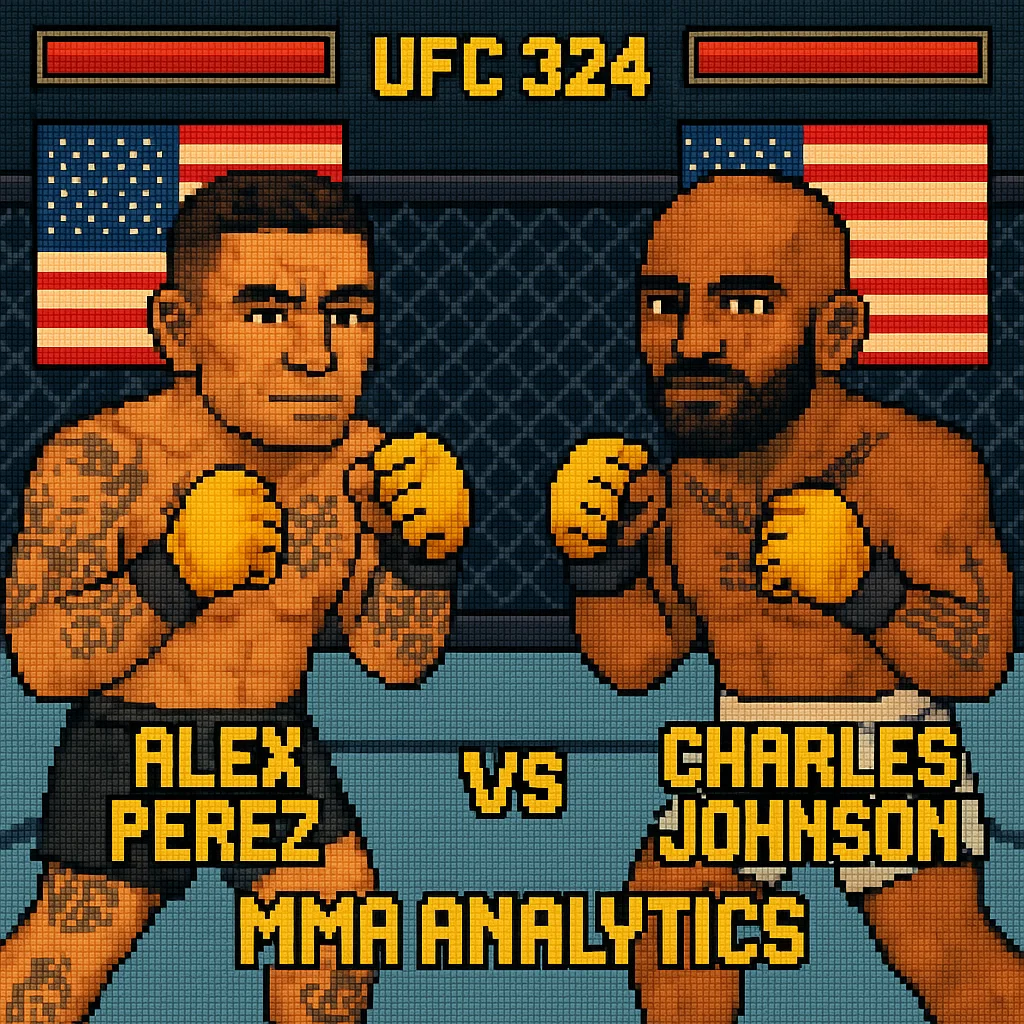
Explore Detailed Fighter Profiles
Click on either the fighter's name or profile image for each fighter to access comprehensive UFC statistics including striking metrics, grappling data, clinch performance, complete fight history, offensive & defensive analytics, and round-by-round breakdowns.

Alex Perez
Fighter Metrics
Victory Methods
Win Round Distribution
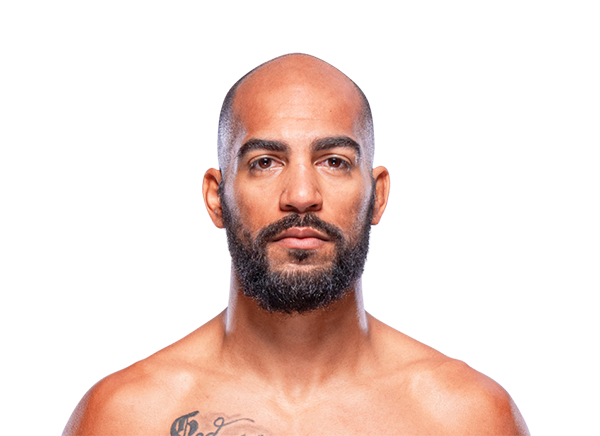
Charles Johnson
Fighter Metrics
Victory Methods
Win Round Distribution
📋 Last 5 Fights - Alex Perez
| Date | Opponent | Result | Method |
|---|---|---|---|
| 2024-09-28 | Asu Almabayev | L | Submission - Guillotine (R3, 1:42) |
| 2024-06-01 | Matheus Nicolau | W | TKO - Punches (R2, 4:59) |
| 2023-10-07 | Muhammad Mokaev | L | Decision - Unanimous (R3, 5:00) |
| 2020-11-21 | Alexandre Pantoja | L | Submission - RNC (R1, 1:31) |
| 2020-07-19 | Deiveson Figueiredo | L | Submission - Guillotine (R1, 1:57) |
📋 Last 5 Fights - Charles Johnson
| Date | Opponent | Result | Method |
|---|---|---|---|
| 2024-11-02 | Lone'er Kavanagh | W | TKO - Punches (R2, 4:32) |
| 2024-06-29 | Ramazan Temirov | L | Decision - Unanimous (R3, 5:00) |
| 2024-03-09 | Sumudaerji | W | Decision - Unanimous (R3, 5:00) |
| 2023-09-02 | Joshua Van | W | TKO - Punches (R3, 2:26) |
| 2023-05-06 | Jake Hadley | W | Decision - Unanimous (R3, 5:00) |
Technical Analysis
Technical Score
Cardio Score
Overall Rating
📊 Technical Score
Calculated as the average of Striking Composite (77.0 vs 79.0) and Grappling Composite (83.0 vs 65.0). Balances overall striking effectiveness with grappling ability to measure complete technical skills.
💪 Cardio Score
Based on average fight duration, striking rate per minute, takedown rate, and finish rate. Measures cardiovascular endurance and ability to maintain pace throughout fights.
🎯 Overall Rating
Simple average of Technical Score and Cardio Score. Provides a holistic view of fighter capabilities combining skill level with physical conditioning and fight performance.
Striking Composite
Grappling Composite
📊 Technical Radar Comparison
📊 Metrics Legend
📊 Detailed Statistical Comparison
🥊 Fight Analysis Breakdown
🧩 Alex Perez Key Advantages
2.28 takedowns per 15min vs 0.56 represents a 4x differential that fundamentally shifts fight control. Perez's chain-wrestling sequences—single/double leg entries with fence pressure—create minute-winning cycles that accumulate control time. His 48% takedown accuracy against Johnson's 67% defense suggests first-layer resistance, but Perez's persistence and re-shot ability typically break through. The Californian's ability to chain multiple attempts and maintain pressure while Johnson defends creates fatigue differentials that compound over three rounds.
The 0.56 strikes absorbed per minute differential (3.22 vs 3.78) creates a damage economy that favors Perez in scoring optics. While Johnson's 4.73 SLpM output can rack volume, Perez's 58% striking defense and lower absorption rate mean fewer clean shots land. This defensive efficiency compounds over three rounds—Perez maintains his pace without accumulating damage, while Johnson's high-volume approach requires sustained output that becomes harder when defending takedowns.
Perez has faced the absolute elite of the flyweight division—Figueiredo, Pantoja, Mokaev, Almabayev—and remained competitive in significant portions of those fights. This experience against championship-level opposition translates to better composure under pressure, improved timing for entries, and a deeper understanding of high-level flyweight dynamics. Johnson's opposition, while solid, hasn't included the same caliber of champions and contenders.
⚠️ Unfavorable Scenarios
Perez has been submitted by guillotine twice in his last five fights (Figueiredo, Almabayev), suggesting a pattern where he exposes his neck during aggressive takedown entries. While Johnson isn't primarily a submission threat, this vulnerability could be exploited if Perez becomes too predictable with his shot selection. The large cage compounds this risk as Perez may force entries from further distances, giving opponents more time to set guillotine grips.
If Perez fails to establish consistent pressure and the fight remains at extended range, Johnson's 4.73 SLpM volume advantage becomes significant. The 30-foot cage provides ample space for Johnson to circle, reset, and maintain his preferred striking distance. His 49% accuracy combined with high output can overwhelm Perez's defensive shell, especially if the Californian becomes hesitant to shoot after early sprawl attempts.
📋 Likely Gameplan
Perez should utilize heavy low kicks to target Johnson's lead leg, limiting his mobility and switch stance effectiveness. These setups create openings for level changes when Johnson is compromised. His 48% takedown accuracy improves significantly when entries are disguised with strikes rather than pure wrestling attempts. By mixing jab-cross combinations with low kicks and takedowns, Perez can keep Johnson guessing and prevent him from settling into rhythm.
Once Perez secures takedowns, his priority should be establishing dominant positions and accumulating control time through ground-and-pound. His wrestling background emphasizes top control, wrist control, and short punches rather than immediate submission attempts. This approach maximizes scoring while minimizing risk—Perez can bank minutes through rides and positional control without exposing himself to sweeps. His 75% takedown defense suggests he can maintain top position once established.
🚀 Charles Johnson Key Advantages
Johnson's 70-inch reach advantage (vs Perez's 65") combined with his 5'9" height creates significant striking opportunities at range. His arsenal includes long jabs, teeps, calf kicks, and intercept uppercuts that can deter takedown attempts while scoring points. The switch stance style makes him difficult to read, while his 49% striking accuracy ensures these long weapons land with consistency. In the 30-foot cage, Johnson can maintain this preferred distance longer, forcing Perez to cover more ground.
Johnson's 4.73 SLpM output represents one of the higher striking rates in the flyweight division, with a proven ability to maintain this pace over three rounds (13:17 avg fight duration). His cardio advantage allows him to sustain high output while Perez typically sees shorter fights (6:47 avg). The ability to string together combinations across all three rounds becomes particularly dangerous if Perez's wrestling becomes less effective as the fight progresses.
⚠️ Unfavorable Scenarios
Johnson's 67% takedown defense, while decent, has shown cracks against persistent wrestlers like Temirov, Mokaev, and Durden. Perez's chain-wrestling sequences create a nightmare scenario—once Perez secures takedowns, his ability to maintain control and execute ground-and-pound prevents Johnson from regaining his feet or establishing striking rhythm. The longer Johnson spends on the ground, the more his striking volume advantage disappears.
Even when Johnson defends takedowns, defending against the cage consumes energy and limits his striking output. Perez can win rounds through pressure and control time even without completing takedowns. Johnson's high-output striking style requires space and freedom of movement— constant fence pressure negates these advantages and turns the fight into a grinding battle where Perez's wrestling background becomes decisive.
📋 Likely Gameplan
Johnson's optimal strategy involves maintaining perimeter control while threatening intercept strikes. His jabs, teeps, and switch-stance calf kicks should target Perez's base and mobility, making takedown entries more difficult. The large cage provides ample space for lateral movement and resets. When Perez does commit to shots, Johnson should threaten uppercuts and knees to deter entries and create counter opportunities rather than backing straight to the fence.
Johnson's path to victory requires consistent volume across all three rounds. His 4.73 SLpM output becomes most dangerous when he can sustain it without grappling exchanges. By establishing early momentum through clean jabs and counters, Johnson can force Perez to become more aggressive with his wrestling—which paradoxically opens up more counter opportunities. Quick stand-ups after any takedowns are critical to maximizing striking time.
🎯 Fight Prediction Analysis
Data-driven prediction model based on statistical analysis
📊Detailed Analysis Summary
🏟️Cage Dynamics
The 30-foot octagon creates a fascinating dynamic in this matchup—initially favoring Johnson's range weapons and movement, but gradually shifting toward Perez's pressure as the fight progresses. Johnson's 70-inch reach and 5'9" height give him significant advantages in the early portions when he can maintain distance and utilize his jabs, teeps, and switch-stance attacks effectively. However, Perez's relentless pressure and chain-wrestling sequences gradually compress the available space, forcing Johnson into increasingly uncomfortable positions. The Californian's ability to cut off angles and force exchanges at the fence transforms the cage from Johnson's ally into Perez's weapon.
🎯Technical Breakdown
The statistical analysis reveals two primary battlefields where this fight will be decided: wrestling activity and striking volume. Perez's 2.28 TD15 vs Johnson's 0.56 represents a 4x differential that fundamentally alters fight control and scoring dynamics. While Johnson's striking volume (4.73 SLpM, 49% accuracy) creates impressive output, Perez's grappling composite (83.0 vs 65.0) means he controls where the fight takes place. The key question becomes whether Johnson can rack up enough volume in standing exchanges to offset the control time Perez will accumulate through takedowns and fence work.
🧩Key Battle Areas
Three critical battle areas will determine the outcome: first-layer takedown defense vs chain wrestling at the fence, intercept strikes vs level changes, and cardio management over three rounds. Johnson's 67% takedown defense suggests he can stuff initial attempts, but Perez's persistence and re-shot ability typically break through over time. Johnson's intercept weapons (uppercuts, knees) represent his most dangerous tools against Perez's entries, but the Californian's ability to mix strikes with takedowns makes these counters less predictable. The cardio battle favors Johnson on paper, but grappling exchanges often neutralize this advantage.
🏁Final Prediction
The most likely outcome is Alex Perez by Decision (34% probability), achieved through consistent takedown pressure, control time accumulation, and superior grappling over three rounds. Perez's KO/TKO path (16%) becomes viable through ground-and-pound accumulation, particularly in later rounds when Johnson's defensive wrestling begins to fade. Johnson's upset lane centers on decision victory (22%) through sustained volume striking if he can avoid consistent takedowns, or KO/TKO (14%) via counter uppercuts as Perez commits to takedown attempts. The fight script heavily depends on Perez's ability to establish wrestling control early.
💰 Betting Analysis: Model vs Market
Detailed value assessment in the betting market
📊Market Odds
🤖Analytical Model
💎Value Opportunities
MAXIMUM VALUE
Model: 34% | Fair: +194
GOOD VALUE
Model: 14% | Fair: +614
SLIGHT VALUE
Model: 62% | Fair: -163
⚠️Key Market Discrepancies
- • Underweights grappling differential – 4x TD volume advantage not fully priced in.
- • Overweights recent momentum – Johnson's 4-1 stretch against lower-level opposition.
- • Big-cage bias – Space helps early, but wrestling pressure erodes it late.
🎯 Comprehensive Probabilistic Analysis
100 hypothetical fight simulation based on statistical data
🏆Outcome Distribution - Alex Perez
Primary path via wrestling control and ground-and-pound
Ground-and-pound accumulation in later rounds
Opportunistic submissions from dominant positions
💥Outcome Distribution - Charles Johnson
Volume striking with successful TDD over 3 rounds
Counter uppercuts on takedown entries
Low historical submission profile
⏰Fight Timeline Analysis
⚡Window of Opportunity - Charles Johnson
- • First 5–7 minutes: Highest counter KO equity.
- • Perimeter control: Jabs + calf kicks to stall entries.
- • Quick stand-ups: Minimize ground time per takedown.
🎯Progressive Dominance - Alex Perez
- • Chain shots: Re-mats and rides bank control time.
- • Low kicks: Limit Johnson's mobility and stance switching.
- • Late minutes: Safer control edges decision likelihood.
🎯 Final Confidence Assessment
Confidence level and uncertainty factors
Confidence Level
Clear grappling edge with historical wrestler success vs Johnson's profile
✅Supporting Factors
- • 4x takedown volume differential (2.28 vs 0.56 TD15)
- • Superior grappling composite (83.0 vs 65.0)
- • Elite-level experience against top contenders
- • Better damage economy and striking defense
⚠️Risk Factors
- • Recent submission losses on forced entries
- • Big cage extends Johnson's range time
- • Perez 1-4 in last 5 vs Johnson's 4-1 momentum
🏁Executive Summary
Alex Perez's systematic wrestling approach should steadily compress the 30-foot octagon space and bank safe minutes through chain-wrestling sequences, while Charles Johnson's best equity centers on early volume striking and counter uppercuts before the Californian's pressure takes hold. The statistical differentials heavily favor Perez: his 2.28 TD15 vs Johnson's 0.56 creates a 4x takedown volume advantage, while his grappling composite (83.0 vs 65.0) represents a clear skill gap in the wrestling department. Johnson's cardio advantage (13:17 vs 6:47 avg duration) and reach advantage (+5") provide legitimate paths to victory, but historical data shows wrestlers of Perez's caliber consistently challenge Johnson's striking-first approach.
Prediction: Perez by Decision most likely (34% probability) through consistent takedown pressure and control time accumulation; Johnson's upset lane is Decision (22%) via sustained volume if he avoids consistent takedowns, or KO/TKO (14%) via counter strikes as Perez commits to shots. The fight's outcome hinges on whether Johnson can maintain distance and out-volume Perez before the wrestling pressure becomes decisive.