

Ateba Gautier vs Andrey Pulyaev
Men's Middleweight Bout • UFC 324: Gaethje vs Pimblett
Saturday, January 24, 2026 • T-Mobile Arena • 30ft Octagon (Large Cage)
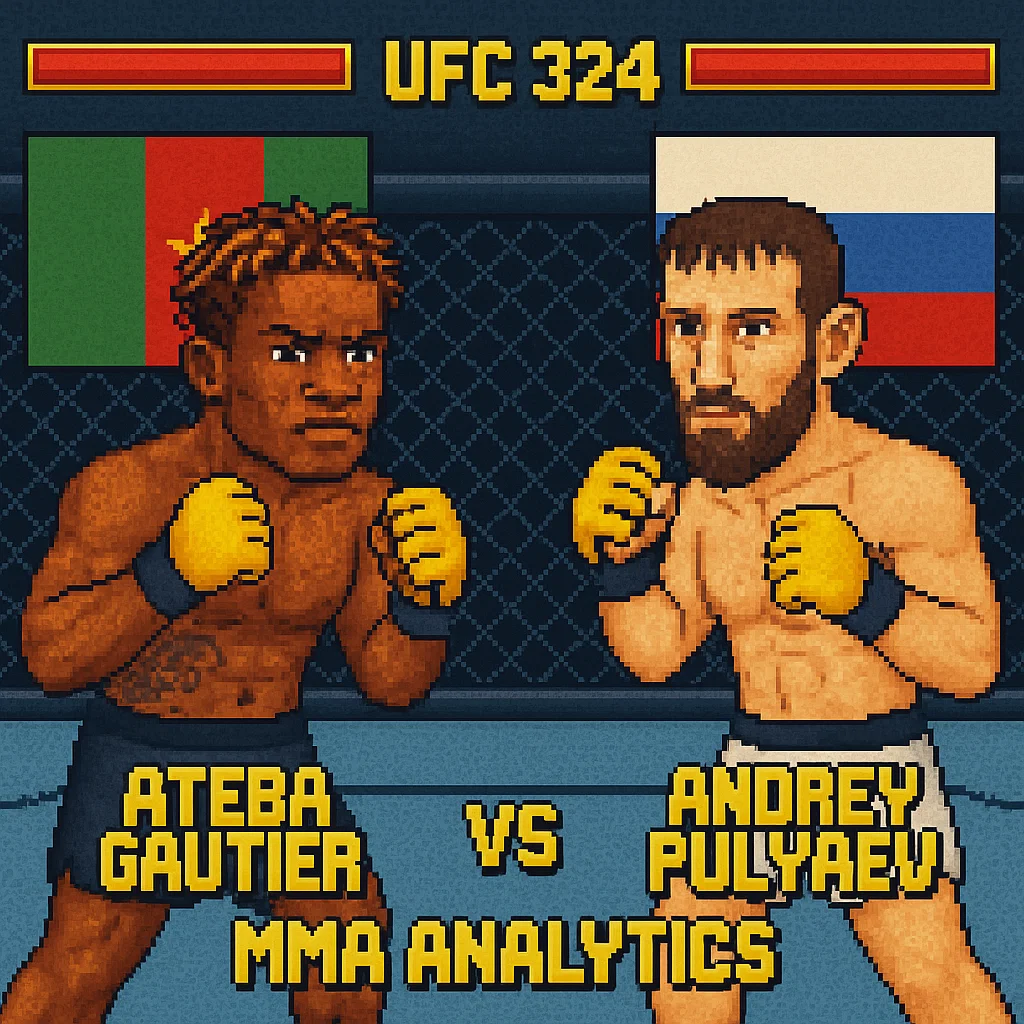
Explore Detailed Fighter Profiles
Click on either the fighter's name or profile image for each fighter to access comprehensive UFC statistics including striking metrics, grappling data, clinch performance, complete fight history, offensive & defensive analytics, and round-by-round breakdowns.
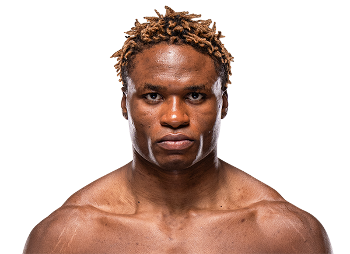
Ateba Gautier
Fighter Metrics
Victory Methods
Win Round Distribution
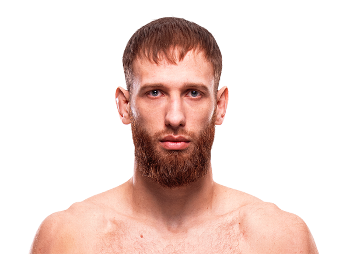
Andrey Pulyaev
Fighter Metrics
Victory Methods
Win Round Distribution
📋 Last 5 Fights - Ateba Gautier
| Date | Opponent | Result | Method |
|---|---|---|---|
| 2025-09-20 | Tre'ston Vines | W | TKO - Elbows and Ground-and-Pound (R1, 1:41) |
| 2025-06-14 | Robert Valentin | W | KO - Uppercut and Right Hand (R1, 1:10) |
| 2025-02-01 | José Medina | W | TKO - Knee (R1, 3:32) |
| 2024-08-27 | Yura Naito | W | TKO - Punches (R2, 4:00) |
| 2024-03-15 | Carlos de Souza | W | TKO - Punches (R1, 2:45) |
📋 Last 5 Fights - Andrey Pulyaev
| Date | Opponent | Result | Method |
|---|---|---|---|
| 2025-07-19 | Nick Klein | W | TKO - Body Kick and Follow-up (R2, 1:31) |
| 2025-02-22 | Christian Leroy Duncan | L | Decision - Unanimous (R3, 5:00) |
| 2024-08-13 | Liam Anderson | W | Decision - Unanimous (R3, 5:00) |
| 2024-03-09 | Well Oliveira | W | TKO - Punches (R1, 1:16) |
| 2023-10-21 | Nikita Kondratov | W | Submission - Armbar (R3, 3:42) |
Technical Analysis
Technical Score
Cardio Score
Overall Rating
📊 Technical Score
Calculated as the average of Striking Composite (75.0 vs 49.0) and Grappling Composite (56.0 vs 16.0). Balances overall striking effectiveness with grappling ability to measure complete technical skills.
💪 Cardio Score
Based on average fight duration, striking rate per minute, takedown rate, and finish rate. Measures cardiovascular endurance and ability to maintain pace throughout fights.
🎯 Overall Rating
Simple average of Technical Score and Cardio Score. Provides a holistic view of fighter capabilities combining skill level with physical conditioning and fight performance.
Striking Composite
Grappling Composite
📊 Technical Radar Comparison
📊 Metrics Legend
📊 Detailed Statistical Comparison
🥊 Fight Analysis Breakdown
🧩 Ateba Gautier Key Advantages
Gautier's 6.57 SLpM nearly doubles Pulyaev's 3.81 output, representing one of the most significant volume differentials in recent middleweight matchups. This striking output, combined with 60% accuracy, creates overwhelming pressure that forces opponents into desperate positions. The Cameroonian's ability to maintain this volume while still landing with precision makes him exceptionally difficult to gameplan against. In practical terms, this means Gautier is landing approximately 2.76 more significant strikes per minute—a differential that compounds exponentially over the course of a round. When you consider that a typical round lasts 5 minutes, this translates to roughly 13-14 additional significant strikes per round, creating massive scorecard advantages even if the fight goes to decision. The psychological impact of this volume cannot be overstated: opponents find themselves constantly defending, unable to establish their own rhythm, and increasingly desperate to change the fight's location or find a finish before the accumulation becomes insurmountable. Gautier's switch-stance approach amplifies this advantage, as he can maintain this high output from both orthodox and southpaw stances, making him even more unpredictable and difficult to counter effectively.
The 1.56 strikes absorbed per minute differential (1.95 vs 3.51) creates a damage economy heavily favoring Gautier. His 53% striking defense combined with low absorption means fewer clean shots accumulate over time. This efficiency compounds—Gautier maintains his explosive pace without accumulating damage, while Pulyaev's higher absorption rate indicates defensive vulnerabilities that a power puncher like Gautier can exploit. The mathematical reality is stark: over a 3-round fight, Pulyaev would absorb approximately 10.5 significant strikes per round (3.51 × 3 rounds), while Gautier absorbs only 5.85 per round (1.95 × 3 rounds). This nearly 2:1 damage ratio means Pulyaev is taking twice the punishment while dealing less volume. The visual optics of this differential are crucial in judging—Gautier's face remains relatively clean while Pulyaev shows visible damage accumulation, creating a narrative that heavily favors the Cameroonian on scorecards. Additionally, this damage economy allows Gautier to maintain his explosive power throughout the fight, as he's not being worn down by accumulated damage. His ability to stay fresh means his knockout power remains a constant threat, forcing Pulyaev to remain defensive and limiting his offensive opportunities. The defensive efficiency also means Gautier can take calculated risks—committing to power shots knowing his defense will minimize counter opportunities.
Gautier's 92% takedown defense compared to Pulyaev's 64% represents a massive differential. This elite defensive wrestling means Pulyaev cannot escape the striking exchanges where Gautier dominates. Even if Pulyaev attempts to change the fight's location, Gautier's ability to stuff takedowns and return to his feet keeps the fight in his preferred domain—standing range where his power and volume shine. The 28-percentage-point gap in takedown defense is one of the largest in recent middleweight matchups, and it fundamentally alters how this fight can unfold. When Pulyaev attempts takedowns (which he's done at a 0.41 per 15min rate), he faces a fighter who has successfully defended 92% of all takedown attempts in his UFC career. This creates a scenario where Pulyaev's takedown attempts not only fail but also waste precious energy and expose him to Gautier's counter-striking. The Cameroonian's ability to sprawl, defend underhooks, and immediately return to striking range means every failed takedown attempt from Pulyaev results in Gautier landing clean shots on the break. This defensive wrestling also allows Gautier to commit fully to his striking game without fear of being taken down, enabling him to throw power shots and combinations that would be too risky against a superior wrestler. The psychological impact is equally important: Pulyaev knows his takedown attempts are unlikely to succeed, which may cause him to abandon wrestling entirely and fight exclusively in Gautier's preferred range.
Gautier's 89% career finish rate with 8 of 9 wins coming by KO/TKO demonstrates genuine one-punch knockout power that fundamentally changes how opponents must approach him. Seven of his nine career wins came in Round 1, with an average fight duration of just 2:08, showing he doesn't need to accumulate damage—he can end fights instantly. This power threat forces opponents into defensive shells, limiting their offensive output and creating opportunities for Gautier to land clean shots. The psychological impact is massive: Pulyaev cannot afford to trade punches in the pocket or commit to combinations without risking a fight-ending counter. Gautier's uppercuts, hooks, and knees have all proven fight-ending weapons, making him dangerous from multiple ranges and angles. His ability to generate this power from both stances (switch-striker) means Pulyaev cannot predict where the knockout blow will come from. The Cameroonian's power is not just theoretical—it's been proven against UFC-level competition, with three consecutive UFC finishes including a brutal knee knockout in his debut. This finishing ability means Gautier doesn't need to win every exchange; he just needs to land clean once, and the fight could be over.
⚠️ Unfavorable Scenarios
Pulyaev's southpaw stance creates natural angles for body kicks that can accumulate damage and slow Gautier's explosive pace. If Gautier overcommits to early aggression without protecting his midsection, these kicks could compound and affect his gas tank later in the fight. The body kick that finished Nick Klein shows Pulyaev's power in this weapon. The southpaw angle is particularly dangerous because it allows Pulyaev to target Gautier's liver and solar plexus from angles that are difficult to defend against orthodox fighters. These body kicks don't need to be fight-ending to be effective—they can slow Gautier's movement, reduce his power output, and create openings for follow-up strikes. If Gautier becomes hesitant to press forward after eating a few body kicks, Pulyaev can establish his rhythm and control the distance. The accumulation of body shots could also affect Gautier's ability to maintain his high-volume output, potentially leveling the playing field in later rounds.
Almost all of Gautier's wins come in the first two rounds, with an average fight duration of just 2:08. If Pulyaev can survive the initial storm and drag this fight into Round 3, we're in uncharted territory for Gautier. His explosive style may not be sustainable, and Pulyaev's proven cardio (multiple 3-round decisions) could become the deciding factor. The question mark around Gautier's cardio is significant because his fighting style relies on explosive bursts and high-volume output—both of which are energy-intensive. If he cannot maintain his 6.57 SLpM pace into Round 3, his primary advantage (volume) begins to diminish. Pulyaev's experience in longer fights gives him confidence in deep waters, and his ability to maintain a steady pace (3.81 SLpM) is more sustainable than Gautier's explosive bursts. The Russian's cardio advantage could become decisive if he can survive the early rounds without taking fight-ending damage.
Pulyaev's southpaw stance creates awkward angles that can disrupt Gautier's rhythm and create counter opportunities. The Russian's ability to land straight lefts and left hooks from angles that orthodox fighters aren't accustomed to defending could catch Gautier off-guard. If Gautier becomes too aggressive in his pursuit of the finish, he could walk into a perfectly timed counter that changes the fight's momentum. Pulyaev's 60% striking accuracy shows he can land these counters with precision when he finds his timing.
📋 Likely Gameplan
Gautier should immediately establish center control and pressure Pulyaev toward the fence. His reach advantage (+3") allows him to maintain distance while landing jabs and setting up power shots. The goal is to force Pulyaev into defensive mode, limiting his ability to set up his kicks and counterpunching. The 30-foot cage provides ample space initially, but Gautier's pressure should gradually compress this space, cutting off Pulyaev's escape routes and forcing him into exchanges. By controlling the center, Gautier dictates the fight's pace and location, preventing Pulyaev from establishing his preferred range. The Cameroonian's jab should be his primary weapon early—using it to measure distance, set up combinations, and disrupt Pulyaev's rhythm. His ability to switch stances while maintaining pressure makes him unpredictable and difficult to counter effectively.
With 89% of his wins coming by KO/TKO and 7 of 9 wins in Round 1, Gautier should trust his power and look to end this fight early. His uppercuts and knee strikes have proven devastating. The best approach is calculated aggression—pressure without overextending, setting up his power shots with volume while staying defensively sound. Gautier should look for opportunities to land his fight-ending weapons: uppercuts when Pulyaev dips his head, knees when the Russian closes distance, and hooks when Pulyaev circles into his power hand. The key is setting up these power shots with volume—using his 6.57 SLpM output to create openings rather than loading up on single shots. His ability to mix feints with real attacks keeps Pulyaev guessing and creates opportunities for clean connections.
Gautier must be aware of Pulyaev's body kick threat and defend accordingly. Keeping his lead hand low to block body kicks while maintaining his guard high for head shots is crucial. When Pulyaev throws body kicks, Gautier should look to counter with straight punches or catch the kick and counter with strikes. His 92% takedown defense means he doesn't need to worry about being taken down if he catches a kick, allowing him to focus on counter-striking opportunities.
🚀 Andrey Pulyaev Key Advantages
Pulyaev's cardio score of 80 exceeds Gautier's 75, with multiple 3-round decisions and finishes in later rounds proving his durability. His 7:45 average fight duration shows he's comfortable in extended battles. If Pulyaev can weather the early storm, his conditioning advantage becomes increasingly significant as the fight progresses into uncharted territory for the explosive Cameroonian. The Russian's experience in longer fights is crucial here: he's been through multiple 15-minute battles, knows how to pace himself, and understands how to maintain output while conserving energy. His cardio advantage becomes most relevant in Round 3, where Gautier's explosive style may begin to fade. Pulyaev's ability to maintain his 3.81 SLpM pace throughout a fight is more sustainable than Gautier's 6.57 SLpM bursts, meaning if the fight reaches the later rounds, Pulyaev's steady output could overcome Gautier's diminished volume. The Russian's cardio also allows him to recover between rounds more effectively, meaning he can come out fresh in Round 3 while Gautier may be showing signs of fatigue.
Pulyaev's southpaw stance creates awkward angles, and his devastating body kick (as seen vs Nick Klein) is a fight-ending weapon. His ability to mix calf kicks, body kicks, and high kicks from the southpaw stance can disrupt Gautier's rhythm and accumulate damage. The 60% striking accuracy shows these kicks land with precision when he finds his timing. The body kick that finished Klein demonstrates genuine knockout power, and from the southpaw stance, these kicks come from angles that are difficult for orthodox fighters to defend. The calf kicks can slow Gautier's movement and reduce his ability to press forward, while the body kicks target the liver and solar plexus—areas that can drain an opponent's energy even if they don't result in immediate knockdowns. Pulyaev's ability to vary his kick targets (legs, body, head) keeps Gautier guessing and prevents the Cameroonian from settling into a defensive rhythm. The southpaw angle also allows Pulyaev to land these kicks while maintaining distance, reducing his exposure to Gautier's counter-punching.
Pulyaev's experience in tactical, decision-based fights gives him confidence in scenarios where he needs to outpoint an opponent over 15 minutes. His ability to read opponents, adjust his gameplan mid-fight, and maintain composure under pressure has been proven in multiple 3-round battles. This experience is particularly valuable against an explosive finisher like Gautier, as Pulyaev knows how to survive early storms and capitalize on opportunities as fights progress. The Russian's fight IQ allows him to recognize when to engage and when to disengage, when to press forward and when to circle away. His ability to make these tactical adjustments mid-fight could be the difference if this contest reaches the later rounds, where experience often trumps raw athleticism.
⚠️ Unfavorable Scenarios
Gautier's one-punch knockout power is genuine—7 of his 9 wins came in Round 1. If Pulyaev engages in early firefights or trades at close range, he's playing into Gautier's strengths. His 3.51 SApM absorption rate means he's getting hit frequently, and against Gautier's power, any clean shot could end the fight instantly.
Pulyaev's 64% takedown defense and 17% takedown accuracy are concerning against Gautier's 92% TDDef and opportunistic wrestling. If Pulyaev can't maintain distance or gets pressured to the fence, Gautier could mix in takedowns to score easy rounds or finish with ground-and-pound. This grappling disparity limits Pulyaev's margin for error. The 28-percentage-point gap in takedown defense means Pulyaev is significantly more vulnerable to being taken down than Gautier. While Gautier isn't a primary wrestler, his 0.98 TD15 rate with 100% accuracy shows he can successfully take opponents down when he chooses to. If Pulyaev becomes too focused on defending strikes, he could leave openings for takedown attempts. Once on the ground, Pulyaev's 64% takedown defense suggests he struggles to get back to his feet, meaning Gautier could accumulate significant control time and ground-and-pound damage.
Gautier's 6.57 SLpM output nearly doubles Pulyaev's 3.81, creating a massive volume differential that could overwhelm the Russian. If Pulyaev cannot establish his kicking game or maintain distance, he could find himself constantly defending against Gautier's high-volume attack. The accumulation of strikes, even if not all are fight-ending, could sway judges and create visible damage that affects Pulyaev's performance as the fight progresses.
📋 Likely Gameplan
Pulyaev needs to utilize the large cage (30ft) to stay mobile and avoid getting trapped against the fence. His southpaw stance creates natural lateral movement opportunities. The key is circling away from Gautier's power hand while landing calf kicks and body kicks to slow the Cameroonian's explosiveness. The 30-foot octagon provides Pulyaev with space to reset and maintain his preferred range, but he must be active enough to score points and prevent Gautier from cutting off the cage. His southpaw stance allows him to circle to his right (away from Gautier's power hand) while still being able to land his left straight and left hook. The calf kicks are particularly important early, as they can slow Gautier's forward movement and reduce his ability to press forward with the same explosiveness. Pulyaev must balance movement with offense—circling without engaging allows Gautier to control the center and dictate the pace.
Pulyaev's best chance is making this a tactical, drawn-out affair. By surviving the first 5-7 minutes without taking major damage, he can potentially exploit Gautier's untested cardio in Round 3. His experience in longer fights (multiple decisions, R3 submission) gives him confidence in deep waters where Gautier has never been tested. The Russian's cardio advantage becomes most relevant if the fight reaches Round 3, where Gautier's explosive style may begin to fade. Pulyaev's ability to maintain a steady pace (3.81 SLpM) is more sustainable than Gautier's high-volume bursts, meaning if the fight goes the distance, Pulyaev's consistent output could overcome Gautier's diminished volume. The key is surviving the early rounds without taking fight-ending damage—if Pulyaev can make it to Round 3 relatively fresh, his experience and cardio could become decisive factors.
Pulyaev must establish his body kick threat early to slow Gautier's forward pressure and create respect for his power. The body kick that finished Nick Klein shows genuine knockout potential, and from the southpaw stance, these kicks come from angles that are difficult to defend. By landing a few body kicks early, Pulyaev can make Gautier hesitant to press forward, creating space for the Russian to operate and score points. The calf kicks are also crucial for slowing Gautier's movement and reducing his ability to cut off the cage effectively.
🎯 Fight Prediction Analysis
Data-driven prediction model based on statistical analysis
📊Detailed Analysis Summary
🏟️Cage Dynamics
The 30-foot octagon at T-Mobile Arena provides Pulyaev with space to utilize his movement and kicking game, but Gautier's pressure and reach advantage (+3") allow him to cut off the cage effectively. The large cage initially benefits the southpaw's circling, but Gautier's aggressive style compresses available space quickly. His ability to force exchanges at the fence or in the center, combined with elite takedown defense (92%), means Pulyaev cannot escape the striking differential where the Cameroonian dominates. The cage dynamics create an interesting tension: Pulyaev needs space to establish his kicking game and maintain distance, but Gautier's pressure and reach advantage allow him to gradually compress that space. The Cameroonian's ability to cut off angles and force exchanges at the fence transforms the large cage from Pulyaev's ally into Gautier's weapon. As the fight progresses, the available space diminishes, and Pulyaev finds himself increasingly trapped in exchanges where Gautier's volume and power advantages become decisive. The 30-foot octagon provides initial opportunities for Pulyaev to circle and reset, but Gautier's relentless pressure and ability to maintain his high-volume output while cutting off escape routes means the Russian cannot rely on movement alone to win this fight.
🎯Technical Breakdown
The statistical differentials heavily favor Gautier across almost every metric. His 6.57 SLpM vs Pulyaev's 3.81 creates a 72% volume advantage—massive in any striking matchup. The damage economy (1.95 SApM vs 3.51) shows Gautier both deals more damage and takes less. Most critically, his 92% TDDef vs Pulyaev's 64% eliminates any grappling escape route. Pulyaev's only statistical advantage is cardio (80 vs 75), but this only matters if he survives the explosive early onslaught. The volume differential is particularly striking: Gautier lands 2.76 more significant strikes per minute, which over a 3-round fight translates to approximately 41 additional significant strikes. This massive differential creates overwhelming pressure that forces opponents into defensive shells, unable to establish their own rhythm or offensive output. The damage economy is equally important: Gautier absorbs 1.56 fewer strikes per minute, meaning over the course of a fight, he takes significantly less damage while dealing more. This efficiency compounds over time, allowing Gautier to maintain his explosive pace without accumulating the visible damage that affects performance and sway judges. The takedown defense differential (92% vs 64%) is crucial because it eliminates Pulyaev's potential escape route from the striking exchanges where Gautier dominates. Even if Pulyaev attempts to change the fight's location, Gautier's elite defensive wrestling means he can stuff takedowns and immediately return to his preferred range.
🧩Key Battle Areas
Three critical areas will determine the outcome: early exchanges where Gautier's power is most dangerous, Pulyaev's ability to establish his body kick game without getting countered, and the cardio question in Round 3 if the fight goes that far. Gautier's 89% finish rate and 7/9 R1 finishes suggest this fight won't reach the later rounds. Pulyaev's survival gameplan requires exceptional defensive discipline for 5+ minutes while landing enough kicks to slow Gautier's explosiveness—a narrow path to victory. The first critical battle area is the early exchanges, where Gautier's one-punch knockout power is at its peak. Seven of his nine career wins came in Round 1, demonstrating his ability to end fights instantly. Pulyaev must navigate these early minutes without taking fight-ending damage, which requires exceptional defensive discipline and the ability to avoid Gautier's power shots while still maintaining offensive output. The second critical area is Pulyaev's ability to establish his body kick game without getting countered. Pulyaev's southpaw stance creates natural angles for body kicks, and his devastating body kick that finished Nick Klein shows genuine knockout power. However, landing these kicks requires committing to the technique, which exposes Pulyaev to Gautier's counter-punching. The Russian must find the balance between establishing his kicking threat and avoiding Gautier's counters. The third critical area is the cardio question in Round 3, which represents uncharted territory for Gautier. Almost all of his wins come in the first two rounds, with an average fight duration of just 2:08. If Pulyaev can survive the early storm and drag this fight into Round 3, his cardio advantage (80 vs 75) could become decisive. However, reaching Round 3 requires surviving 10 minutes against one of the most dangerous finishers in the middleweight division.
🏁Final Prediction
The most likely outcome is Ateba Gautier by KO/TKO in Round 1 or early Round 2 (55% probability). His overwhelming statistical advantages in volume, power, and defensive wrestling create multiple paths to victory. Pulyaev's best chance (18% KO/TKO) requires catching Gautier with a perfectly timed body kick or counter while the Cameroonian loads up on power shots. The decision path for either fighter is less likely given both fighters' high finish rates, but if this goes the distance, Gautier's volume advantage should secure the nod. Gautier's 55% KO/TKO probability reflects his overwhelming advantages in volume (6.57 vs 3.81 SLpM), power (89% finish rate), and defensive wrestling (92% TDDef). His ability to generate fight-ending power from multiple angles (uppercuts, hooks, knees) means he doesn't need to land multiple clean shots—one perfectly placed strike could end the fight. The Cameroonian's finishing ability has been proven against UFC-level competition, with three consecutive UFC finishes including a brutal knee knockout in his debut. Pulyaev's 18% KO/TKO probability requires a perfectly executed gameplan: surviving the early storm, establishing his body kick game without getting countered, and landing a fight-ending strike at the perfect moment. The Russian's body kick that finished Nick Klein shows he has the power to end fights, but landing it against Gautier's elite takedown defense and counter-punching ability is a narrow path. The decision path (16% for Gautier, 8% for Pulyaev) is less likely given both fighters' high finish rates, but if the fight goes the distance, Gautier's massive volume advantage should secure the nod on scorecards.
💰 Betting Analysis: Model vs Market
Detailed value assessment in the betting market
📊Market Odds
🤖Analytical Model
💎Value Opportunities
MAXIMUM VALUE
Model: 55% | Fair: -122
GOOD VALUE
Model: 18% | Fair: +456
SLIGHT VALUE
Model: 56% | Fair: -126
⚠️Key Market Discrepancies
- • Massive volume differential – 6.57 vs 3.81 SLpM favors early finish.
- • Untested cardio both ways – Gautier's explosive style may fade, but rarely gets tested.
- • Finish rate probability – Combined 84% finish rate suggests decision unlikely.
🎯 Comprehensive Probabilistic Analysis
100 hypothetical fight simulation based on statistical data
🏆Outcome Distribution - Ateba Gautier
Primary path via explosive power and volume
Volume advantage secures cards if fight goes distance
Limited submission game, unlikely path
💥Outcome Distribution - Andrey Pulyaev
Best lane via body kicks or counters
Requires survival and late-round scoring
Has armbar finish but unlikely to get position
⏰Fight Timeline Analysis
⚡Window of Opportunity - Andrey Pulyaev
- • Round 3: Only round where cardio advantage materializes.
- • Body kick setup: Must establish early without eating counters.
- • Survival mode R1-R2: Minimize damage while finding timing.
🎯Window of Dominance - Ateba Gautier
- • First 7 minutes: Peak danger zone with fresh legs and power.
- • Volume pressure: 6.57 SLpM creates overwhelming pace.
- • Finish hunting: 89% finish rate suggests early stoppage likely.
🎯 Final Confidence Assessment
Confidence level and uncertainty factors
Confidence Level
Strong edge via striking volume and power differential
✅Supporting Factors
- • Massive SLpM advantage (6.57 vs 3.81)
- • Lower SApM and better damage economy
- • Elite takedown defense (92% vs 64%)
- • 89% career finish rate with 7/9 R1 wins
⚠️Risk Factors
- • Untested cardio beyond R2
- • Southpaw body kick threat from Pulyaev
- • Small UFC sample size (3 fights)
🏁Executive Summary
Ateba Gautier enters this fight as a dominant statistical favorite, boasting a striking volume advantage that nearly doubles his opponent's output (6.57 vs 3.81 SLpM) while absorbing significantly less damage (1.95 vs 3.51 SApM). His 89% career finish rate, with 7 of 9 wins coming in Round 1, demonstrates elite finishing ability that matches his overwhelming physical attributes. The 3-inch reach advantage and elite takedown defense (92%) eliminate Pulyaev's potential escape routes from the striking exchanges where Gautier excels. The statistical differentials paint a clear picture: Gautier's 6.57 SLpM output represents one of the highest striking rates in the middleweight division, while his 1.95 SApM absorption rate shows exceptional defensive efficiency. This combination of high volume and low absorption creates a damage economy that heavily favors the Cameroonian. Over the course of a 3-round fight, Gautier would land approximately 98 significant strikes (6.57 × 15 minutes) while absorbing only 29 (1.95 × 15 minutes), creating a massive 69-strike differential. Pulyaev, by contrast, would land approximately 57 significant strikes (3.81 × 15 minutes) while absorbing 53 (3.51 × 15 minutes), creating only a 4-strike differential. This mathematical reality demonstrates why Gautier is such a heavy favorite: he deals significantly more damage while taking significantly less, creating a scoring framework that judges consistently reward. The Cameroonian's 89% finish rate with 7 of 9 wins in Round 1 shows he doesn't need to rely on scorecards—his one-punch knockout power can end fights instantly. His ability to generate fight-ending power from multiple angles (uppercuts, hooks, knees) means opponents cannot afford to let their guard down for even a moment. The 3-inch reach advantage allows Gautier to maintain distance while landing clean shots, and his elite takedown defense (92%) means Pulyaev cannot escape the striking exchanges where the Cameroonian dominates. Even if Pulyaev attempts to change the fight's location, Gautier's ability to stuff takedowns and immediately return to striking range keeps the fight in his preferred domain.
Prediction: Gautier by KO/TKO most likely (55% probability), with the majority of finish scenarios occurring in Round 1 or early Round 2. Pulyaev's best path requires surviving the initial storm and exploiting Gautier's untested cardio in Round 3—a narrow but viable 28% upset lane, primarily through body kicks or well-timed counters. The fight's outcome hinges on whether Pulyaev can avoid Gautier's power for the first 7+ minutes while establishing his kicking game without eating devastating counters. The 55% KO/TKO probability for Gautier reflects his overwhelming advantages in volume, power, and defensive wrestling. His ability to generate fight-ending power from multiple angles means he doesn't need to land multiple clean shots—one perfectly placed strike could end the fight. The Cameroonian's finishing ability has been proven against UFC-level competition, with three consecutive UFC finishes including a brutal knee knockout in his debut. The majority of these finish scenarios will occur in Round 1 or early Round 2, when Gautier's power is at its peak and his explosive style is most effective. Pulyaev's 28% upset lane requires a perfectly executed gameplan: surviving the early storm without taking fight-ending damage, establishing his body kick game without getting countered, and potentially exploiting Gautier's untested cardio in Round 3. The Russian's body kick that finished Nick Klein shows he has the power to end fights, but landing it against Gautier's elite takedown defense and counter-punching ability is a narrow path. The cardio question in Round 3 represents the only significant uncertainty in this matchup, as Gautier's explosive style has rarely been tested beyond Round 2. However, reaching Round 3 requires Pulyaev to survive 10 minutes against one of the most dangerous finishers in the middleweight division—a task that his 3.51 SApM absorption rate and 48% striking defense suggest will be extremely difficult. The fight's outcome ultimately hinges on whether Pulyaev can avoid Gautier's power for the first 7+ minutes while establishing his kicking game without eating devastating counters. If he can survive the early storm and drag the fight into Round 3, his cardio advantage could become decisive. However, the statistical differentials heavily favor Gautier, making this a narrow but viable path to victory for the Russian.