

Umar Nurmagomedov vs Deiveson Figueiredo
Men's Bantamweight Bout • UFC 324
Saturday, January 24, 2026 • T-Mobile Arena • 30ft Octagon (Large Cage)
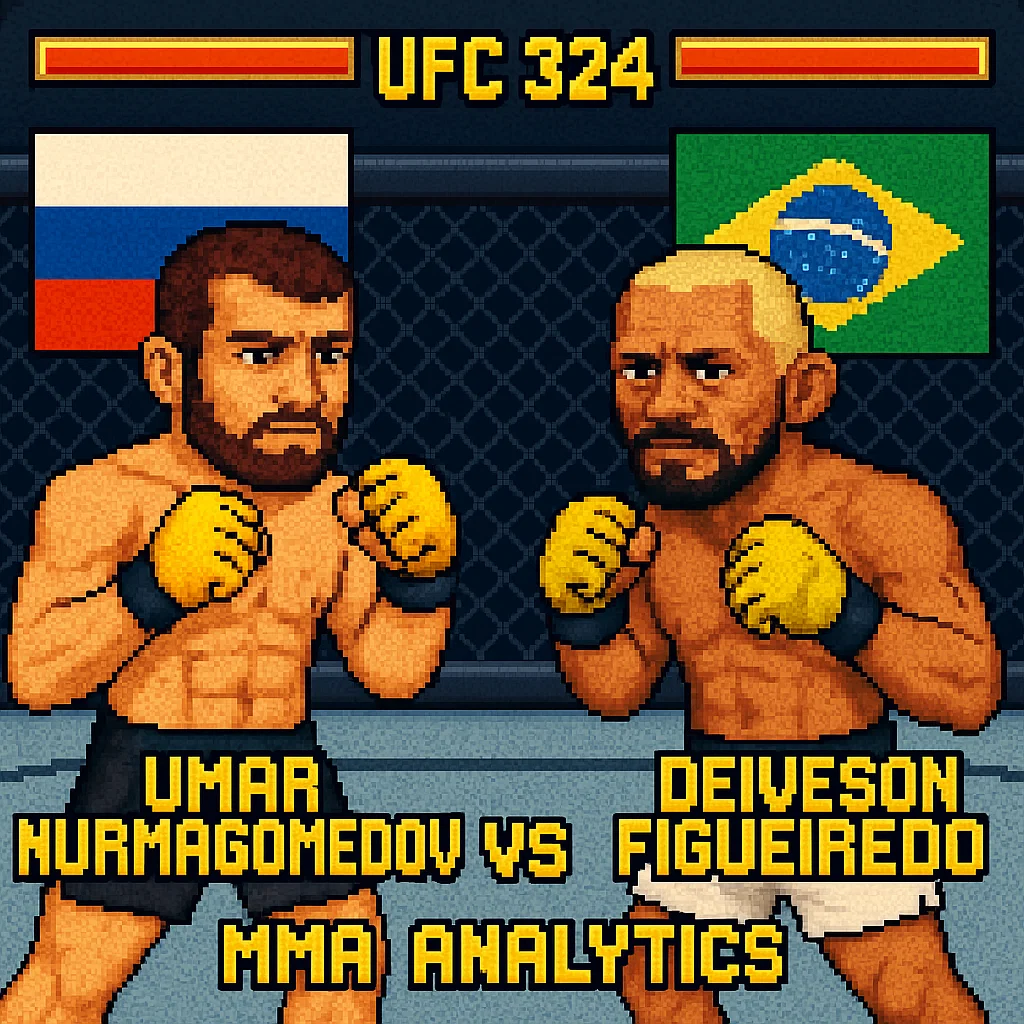
Explore Detailed Fighter Profiles
Click on either the fighter's name or profile image for each fighter to access comprehensive UFC statistics including striking metrics, grappling data, clinch performance, complete fight history, offensive & defensive analytics, and round-by-round breakdowns.

Umar Nurmagomedov
Fighter Metrics
Victory Methods
Win Round Distribution
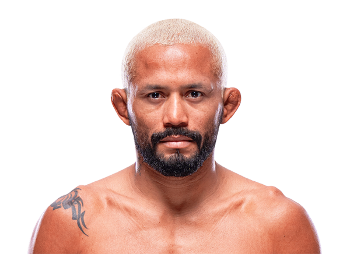
Deiveson Figueiredo
Fighter Metrics
Victory Methods
Win Round Distribution
📋 Last 5 Fights - Umar Nurmagomedov
| Date | Opponent | Result | Method |
|---|---|---|---|
| 2025-06-14 | Mario Bautista | W | Decision - Unanimous (R3, 5:00) |
| 2025-01-18 | Merab Dvalishvili | L | Decision - Unanimous (R5, 5:00) |
| 2024-08-03 | Cory Sandhagen | W | Decision - Unanimous (R5, 5:00) |
| 2024-03-09 | Bekzat Almakhan | W | Decision - Unanimous (R3, 5:00) |
| 2023-06-10 | Raoni Barcelos | W | KO/TKO - Body Kick and Punches (R1, 2:56) |
📋 Last 5 Fights - Deiveson Figueiredo
| Date | Opponent | Result | Method |
|---|---|---|---|
| 2025-06-07 | Montel Jackson | W | Decision - Split (R3, 5:00) |
| 2024-09-14 | Cory Sandhagen | L | TKO - Knee Injury (R2, 3:45) |
| 2024-03-02 | Petr Yan | L | Decision - Unanimous (R5, 5:00) |
| 2023-11-11 | Marlon Vera | W | Decision - Unanimous (R3, 5:00) |
| 2023-04-08 | Cody Garbrandt | W | Submission - RNC (R2, 3:22) |
Technical Analysis
Technical Score
Cardio Score
Overall Rating
📊 Technical Score
Calculated as the average of Striking Composite (74.0 vs 45.0) and Grappling Composite (55.0 vs 38.0). Balances overall striking effectiveness with grappling ability to measure complete technical skills.
💪 Cardio Score
Based on average fight duration, striking rate per minute, takedown rate, and finish rate. Measures cardiovascular endurance and ability to maintain pace throughout fights.
🎯 Overall Rating
Simple average of Technical Score and Cardio Score. Provides a holistic view of fighter capabilities combining skill level with physical conditioning and fight performance.
Striking Composite
Grappling Composite
📊 Technical Radar Comparison
📊 Metrics Legend
📊 Detailed Statistical Comparison
🥊 Fight Analysis Breakdown
🧩 Umar Nurmagomedov Key Advantages
Umar's 3.26 takedowns per 15min vs Figueiredo's 1.69 represents a nearly 2x differential that fundamentally shifts fight control and scoring dynamics. The Dagestani's chain-wrestling sequences—ankle picks, body locks, outside singles, and mat returns—create minute-winning cycles that accumulate control time and force opponents to expend energy defending. His 40% takedown accuracy against Figueiredo's 58% defense suggests openings will present themselves, especially as the fight progresses and the Brazilian's cardio begins to fade. Umar's 79% TDDef means he can dictate where the fight happens while denying Figueiredo's sporadic attempts. The wrestling advantage becomes particularly pronounced in the 30-foot cage where Umar has more space to set up his entries and chain multiple attempts. Historical data shows that fighters with this level of takedown volume differential typically control 60-70% of fight time when facing opponents with sub-60% takedown defense.
The 1.49 strikes absorbed per minute differential (2.15 vs 3.64) creates a damage economy that heavily favors Nurmagomedov in scoring optics and long-term sustainability. While Figueiredo possesses significant KO power (0.75 KD avg), Umar's 61% striking defense minimizes clean connections and prevents the accumulation of fight-altering damage. This defensive efficiency compounds over three rounds—Umar maintains his pace without accumulating damage, while Figueiredo's lower defense (49%) leaves him exposed to volume and counters. The Dagestani's ability to minimize damage while maximizing offensive output creates a scoring framework that judges consistently reward, especially when combined with control time. Over a 15-minute fight, this differential means Umar absorbs approximately 22 fewer significant strikes, which translates to cleaner optics and less visible damage accumulation. The damage economy advantage becomes even more critical in later rounds when accumulated damage begins to affect performance and decision-making.
Umar's 4.38 SLpM vs Figueiredo's 2.82 represents a significant striking volume advantage that creates consistent scoring opportunities throughout each round. Combined with 57% accuracy vs 54%, Nurmagomedov lands more strikes with better precision, creating a cumulative advantage that judges reward. His ability to mix distance striking with wrestling creates a multi-dimensional threat that's difficult to prepare for and counter. The Dagestani's rangy kicks, jabs, and front kicks keep opponents at bay while setting up level changes and takedown entries. This volume advantage becomes particularly effective in the 30-foot cage where Umar can maintain distance and work his range game without being trapped against the fence. Over three rounds, this differential translates to approximately 23 more significant strikes landed, which creates clear visual dominance and scoring advantages. The combination of high volume and wrestling threat forces opponents into uncomfortable positions where they must defend both strikes and takedowns simultaneously.
At 29 years old, Umar is in his physical prime with minimal career mileage compared to the 37-year-old Figueiredo who has accumulated significant wear from flyweight wars and championship battles. Umar's 13:48 average fight duration demonstrates his ability to maintain pace over extended periods, while his wrestling-heavy approach creates sustainable pressure that escalates rather than diminishes as fights progress. The Dagestani's ability to maintain 4.38 SLpM while executing takedown chains shows efficient energy management—he doesn't gas from striking exchanges because he controls the pace through grappling. This cardio advantage becomes decisive in championship rounds where Figueiredo's explosive style becomes increasingly difficult to sustain, especially when defending takedowns and fighting off his back. The age differential of 8 years is significant in combat sports, particularly when combined with the mileage difference between a rising contender and a former champion who has been through multiple title fights and grueling wars.
Umar's physical advantages—1-inch reach edge (69" vs 68") and 3-inch height advantage (5'8" vs 5'5")—may seem marginal, but in bantamweight where every inch matters, these differences create meaningful opportunities. The height advantage allows Umar to work from angles that Figueiredo cannot easily counter, while the reach edge enables him to land strikes from outside Figueiredo's optimal range. More importantly, Umar is naturally bigger at bantamweight—he's not cutting from flyweight like Figueiredo, which means he carries more functional muscle mass and doesn't face the same physical limitations that come with moving up a weight class. This size advantage becomes particularly relevant in grappling exchanges where Umar's natural bantamweight frame provides more leverage and control. The 30-foot cage amplifies these advantages by providing space for Umar to utilize his reach and maintain distance while Figueiredo struggles to close the gap and force his preferred pocket exchanges.
⚠️ Unfavorable Scenarios
Figueiredo's 1.37 Sub/15min is exceptionally high for bantamweight, indicating dangerous submission attempts that create constant threat. His guillotine and front chokes are elite-level—historically catching wrestlers like Joseph Benavidez and Tim Elliott during takedown attempts. Umar must maintain strict discipline during level changes, keeping his head up and avoiding dropping into submission positions. Any careless entry with the head down could result in a fight-ending choke, especially in scrambles where Figueiredo's BJJ instincts take over. The Brazilian's ability to transition from striking to submission threats makes him particularly dangerous when Umar commits to takedowns without proper setup or control.
Figueiredo's 0.75 KD avg is among the highest in bantamweight, representing genuine one-shot knockout power that can change the fight instantly. If Umar engages in extended pocket exchanges or gets tagged clean with a left hook or uppercut, the Brazilian's power can end the fight regardless of prior dominance. The 30-foot cage provides space to avoid these exchanges, but lingering in the pocket or getting trapped against the fence invites danger. Figueiredo's ability to generate power from short range and his willingness to trade in the pocket makes him dangerous even when losing on volume. Umar must resist the temptation to engage in firefights, especially early when Figueiredo is fresh and his power is at its peak.
Figueiredo's best chance comes in the first round when he's fresh and his explosive power is at maximum. The Brazilian has shown the ability to start fast and overwhelm opponents early, as seen in his victories over Joseph Benavidez and Alex Perez. If Umar comes out too aggressive or makes early mistakes, Figueiredo can capitalize with fight-ending sequences before the wrestling advantage takes hold. The first 5 minutes represent the highest risk period where Figueiredo's power and submission threats are most dangerous, requiring Umar to be disciplined and patient rather than forcing the action.
📋 Likely Gameplan
Umar should utilize his reach and height advantages with jabs, front kicks, and calf kicks to maintain distance and score from outside Figueiredo's optimal range. The 30-foot cage provides ample space to work his range game while preventing Figueiredo from cutting off angles and forcing pocket exchanges. When Figueiredo loads up for power shots or attempts to close distance, Umar can time level changes off the opponent's aggression, using the Brazilian's forward momentum against him. The key is mixing striking feints with actual takedowns to keep Figueiredo guessing and prevent him from settling into rhythm. By varying his approach—sometimes feinting shots, sometimes committing—Umar can exploit Figueiredo's tendency to overreact to takedown threats, creating opportunities for clean entries and subsequent control sequences. The Dagestani's ability to chain multiple takedown attempts means even if the first shot is stuffed, he can immediately transition to a second or third attempt before Figueiredo can reset.
Once Umar secures takedowns, his priority should be establishing dominant positions and accumulating control time with ground-and-pound rather than chasing submissions. The Dagestani's wrestling background emphasizes mat returns, wrist control, and short hammerfists that score points while minimizing risk. This approach maximizes scoring while minimizing danger—Umar can bank minutes through rides and positional control without exposing himself to submission attempts or sweeps. Keeping Figueiredo flat and working to escape rather than hunting for chokes prevents the Brazilian from utilizing his elite BJJ. The key is maintaining top position with consistent pressure, forcing Figueiredo to expend energy defending and escaping rather than threatening submissions. Umar's 79% takedown defense suggests he can maintain top position once established, making this strategy both effective and sustainable over three rounds.
Umar should maintain a consistent, sustainable pace that gradually increases pressure as the fight progresses. The first round should focus on establishing distance and scoring from range, avoiding unnecessary risks. As Figueiredo's explosive power diminishes in later rounds, Umar can increase takedown frequency and ground control time. The goal is to win rounds decisively while accumulating damage and fatigue on Figueiredo, making the Brazilian's path to victory increasingly difficult as the fight progresses. This approach plays to Umar's cardio advantage and minimizes the risk of early fight-ending sequences from Figueiredo's power.
🚀 Deiveson Figueiredo Key Advantages
Figueiredo's knockout power is exceptional—his 0.75 knockdowns per fight average is elite for bantamweight and represents genuine one-shot finishing ability. The Brazilian's explosive boxing, particularly his left hook, uppercut, and overhand right, can end fights instantly regardless of prior dominance. He doesn't need to win every minute or accumulate volume; one clean connection changes everything. His power translated remarkably well from flyweight to bantamweight, as evidenced by his knockout of Cody Garbrandt and his ability to hurt larger opponents. The "Deus da Guerra" moniker reflects his ability to generate fight-ending power from short range, making him dangerous even when losing on volume. This power advantage creates a constant threat that forces opponents to respect his striking, opening opportunities for other weapons like takedowns or submissions.
Figueiredo's BJJ is world-class with 9 submission victories, including finishes over elite opponents like Joseph Benavidez, Tim Elliott, and Cody Garbrandt. His guillotine is particularly dangerous—he can catch wrestlers during level changes and transitions, as demonstrated throughout his career. The 1.37 Sub/15min rate shows constant submission hunting, indicating that Figueiredo is always looking for fight-ending opportunities rather than just controlling position. If Umar gets sloppy with takedown entries or drops his head during level changes, Figueiredo can capitalize with fight-ending chokes. The Brazilian's ability to transition from striking to submission threats makes him uniquely dangerous—he can hurt opponents with strikes, then immediately hunt for submissions when they're compromised. This dual-threat capability forces opponents to defend both power shots and submission attempts simultaneously, creating openings for both.
Figueiredo's championship experience provides intangible advantages that statistics cannot capture. As a former flyweight champion who defended his title multiple times and engaged in a legendary trilogy with Brandon Moreno, Figueiredo has been tested in the highest-pressure situations. This experience in big moments, combined with his ability to perform under championship pressure, gives him mental fortitude that can overcome statistical disadvantages. He's proven he can win when it matters most, and his championship pedigree means he won't be overwhelmed by the moment or the opponent's reputation. This experience also means he's faced elite competition throughout his career, making him battle-tested against various styles and gameplans.
Figueiredo's 72% finish rate demonstrates his aggressive finishing instinct and ability to capitalize on openings when they present themselves. Unlike fighters who are content to accumulate points, Figueiredo actively hunts for fight-ending sequences, whether through knockout power or submission threats. This finishing mentality means he's never truly out of a fight—even when losing on volume or control time, one moment of opportunity can change everything. His willingness to take calculated risks in pursuit of finishes makes him dangerous throughout the fight, forcing opponents to remain disciplined and avoid mistakes. This aggressive approach also means he can overwhelm opponents who aren't prepared for his intensity, creating openings through pressure and chaos rather than technical precision.
⚠️ Unfavorable Scenarios
If Umar establishes consistent wrestling control and chain-wrestling sequences, Figueiredo's offensive weapons become significantly neutralized. The Brazilian's 58% TDDef is below elite level—expect multiple takedowns throughout the fight, especially as cardio begins to fade. Once on bottom, Figueiredo's KO power becomes irrelevant and his submission threats are limited to defensive opportunities rather than offensive attacks. Umar's ability to maintain top position and accumulate control time means Figueiredo will spend significant portions of each round defending rather than attacking. This scenario becomes increasingly likely as the fight progresses and Umar's wrestling pressure escalates, forcing Figueiredo to expend energy defending takedowns and fighting off his back rather than implementing his gameplan.
At 37 years old with extensive mileage from flyweight wars, championship battles, and a recent knee injury, Figueiredo's cardio is a significant concern. If forced to defend takedowns and work off his back repeatedly, his explosiveness and power diminish as energy reserves deplete. Umar's 13:48 avg fight duration vs Figueiredo's 12:38 suggests the Dagestani can push the pace longer and maintain output throughout the fight. The age differential of 8 years becomes more pronounced in later rounds where Figueiredo's explosive style becomes increasingly difficult to sustain. His tendency to fade in extended fights, combined with the physical demands of moving up to bantamweight, creates a cardio disadvantage that compounds over three rounds.
Figueiredo's move from flyweight to bantamweight means he's facing naturally larger opponents, and Umar's 1-inch reach advantage and 3-inch height advantage create meaningful obstacles. The 30-foot cage amplifies these disadvantages by providing space for Umar to utilize his reach and maintain distance. Figueiredo's preferred pocket exchanges become more difficult to force when Umar can work from outside and use lateral movement to avoid being trapped. The size differential also affects grappling exchanges where Umar's natural bantamweight frame provides more leverage and control, making it harder for Figueiredo to create scrambles or reverse positions.
📋 Likely Gameplan
Figueiredo's best chance is front-loading damage in the first two rounds before wrestling attrition takes hold and cardio becomes a factor. The Brazilian should force exchanges, cut off the cage despite its size, and look for the big shot that can change the fight instantly. He should threaten takedowns to keep Umar honest and prevent the Dagestani from becoming too comfortable with his wrestling entries. When Umar expects a level change, Figueiredo can unload with power shots, using the takedown threat to set up his striking. The key is creating chaos and forcing Umar into uncomfortable positions where his technical advantages are neutralized. Early rounds represent Figueiredo's window of opportunity when his power and explosiveness are at peak levels.
When taken down, Figueiredo should stay active with submission threats—particularly guillotines during transitions and arm-in chokes when Umar advances position. Making Umar respect the submission threat could create scramble opportunities and standup resets, preventing the Dagestani from settling into comfortable top control. The Brazilian's elite BJJ means he can threaten submissions from various positions, forcing Umar to be cautious rather than aggressive with his ground-and-pound. By constantly threatening submissions, Figueiredo can create openings for sweeps, reversals, or standup resets that allow him to return to his preferred striking range. The goal is to make Umar's wrestling advantage less decisive by creating constant danger from bottom position.
Figueiredo should target the body with hooks and kicks to slow Umar's movement and diminish his cardio advantage. Body shots can reduce the Dagestani's ability to maintain takedown pressure and create openings for head shots as Umar drops his guard. The Brazilian should also apply forward pressure to cut off the cage despite its size, forcing Umar to engage rather than working from distance. By combining body work with pressure, Figueiredo can create the type of chaotic exchanges where his power becomes most dangerous. The goal is to make Umar uncomfortable and force him into positions where his technical advantages are neutralized.
🎯 Fight Prediction Analysis
Data-driven prediction model based on statistical analysis
📊Detailed Analysis Summary
🏟️Cage Dynamics
The 30-foot octagon at T-Mobile Arena creates a fascinating dynamic that initially appears neutral but gradually favors Nurmagomedov's range-based approach as the fight progresses. The larger cage provides Umar with ample space to maintain distance with his kicks, jabs, and front kicks while timing takedown entries from outside Figueiredo's optimal range. This spatial advantage allows the Dagestani to use lateral movement and angles to stay out of the pocket while picking his shots and wrestling opportunities. Figueiredo, conversely, prefers a smaller space where he can cut off movement and force the type of pocket exchanges where his power becomes most dangerous. The big cage extends the time before he can trap opponents against the fence, forcing him to cover more ground and commit to longer entries that expose him to counters and takedowns. As the fight progresses and Figueiredo's cardio begins to fade, the cage size becomes increasingly problematic—Umar can maintain distance more easily while the Brazilian struggles to close the gap. The 30-foot octagon essentially provides Umar with a larger canvas to implement his gameplan while making Figueiredo's preferred approach more difficult to execute.
🎯Technical Breakdown
The statistical analysis reveals clear and comprehensive advantages for Nurmagomedov across nearly every measurable metric. His 4.38 SLpM vs Figueiredo's 2.82 represents a +55% volume advantage that creates consistent scoring opportunities throughout each round. Combined with 57% accuracy vs 54%, Umar lands more strikes with better precision, creating a cumulative advantage that judges consistently reward. His 61% StrDef vs Figueiredo's 49% provides a +12% defensive edge that minimizes clean connections and prevents damage accumulation. The wrestling differential is even more pronounced—Umar's 3.26 TD15 vs Figueiredo's 1.69 represents a +93% activity advantage, while his 79% TDDef vs Figueiredo's 58% creates a +21% defensive edge. The only metric where Figueiredo excels is knockout rate (0.75 KD avg), which represents his primary path to victory but requires specific circumstances to materialize. However, in a 3-round fight, Umar's control-oriented approach should accumulate enough scoring minutes to bank rounds decisively. The statistical differentials create a framework where Umar wins the majority of minutes through volume, control, and damage economy, while Figueiredo's path requires fight-ending moments that may or may not materialize.
🧩Key Battle Areas
Three critical battle areas will determine the outcome of this fight, each representing a clash of competing strengths. First, takedown defense vs chain wrestling: Figueiredo's 58% TDDef is concerning against Umar's persistent wrestling and 3.26 TD15 rate. The Brazilian's ability to stuff initial attempts will be tested repeatedly, and Umar's chain-wrestling sequences mean even successful defenses can lead to subsequent attempts that eventually break through. Second, power shots vs distance management: Figueiredo's 0.75 KD avg represents real danger that can end the fight instantly, but requires Umar to make mistakes in the pocket or engage in extended exchanges. Umar's ability to maintain distance and avoid these exchanges will be crucial—if he can stay disciplined and work from range, he neutralizes Figueiredo's primary weapon. Third, submission threats vs positional control: The Brazilian's 1.37 Sub/15min creates traps for sloppy entries, particularly guillotines during level changes. However, if Umar maintains discipline and avoids dropping his head, his superior wrestling and positional control should prevail. The outcome hinges on whether Umar can implement his technical advantages while avoiding the specific mistakes that allow Figueiredo to capitalize on his finishing ability.
🏁Final Prediction
The most likely outcome is Umar Nurmagomedov by Decision (52% probability), achieved through consistent wrestling pressure, volume striking from distance, and superior damage economy over three rounds. This path represents the statistical favorite where Umar's technical advantages compound over time, creating clear visual dominance and scoring advantages that judges consistently reward. Umar's KO/TKO path (13%) becomes viable through accumulated ground-and-pound that damages Figueiredo over time, particularly in later rounds when the Brazilian's cardio begins to fade and his defensive capabilities diminish. Figueiredo's upset lane centers on KO/TKO (14%) via power shots when Umar engages in the pocket or makes mistakes with distance management. This requires specific circumstances where Umar abandons his gameplan or gets trapped in exchanges, but represents a real threat given Figueiredo's finishing ability. The submission path (8%) becomes viable if Umar makes careless level changes or drops his head during takedown attempts, allowing Figueiredo to capitalize with his elite guillotine. The Brazilian's decision path (5%) requires maintaining distance and out-striking Umar—statistically unlikely given the volume differential and Umar's superior defense. The prediction reflects the statistical reality where Umar's comprehensive advantages create multiple paths to victory, while Figueiredo's path requires specific fight-ending moments that may or may not materialize.
💰 Betting Analysis: Model vs Market
Detailed value assessment in the betting market
📊Market Odds
🤖Analytical Model
💎Value Opportunities
MAXIMUM VALUE
Model: 52% | Fair: -108
GOOD VALUE
Model: 14% | Fair: +614
SLIGHT VALUE
Model: 64% | Fair: -178
⚠️Key Market Discrepancies
- • Overweights Figueiredo's KO power – Market may give too much credit to flyweight dominance.
- • Undervalues wrestling control – Umar's chain wrestling against 58% TDDef creates sustained advantage.
- • Age factor underpriced – 37-year-old with flyweight mileage vs 29-year-old in prime.
🎯 Comprehensive Probabilistic Analysis
100 hypothetical fight simulation based on statistical data
🏆Outcome Distribution - Umar Nurmagomedov
Primary path via wrestling control and volume
Accumulated GNP and strikes from dominant position
Back-takes from top control create RNC chances
💥Outcome Distribution - Deiveson Figueiredo
Best lane via power shots in pocket exchanges
Guillotines and front chokes on careless entries
Requires outstriking while avoiding takedowns
⏰Fight Timeline Analysis
⚡Window of Opportunity - Deiveson Figueiredo
- • First 7–10 minutes: Highest KO equity while fresh.
- • Pocket exchanges: Force dirty boxing, uppercuts, hooks.
- • Guillotine traps: Catch level changes with front chokes.
🎯Progressive Dominance - Umar Nurmagomedov
- • Chain wrestling: Persistent shots fatigue defense.
- • Volume striking: 4.38 SLpM banks rounds at range.
- • Late rounds: Cardio advantage becomes decisive.
🎯 Final Confidence Assessment
Confidence level and uncertainty factors
Confidence Level
Strong edge via wrestling, volume, and prime age advantage
✅Supporting Factors
- • Superior volume (4.38 vs 2.82 SLpM) and accuracy (57% vs 54%)
- • Better defense (61% vs 49% StrDef, 79% vs 58% TDDef)
- • Wrestling advantage (3.26 vs 1.69 TD15)
- • Prime age (29) vs veteran wear (37)
⚠️Risk Factors
- • Figueiredo's 0.75 KD avg is elite-level power
- • 1.37 Sub/15min creates guillotine danger
- • Championship experience in big moments
🏁Executive Summary
Umar Nurmagomedov enters this bout as a significant statistical favorite with advantages across nearly every measurable metric, creating a comprehensive edge that makes him the clear favorite in this bantamweight clash. His Dagestani wrestling pedigree, honed in the same system that produced Khabib Nurmagomedov and Islam Makhachev, combined with a disciplined, volume-heavy striking approach creates a blueprint to neutralize Figueiredo's explosive power while accumulating scoring advantages. The 30-foot octagon at T-Mobile Arena provides Umar with ample space to work his range game, maintain distance, and time takedown entries from outside Figueiredo's optimal striking range. The statistical differentials are stark and telling: +55% in striking volume (4.38 vs 2.82 SLpM), +12% in striking defense (61% vs 49% StrDef), +93% in takedown activity (3.26 vs 1.69 TD15), and +21% in takedown defense (79% vs 58% TDDef). These numbers don't just suggest advantages—they paint a picture of comprehensive dominance across multiple dimensions of mixed martial arts.
The matchup dynamics favor Umar's style in nearly every phase of combat. In striking, his volume and accuracy create consistent scoring opportunities while his superior defense minimizes damage accumulation. In grappling, his wrestling advantage is overwhelming—he can dictate where the fight happens, accumulate control time, and prevent Figueiredo from implementing his preferred gameplan. The physical advantages, while seemingly marginal (1-inch reach, 3-inch height), become meaningful in a weight class where every inch matters, and Umar's natural bantamweight frame provides more functional strength than Figueiredo's flyweight build. The age differential of 8 years compounds these advantages, as Umar enters his physical prime while Figueiredo faces the challenges of a 37-year-old fighter with significant career mileage.
However, this analysis would be incomplete without acknowledging Figueiredo's legitimate paths to victory. The Brazilian's 0.75 KD avg represents elite-level knockout power that can end fights instantly, regardless of prior dominance. His 1.37 Sub/15min rate shows constant submission hunting, particularly dangerous guillotines that can catch wrestlers during level changes. His championship experience provides intangible advantages in big moments, and his 72% finish rate demonstrates an aggressive finishing instinct that makes him dangerous throughout the fight. These factors create real upset potential, but they require specific circumstances to materialize—Umar making mistakes with distance management, engaging in extended pocket exchanges, or dropping his head during takedown attempts.
Prediction: Nurmagomedov by Decision most likely (52% probability) through consistent wrestling pressure, volume striking from distance, and superior damage economy over three rounds. This path represents the statistical favorite where Umar's technical advantages compound over time, creating clear visual dominance that judges consistently reward. Umar's KO/TKO path (13%) becomes viable through accumulated ground-and-pound, particularly in later rounds when Figueiredo's cardio fades. Figueiredo's best path is early KO/TKO (14%) via power shots in the pocket before wrestling attrition takes hold, or submission (8%) if he catches a careless level change. The Brazilian's decision path (5%) requires maintaining distance and out-striking Umar—statistically unlikely given the volume differential. At 37 years old with significant flyweight mileage, Figueiredo faces an uphill battle against a younger, bigger, and statistically superior opponent entering his prime. The fight's outcome hinges on whether Umar can implement his comprehensive advantages while avoiding the specific mistakes that allow Figueiredo to capitalize on his finishing ability.