

Waldo Cortes-Acosta vs Derrick Lewis
Men's Heavyweight Bout • UFC 324: Gaethje vs Pimblett
Saturday, January 24, 2026 • T-Mobile Arena • 30ft Octagon (Large Cage)
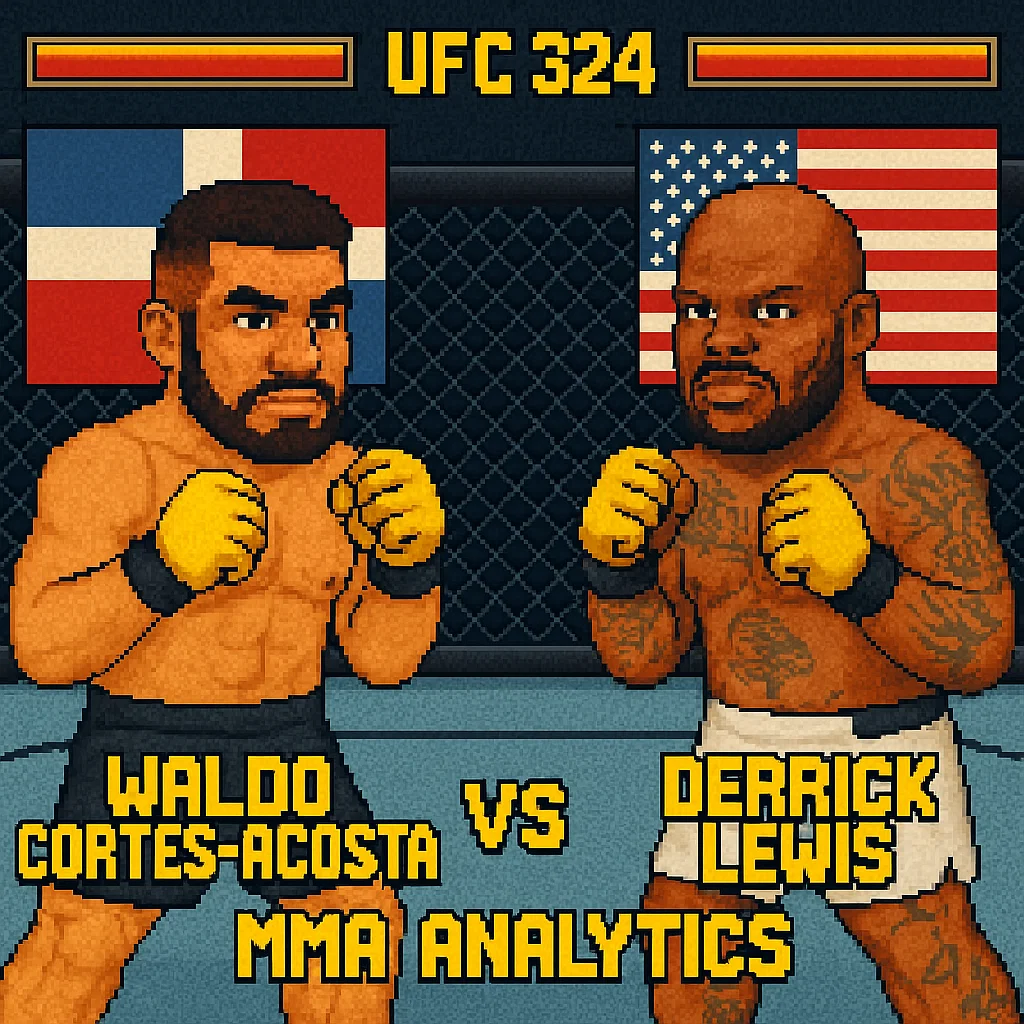
Explore Detailed Fighter Profiles
Click on either the fighter's name or profile image for each fighter to access comprehensive UFC statistics including striking metrics, grappling data, clinch performance, complete fight history, offensive & defensive analytics, and round-by-round breakdowns.

Waldo Cortes-Acosta
Fighter Metrics
Victory Methods
Win Round Distribution

Derrick Lewis
Fighter Metrics
Victory Methods
Win Round Distribution
📋 Last 5 Fights - Waldo Cortes-Acosta
| Date | Opponent | Result | Method |
|---|---|---|---|
| 2024-07-13 | Shamil Gaziev | W | TKO - Punches (R1, 1:22) |
| 2024-03-09 | Ante Delija | W | TKO - Punches (R1, 3:59) |
| 2023-09-16 | Sergei Pavlovich | L | Decision - Unanimous (R3, 5:00) |
| 2023-05-06 | Serghei Spivac | W | Decision - Unanimous (R3, 5:00) |
| 2023-01-14 | Ryan Spann | W | TKO - Punches (R2, 4:48) |
📋 Last 5 Fights - Derrick Lewis
| Date | Opponent | Result | Method |
|---|---|---|---|
| 2024-08-03 | Tallison Teixeira | W | TKO - Punches (R1, 0:35) |
| 2024-03-09 | Rodrigo Nascimento | W | TKO - Punches (R3, 0:49) |
| 2023-09-09 | Jailton Almeida | L | Decision - Unanimous (R5, 5:00) |
| 2023-06-03 | Marcos Rogério de Lima | W | TKO - Punches (R1, 3:21) |
| 2023-02-04 | Serghei Spivac | L | Submission - Armbar (R1, 3:47) |
Technical Analysis
Technical Score
Cardio Score
Overall Rating
📊 Technical Score
Calculated as the average of Striking Composite (67.9 vs 49.5) and Grappling Composite (43.7 vs 25.9). Balances overall striking effectiveness with grappling ability to measure complete technical skills.
💪 Cardio Score
Based on average fight duration, striking rate per minute, takedown rate, and finish rate. Measures cardiovascular endurance and ability to maintain pace throughout fights.
🎯 Overall Rating
Simple average of Technical Score and Cardio Score. Provides a holistic view of fighter capabilities combining skill level with physical conditioning and fight performance.
Striking Composite
Grappling Composite
📊 Technical Radar Comparison
📊 Metrics Legend
📊 Detailed Statistical Comparison
🥊 Fight Analysis Breakdown
🧩 Waldo Cortes-Acosta Key Advantages
Cortes-Acosta's 5.98 SLpM nearly doubles Lewis's 2.48, creating overwhelming volume that scores rounds consistently. His high-output kickboxing style allows him to rack up significant strikes while Lewis waits for counter opportunities. In a 3-round fight, this volume advantage compounds—judges see constant activity from Waldo while Lewis throws in isolated bursts. The Dominican can win rounds simply by being busy and landing at respectable accuracy (49%), without needing to hurt Lewis. This volume differential becomes even more pronounced when examining round-by-round output: Cortes-Acosta maintains his pace throughout, while Lewis's output typically drops significantly after the first round. The statistical gap of 3.5 strikes per minute means that over a 15-minute fight, Cortes-Acosta would land approximately 52 more significant strikes—a margin that judges consistently reward, especially when combined with superior defense and movement. His ability to throw combinations (3-4 strikes) while maintaining defensive positioning creates a scoring framework that Lewis's single-shot approach cannot match.
The 15-point striking defense differential is significant against Lewis's bombs. Cortes-Acosta's footwork and head movement allow him to make Lewis miss frequently, while his 11:50 average fight time shows he can maintain pace deep into fights. Lewis's 9:09 average suggests he struggles when fights extend—his cardio limitations become apparent after the first round. In the large cage, Waldo has space to circle and reset, minimizing the static moments where Lewis is most dangerous. This defensive advantage compounds over time: while Cortes-Acosta absorbs 3.43 strikes per minute (already below heavyweight average), Lewis's 41% defense means he's getting hit cleanly more often when exchanges occur. The Dominican's ability to maintain lateral movement and reset after combinations prevents Lewis from finding his rhythm. Additionally, Cortes-Acosta's cardio profile (11:50 average duration) demonstrates he can sustain his high-volume approach throughout all three rounds, while Lewis's 9:09 average and visible fatigue patterns suggest he'll become increasingly static and vulnerable as the fight progresses. The 30-foot cage amplifies this advantage, giving Cortes-Acosta more space to evade and reset, making it harder for Lewis to cut off angles and force exchanges.
At 33, Cortes-Acosta is ascending with back-to-back R1 KOs over Gaziev and Delija, while 40-year-old Lewis shows signs of decline despite recent wins over lower-tier opposition. Waldo's 88.9% win rate in UFC demonstrates elite-level consistency, and his only two losses came against legitimate top-10 competition. Lewis's 70.7% win rate includes multiple losses to technical fighters who neutralized his power—a template Cortes-Acosta can follow. The age differential (7 years) is significant in heavyweight, where physical decline accelerates after 35. Cortes-Acosta's recent performances show improvement in timing, power, and fight IQ—his finishes over Gaziev (1:22) and Delija (3:59) demonstrate he's finding his finishing ability. Conversely, Lewis's recent wins came against Teixeira (0:35) and Nascimento (0:49), but both were lower-ranked opponents. His losses to Almeida and Spivac show a pattern: technical fighters who maintain discipline and avoid his power shots consistently beat him. Cortes-Acosta fits this profile perfectly—he has the technical skills, volume, and cardio to execute the same gameplan that has worked against Lewis multiple times.
While Cortes-Acosta's 49% striking accuracy is slightly below Lewis's 51%, the context matters significantly. His high volume (5.98 SLpM) means he's landing approximately 2.93 significant strikes per minute, compared to Lewis's 1.26. This creates a massive activity differential that judges reward. More importantly, Cortes-Acosta's targeting is more diverse—he mixes head, body, and leg strikes effectively, while Lewis primarily targets the head (79% of his significant strikes). This body work becomes crucial against Lewis, whose cardio limitations make him vulnerable to sustained body attacks. Cortes-Acosta's ability to vary his attack angles and mix in low kicks prevents Lewis from settling into a defensive rhythm, forcing him to defend multiple levels while expending energy. The Dominican's recent fights show improved finishing ability, suggesting his accuracy is translating to fight-ending sequences when opportunities present themselves.
Cortes-Acosta's last two fights resulted in first-round knockouts, demonstrating he's not just a volume point fighter but can finish when opportunities arise. His victory over Shamil Gaziev (1:22) showed improved timing and power, while the Delija finish (3:59) demonstrated his ability to capitalize on openings. This recent form suggests Cortes-Acosta is peaking at the right time, combining his established volume game with newfound finishing ability. In contrast, Lewis's recent wins, while impressive in their speed, came against opponents who engaged recklessly—something Cortes-Acosta is unlikely to do. The Dominican's discipline and technical approach make him a much more difficult target for Lewis's power shots. Additionally, Cortes-Acosta's only losses came against Sergei Pavlovich (a top-5 contender) and a competitive decision, showing he can hang with elite competition. Lewis's recent losses to Almeida and Spivac demonstrate he struggles against technical fighters who don't engage in his preferred style of brawl.
⚠️ Unfavorable Scenarios
Despite his volume advantage, Cortes-Acosta absorbs 3.43 strikes per minute—not exceptional for heavyweight. If he gets drawn into extended pocket exchanges where Lewis's 79-inch reach and one-shot power can shine, any clean connection could end the fight instantly. Lewis has finished fighters who were winning the technical battle, and Waldo's shorter reach (70") means he must enter danger range to land his combinations. The 9-inch reach disadvantage becomes most dangerous in close quarters, where Lewis's uppercuts and hooks can find their mark before Cortes-Acosta can exit. Historical data shows Lewis's success when opponents abandon their gameplan and engage in firefights—his power and timing allow him to land fight-ending shots even when losing on volume. Cortes-Acosta's recent R1 KOs over Gaziev and Delija show he can be drawn into exchanges when he smells a finish, which could play into Lewis's hands if he baits Waldo into trading in the pocket.
Lewis's counter overhand right remains one of the most dangerous weapons in heavyweight history. If Cortes-Acosta becomes predictable with his entries or gets careless after building a lead, a single well-timed counter could erase all accumulated work. Lewis has 24 KO/TKO wins, many coming when opponents thought they were in control. The counter right hand has been Lewis's signature weapon throughout his career, and his 79-inch reach allows him to land it from distances where shorter fighters can't respond. Cortes-Acosta's tendency to throw combinations (3-4 strikes) creates windows for Lewis to time counters between shots. If Waldo becomes overconfident after winning early rounds and starts loading up on power shots, he could walk into the exact type of counter that has ended many fighters' nights. Lewis's ability to remain patient and wait for these opportunities, even when losing, makes him dangerous throughout the entire fight.
The 9-inch reach differential is one of the largest Cortes-Acosta has faced in his UFC career. Lewis's 79-inch reach allows him to land jabs and straight rights while Waldo is still out of range, forcing the Dominican to cover more distance to land his own shots. This reach advantage becomes particularly dangerous when Lewis uses it proactively rather than just waiting to counter. If Lewis establishes his jab early and uses it to set up power shots, he can control distance and make Cortes-Acosta's entries more difficult. The reach differential also means Lewis can land his overhand right from outside Cortes-Acosta's effective range, creating opportunities for fight-ending shots without having to enter the pocket himself.
📋 Likely Gameplan
Cortes-Acosta should maintain constant movement on the outside, using jabs, low kicks, and body shots to accumulate volume while making Lewis chase. Avoid standing in the pocket—touch and move, use lateral footwork, and don't get hypnotized into firefights. Win rounds through activity differential rather than seeking a finish. The key is maintaining discipline: throw combinations of 2-3 strikes, then immediately reset and circle away. Use the large cage to create angles and prevent Lewis from cutting off escape routes. The jab should be the primary weapon—it scores points, maintains distance, and sets up other strikes without committing to extended exchanges. Low kicks serve dual purposes: they score points and damage Lewis's base, making him slower and more vulnerable as the fight progresses. The goal is to win every round 10-9 through volume and activity, not to chase a knockout that may never come.
Lewis's cardio issues make body work especially effective. Targeting the midsection early can accelerate his fatigue, making him even more static by Round 2-3. Body kicks from distance are lower risk than head shots in the pocket, and they compound Lewis's conditioning problems while staying outside his power range. Body punches in combination (jab to head, cross to body) force Lewis to defend multiple levels, creating openings for head shots. The body work serves multiple purposes: it scores points, drains Lewis's energy reserves, and makes him more hesitant to engage as the fight progresses. Cortes-Acosta's 15% body targeting (vs Lewis's 17%) shows he already incorporates body shots, but he should increase this percentage significantly against Lewis. The body attacks become even more effective in R2-R3 when Lewis's hands drop and his defensive awareness decreases due to fatigue.
Use feints to draw reactions from Lewis without committing to full combinations. Jab feints can make Lewis raise his guard, creating openings for body shots or low kicks. The goal is to keep Lewis guessing and prevent him from timing counters. After landing combinations, immediately reset and circle away—never stay in the pocket longer than necessary. The large cage provides ample space to reset and re-engage from different angles. This feint-and-reset approach prevents Lewis from finding his rhythm and makes it difficult for him to time his counter shots. Cortes-Acosta's 49% accuracy suggests he can land these setup strikes while maintaining defensive positioning, making this strategy both effective and safe.
🚀 Derrick Lewis Key Advantages
Lewis holds the UFC heavyweight record for most knockouts. His 86.2% finish rate means when he wins, the fight doesn't go to the judges. Despite low volume (2.48 SLpM), his 51% accuracy shows he picks his shots carefully. One clean right hand can turn any fight around—he's knocked out opponents who were dominating him. Against Cortes-Acosta's 70" reach, Lewis's 79" reach gives him a significant 9-inch advantage to land bombs from distance. This power has been proven against elite competition: Lewis has finished former champions, top contenders, and technical strikers who were winning on the scorecards. His ability to generate fight-ending power even when fatigued or losing makes him dangerous throughout the entire fight. The counter overhand right, in particular, has become his signature weapon—it's landed from unexpected angles and distances, catching opponents who thought they were safe. Against Cortes-Acosta's high-volume approach, Lewis's patience and timing could create opportunities for these fight-ending shots, especially if Waldo becomes overconfident or abandons his disciplined gameplan.
The 9-inch reach differential is one of the largest Cortes-Acosta has faced. Lewis can land jabs and straight rights while Waldo is still out of range, and his overhand loops around guards at distances where shorter fighters can't respond. If Lewis uses his reach intelligently rather than just waiting to counter, he can make Cortes-Acosta overextend and catch him coming in. The reach advantage becomes most effective when Lewis establishes his jab early, using it to control distance and set up power shots. His 79-inch reach allows him to land straight punches from outside Cortes-Acosta's effective range, forcing Waldo to cover more ground to land his own shots. This extra distance means Cortes-Acosta must commit more fully to his entries, creating larger windows for Lewis to time counters. Additionally, Lewis's overhand right can loop around guards from angles that shorter fighters can't replicate, making it difficult for Cortes-Acosta to defend even when he sees it coming.
While Lewis's volume is low, his 51% striking accuracy demonstrates he picks his shots carefully and makes them count. This precision becomes dangerous when combined with his power—every shot he throws has fight-ending potential. His ability to time counters, especially his overhand right, has been proven against elite competition. Lewis's patience allows him to wait for the perfect opportunity rather than forcing exchanges, which could work against Cortes-Acosta if Waldo becomes impatient or overconfident. The precision also means Lewis doesn't waste energy throwing shots that won't land, preserving his limited cardio reserves for when opportunities present themselves. Against a high-volume striker like Cortes-Acosta, Lewis's counter-punching style could create openings as Waldo commits to combinations, leaving himself vulnerable to well-timed counters.
With 30 UFC fights, Lewis has faced every type of opponent and scenario imaginable. His experience includes fights against elite wrestlers, technical strikers, and power punchers, giving him a deep understanding of how to adapt mid-fight. This experience has taught him to remain patient even when losing, waiting for opportunities rather than panicking. His composure under pressure has been proven in high-stakes situations, including title fights and main events. Against Cortes-Acosta, this experience could be valuable if the fight doesn't go according to plan—Lewis has shown he can adjust his approach and find ways to win even when the initial gameplan fails. His ability to remain calm and wait for opportunities, even when being out-landed, has been a hallmark of his career and could serve him well against Cortes-Acosta's high-volume approach.
⚠️ Unfavorable Scenarios
Lewis's 9:09 average fight time and 27.4 cardio score reveal significant conditioning limitations. Against a high-volume striker like Cortes-Acosta who averages 11:50 per fight, Lewis may hit empty by Round 2. When fatigued, he becomes stationary, his hands drop, and he relies entirely on single counter shots. Technical fighters have consistently exploited this pattern. The cardio differential becomes even more pronounced when examining round-by-round output: Lewis's striking rate typically drops by 30-40% after the first round, while Cortes-Acosta maintains his pace throughout. This creates a compounding disadvantage where Lewis not only throws fewer shots but also becomes easier to hit as his defensive awareness decreases. Against Cortes-Acosta's body work, Lewis's fatigue will accelerate, making him increasingly vulnerable to both volume accumulation and potential finishes. The 3-round format is slightly better for Lewis than 5-round fights, but his conditioning issues will still manifest if the fight extends past the first round.
If Lewis can't find the knockout, he'll lose every round on volume. His 2.48 SLpM against Cortes-Acosta's 5.98 is an insurmountable gap in judges' eyes unless he's landing damage-causing shots. Lewis rarely wins decisions (only 4 of 29 wins), and against an opponent who won't engage recklessly, the cards will stack against him rapidly. The volume differential means that even if Lewis lands the harder shots, judges consistently reward activity and output over isolated power shots. Cortes-Acosta's ability to maintain constant pressure and rack up significant strike counts will make it nearly impossible for Lewis to win rounds on the scorecards. Historical data shows that when Lewis can't find the finish, he loses decisions—his counter-punching style simply doesn't generate enough activity to sway judges, especially when his opponent is actively winning the volume battle.
Lewis's 41% striking defense is among the lowest in the heavyweight division, meaning he gets hit cleanly more often than most fighters. Against Cortes-Acosta's high-volume approach, this defensive weakness becomes particularly problematic. Lewis's tendency to shell up and rely on his chin rather than active defense means he'll absorb significant damage over the course of the fight. While his chin has held up historically, the accumulation of clean shots from a high-volume striker like Cortes-Acosta could lead to a finish, especially as Lewis fatigues and his defensive awareness decreases. The combination of low defense and cardio limitations creates a dangerous scenario where Lewis becomes increasingly vulnerable as the fight progresses.
📋 Likely Gameplan
Lewis's best path is letting Cortes-Acosta come to him while conserving energy for explosive counters. Use the reach to time jabs and uppercuts as Waldo closes distance. Accept that rounds may be lost on volume but stay patient for the big shot. One clean overhand can end any heavyweight fight regardless of scorecards. The key is maintaining composure even when losing on volume—Lewis's experience has taught him that patience often creates opportunities. Use the jab to establish distance and set up power shots, but don't abandon the counter-punching approach that has served him well. The reach advantage allows Lewis to land from outside Cortes-Acosta's range, so he should use it proactively rather than just waiting. However, he must avoid getting drawn into extended exchanges where Cortes-Acosta's volume becomes decisive. The goal is to land one or two clean power shots per round rather than trying to match Cortes-Acosta's output.
Recognize that the path to victory narrows each round. R1-R2 offers the best KO windows before cardio becomes an issue. Lewis has 11 first-round knockouts—this fight should be approached with early aggression rather than waiting until he's gassed. Create chaos, force exchanges, and hunt the finish while energy permits. The first 5 minutes represent Lewis's best opportunity to land the fight-ending shot, as he'll be freshest and most capable of generating power. He should look to capitalize on any mistakes Cortes-Acosta makes early, especially if Waldo becomes overconfident or abandons his disciplined gameplan. While patience is important, Lewis can't afford to wait too long—his cardio limitations mean the opportunity window closes rapidly after the first round. Creating pressure and forcing exchanges early could create the chaos needed for Lewis to find his opening.
Lewis should use his 79-inch reach to establish the jab early, using it to control distance and set up power shots. The jab serves multiple purposes: it scores points, maintains distance, and creates openings for the overhand right. If Lewis can establish his jab and make Cortes-Acosta respect it, he can control the pace and create opportunities for counters. However, Lewis has historically been reluctant to use his reach proactively, preferring to wait for counter opportunities. Against Cortes-Acosta, he may need to be more active with the jab to prevent Waldo from settling into rhythm and establishing his volume game. The jab also helps Lewis gauge distance and timing, making his power shots more effective when opportunities arise.
🎯 Fight Prediction Analysis
Data-driven prediction model based on statistical analysis
📊Detailed Analysis Summary
🏟️Cage Dynamics
The 30-foot octagon at T-Mobile Arena provides Cortes-Acosta ample space to implement his high-volume gameplan. The large cage allows him to maintain distance, use lateral movement, and avoid the clinch scenarios where Lewis's power is most dangerous. However, Lewis's 79-inch reach means he can still threaten from distance—the space cuts both ways. The key will be whether Cortes-Acosta can circle without getting cut off against the fence, where Lewis's pressure and power become amplified. The large cage initially favors Lewis's reach advantage, giving him more space to maintain distance and land from outside. However, as the fight progresses and Cortes-Acosta's volume and movement begin to take effect, the space becomes an asset for the Dominican. He can use lateral movement to create angles, reset after combinations, and prevent Lewis from cutting off escape routes. The large cage also means more ground to cover, which could accelerate Lewis's cardio issues if he's forced to chase Cortes-Acosta around the octagon. The fence becomes a critical battleground: if Cortes-Acosta gets trapped against it, Lewis's power becomes exponentially more dangerous. But if Cortes-Acosta can use the space effectively and avoid getting cornered, the large cage becomes a significant advantage for his movement-based gameplan.
🎯Technical Breakdown
The statistical comparison heavily favors Cortes-Acosta: he leads in SLpM (5.98 vs 2.48), striking defense (56% vs 41%), takedown accuracy (50% vs 26%), and takedown defense (67% vs 53%). His composite scores (Striking 67.9 vs 49.5, Grappling 43.7 vs 25.9) demonstrate well-rounded superiority. However, heavyweight fights are defined by moments rather than accumulation—Lewis's power and precision (51% StrAcc) mean he doesn't need volume to win, just opportunity. The volume differential is the most significant statistical gap: Cortes-Acosta's 5.98 SLpM means he lands approximately 2.93 significant strikes per minute, compared to Lewis's 1.26. Over a 15-minute fight, this translates to roughly 44 vs 19 significant strikes—a margin that judges consistently reward. The striking defense differential (56% vs 41%) means Cortes-Acosta avoids more shots while landing more, creating a compounding advantage. The grappling composite scores (43.7 vs 25.9) show Cortes-Acosta has better takedown defense and submission threat, though neither fighter is primarily a grappler. The technical superiority is clear across nearly every metric, but heavyweight's inherent volatility means these advantages can be erased by a single well-placed shot from Lewis.
🧩Key Battle Areas
Three factors will decide this fight: (1) Can Cortes-Acosta maintain discipline and avoid firefights despite having power himself? His back-to-back R1 KOs show he can be drawn into exchanges. (2) Will Lewis show early urgency or revert to waiting? His cardio limitations demand action before R2-R3 fatigue sets in. (3) How does the 9-inch reach differential play out? Lewis rarely uses his reach proactively, but this matchup demands he establish the jab to set up power shots. The discipline factor is crucial: Cortes-Acosta's recent finishes show he has finishing ability, but against Lewis, chasing a knockout could be fatal. He must resist the temptation to engage in firefights and stick to his volume-based gameplan. Lewis's urgency question is equally important: if he waits too long, his cardio will betray him, but if he's too aggressive early, he could gas himself out. The reach differential creates an interesting dynamic: Lewis has the tools to control distance, but he's historically been reluctant to use them proactively. If he establishes his jab early, he could make Cortes-Acosta's entries more difficult and create openings for power shots. However, if he reverts to his typical counter-punching style, Cortes-Acosta's volume will likely overwhelm him on the scorecards.
🏁Final Prediction
The most likely outcome is Waldo Cortes-Acosta by Decision (34% probability), achieved through sustained volume, superior footwork, and cardio advantages. His KO/TKO path (32%) becomes viable through accumulation—wearing Lewis down and finding an opening late in rounds. Lewis's upset lane centers on early KO/TKO (28.6%) via his trademark counter right hand or uppercut as Cortes-Acosta enters range. The decision path for Lewis (4%) requires out-landing Cortes-Acosta—highly unlikely given the volume differential. The decision path for Cortes-Acosta is the most probable because it requires the least risk: he can win rounds through volume and activity without having to hurt Lewis or chase a finish. His superior cardio and defense mean he can maintain his pace throughout all three rounds, while Lewis's output will likely decrease as fatigue sets in. The KO/TKO path for Cortes-Acosta becomes more likely in R2-R3 when Lewis becomes stationary and his defensive awareness decreases. Lewis's upset path is almost entirely dependent on landing a fight-ending shot in R1, when he's freshest and most capable of generating power. After the first round, his cardio limitations make it increasingly difficult to land the type of shot needed to finish the fight.
💰 Betting Analysis: Model vs Market
Detailed value assessment in the betting market
📊Market Odds
🤖Analytical Model
💎Value Opportunities
MAXIMUM VALUE
Model: 34% | Fair: +194
GOOD VALUE
Model: 28.6% | Fair: +250
SLIGHT VALUE
Model: 58% | Fair: -138
⚠️Key Market Discrepancies
- • Lewis's name value inflates his line – His historical KO record keeps odds shorter than stats suggest.
- • Volume differential underweighted – 2.4x SLpM edge rarely reflected in heavyweight lines.
- • Cardio factor – 3-round fights favor Lewis less than 5-rounders where he can survive bad rounds.
🎯 Comprehensive Probabilistic Analysis
100 hypothetical fight simulation based on statistical data
🏆Outcome Distribution - Waldo Cortes-Acosta
Primary path via volume and movement
Accumulation damage as Lewis fades
Unlikely but not impossible
💥Outcome Distribution - Derrick Lewis
Best lane via counter power shots
Requires matching volume—unlikely
No historical submission profile
⏰Fight Timeline Analysis
⚡Window of Opportunity - Derrick Lewis
- • First 5 minutes: Highest KO equity before cardio drains.
- • Counter shots: Time Waldo's entries with overhand right.
- • Urgency required: Can't afford to coast in a 3-round fight.
🎯Progressive Dominance - Waldo Cortes-Acosta
- • Survive R1: Weather the storm, don't get drawn into firefights.
- • Body attacks: Accelerate Lewis's fatigue with midsection work.
- • Late finish: Look for stoppage as Lewis shells up tired.
🎯 Final Confidence Assessment
Confidence level and uncertainty factors
Confidence Level
Statistical edge clear; heavyweight volatility limits confidence
✅Supporting Factors
- • 2.4x volume advantage (5.98 vs 2.48 SLpM)
- • Superior striking defense (56% vs 41%)
- • Better cardio profile (11:50 vs 9:09 avg)
- • Career trajectory ascending vs declining
⚠️Risk Factors
- • Lewis's legendary one-punch KO power
- • 9-inch reach disadvantage for Cortes-Acosta
- • Heavyweight fights are inherently volatile
🏁Executive Summary
Waldo Cortes-Acosta holds significant statistical advantages across nearly every measurable category—volume, defense, cardio, and overall composite scores. His 5.98 SLpM vs Lewis's 2.48 creates an activity differential that should win rounds consistently on scorecards. However, this is heavyweight, where Derrick Lewis's legendary knockout power remains an ever-present threat. Lewis's 79-inch reach and counter-punching ability mean any lapse in discipline from Cortes-Acosta could end the fight instantly. The 3-round format slightly favors Lewis compared to 5-round fights where his cardio limitations become more pronounced, but his 40-year-old body and 9:09 average fight duration suggest he may still fade if the fight extends.
The statistical analysis reveals a clear favorite in Cortes-Acosta, but heavyweight's inherent volatility means the outcome is far from certain. The volume differential (5.98 vs 2.48 SLpM) is among the largest in the division, creating a scoring framework that heavily favors the Dominican. His superior striking defense (56% vs 41%) means he'll avoid more shots while landing more, compounding his advantage over three rounds. The cardio differential is equally significant: Cortes-Acosta's 11:50 average fight time demonstrates he can maintain pace throughout, while Lewis's 9:09 average and visible fatigue patterns suggest he'll struggle as the fight progresses. The 30-foot cage at T-Mobile Arena provides Cortes-Acosta ample space to implement his movement-based gameplan, using lateral footwork and angles to avoid Lewis's power while accumulating volume.
However, Lewis's advantages cannot be ignored. His 79-inch reach gives him a 9-inch advantage over Cortes-Acosta's 70", allowing him to land from distances where Waldo can't respond. His legendary knockout power (24 KO/TKOs, UFC heavyweight record) means any clean connection could end the fight instantly, regardless of scorecards. His 51% striking accuracy shows he picks his shots carefully, and his counter-punching style has proven effective against high-volume strikers who become predictable. The 3-round format is slightly better for Lewis than 5-round fights, as it reduces the time for his cardio limitations to manifest. His experience (30 UFC fights) has taught him to remain patient and wait for opportunities, even when losing on volume.
The key battle areas will determine the outcome: (1) Cortes-Acosta's discipline—can he resist the temptation to engage in firefights despite his recent finishing ability? His back-to-back R1 KOs show he can be drawn into exchanges, which could play into Lewis's hands. (2) Lewis's urgency—will he show early aggression to capitalize on his best KO window, or revert to his typical counter-punching style? His cardio limitations demand action before R2-R3 fatigue sets in. (3) The reach differential—if Lewis uses his 79-inch reach proactively to establish the jab and control distance, he could make Cortes-Acosta's entries more difficult. However, Lewis has historically been reluctant to use his reach proactively, preferring to wait for counter opportunities.
Prediction: Cortes-Acosta by Decision most likely (34% probability) through sustained volume and footwork; his KO/TKO path (32%) emerges as Lewis tires and becomes stationary. Lewis's upset lane is early KO/TKO (28.6%) via his trademark power—likely in R1 when he's freshest. Respect the volatility, but the statistical edge is clearly with Cortes-Acosta. The decision path is most probable because it requires the least risk: Cortes-Acosta can win rounds through volume and activity without having to hurt Lewis or chase a finish. His superior cardio and defense mean he can maintain his pace throughout all three rounds, while Lewis's output will likely decrease as fatigue sets in. The KO/TKO path for Cortes-Acosta becomes more likely in R2-R3 when Lewis becomes stationary and his defensive awareness decreases due to fatigue. Lewis's upset path is almost entirely dependent on landing a fight-ending shot in R1, when he's freshest and most capable of generating power. After the first round, his cardio limitations make it increasingly difficult to land the type of shot needed to finish the fight. The conviction rating of 7/10 reflects the clear statistical edge for Cortes-Acosta while acknowledging the ever-present threat of Lewis's one-punch knockout power in the heavyweight division.