

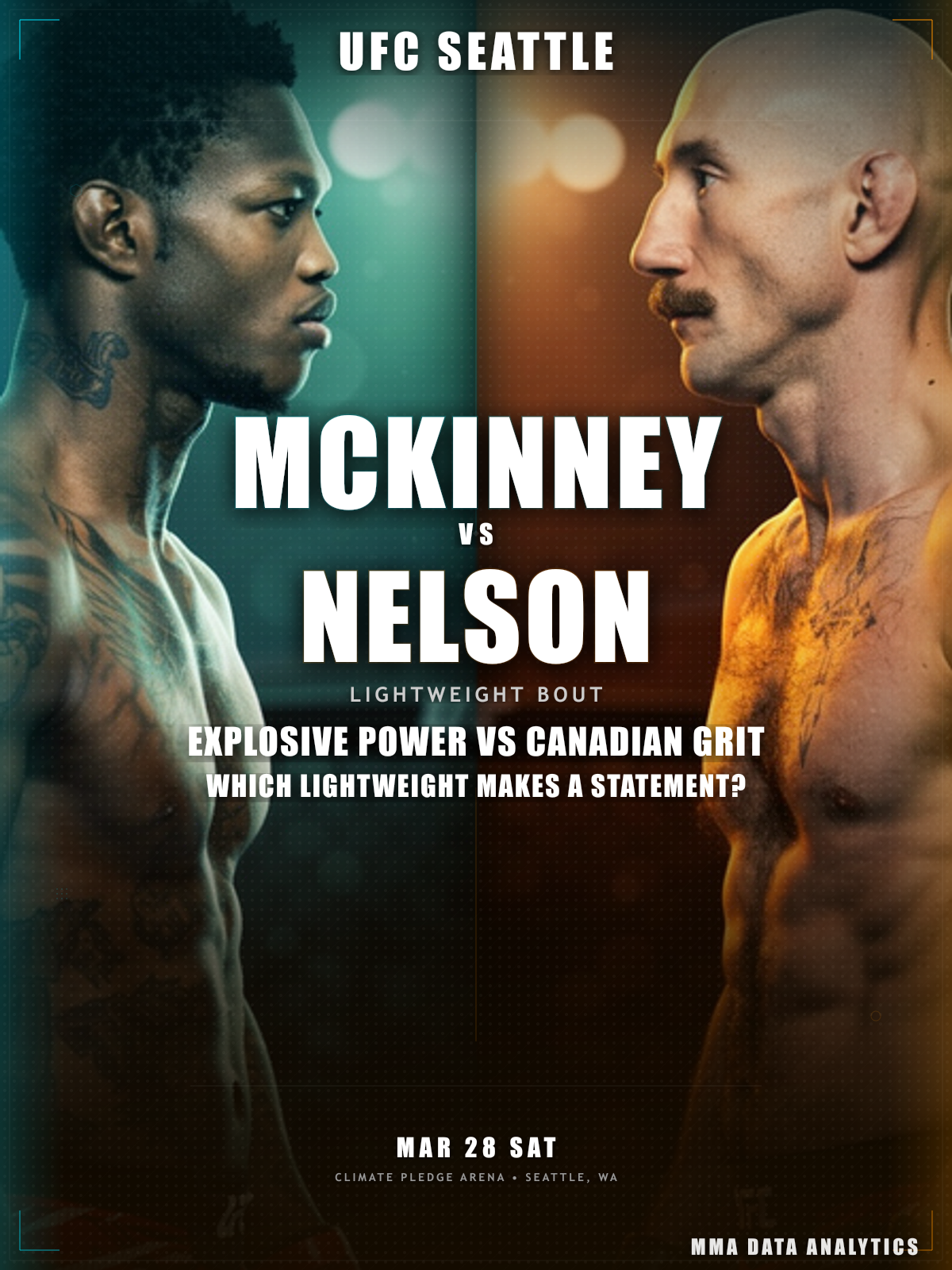
Terrance McKinney vs Kyle Nelson
Lightweight - 3 rounds • UFC Fight Night: Adesanya vs Pyfer
Saturday, March 28, 2026
Explore Detailed Fighter Profiles
Click on either the fighter's name or profile image for each fighter to access comprehensive UFC statistics including striking metrics, grappling data, clinch performance, complete fight history, offensive & defensive analytics, and round-by-round breakdowns.

Terrance McKinney
Fighter Metrics
Victory Methods
Win Round Distribution

Kyle Nelson
Fighter Metrics
Victory Methods
Win Round Distribution
📋 Last 5 Fights - Terrance McKinney
| Date | Opponent | Result | Method |
|---|---|---|---|
| Dec 06, 2025 | Chris Duncan | Loss | SUB (Anaconda Choke) (R1, 2:30) |
| Jun 28, 2025 | Viacheslav Borshchev | Win | SUB (Guillotine Choke) (R1, 0:55) |
| Feb 01, 2025 | Damir Hadzovic | Win | KO/TKO (Punches) (R1, 2:01) |
| May 11, 2024 | Esteban Ribovics | Loss | KO/TKO (Kick) (R1, 0:37) |
| Oct 14, 2023 | Brendon Marotte | Win | KO/TKO (Knee) (R1, 0:20) |
📋 Last 5 Fights - Kyle Nelson
| Date | Opponent | Result | Method |
|---|---|---|---|
| Oct 18, 2025 | Matt Frevola | Win | U-DEC (R3, 5:00) |
| Sep 07, 2024 | Steve Garcia | Loss | KO/TKO (Elbows) (R1, 3:59) |
| Mar 30, 2024 | Bill Algeo | Win | KO/TKO (Punches) (R1, 4:00) |
| Sep 16, 2023 | Fernando Padilla | Win | U-DEC (R3, 5:00) |
| Jun 10, 2023 | Blake Bilder | Win | U-DEC (R3, 5:00) |
Technical Analysis
Technical Score
Cardio Score
Overall Rating
📊 Technical Score
Calculated as the average of Striking Composite (66.0 vs 66.0) and Grappling Composite (78.0 vs 55.0). Balances overall striking effectiveness with grappling ability to measure complete technical skills.
💪 Cardio Score
Based on average fight duration, striking rate per minute, takedown rate, and finish rate. Measures cardiovascular endurance and ability to maintain pace throughout fights.
🎯 Overall Rating
Simple average of Technical Score and Cardio Score. Provides a holistic view of fighter capabilities combining skill level with physical conditioning and fight performance.
Striking Composite
Grappling Composite
Technical Radar Comparison
Visual comparison of key performance metrics between both fighters
📊 Detailed Statistical Comparison
🥊 Fight Analysis Breakdown
🧩 Terrance McKinney Key Advantages
McKinney's 6.24 SLpM at 56% accuracy represents one of the highest offensive outputs in the lightweight division, nearly doubling Nelson's 3.60 SLpM at 45% accuracy. This massive volume differential means McKinney can overwhelm Nelson with sheer striking pressure in the opening minutes. His explosive entries and willingness to throw with power create constant finishing opportunities, and his ability to land 56% of attempts means the strikes that land carry meaningful damage.
McKinney's 3.34 TD15 at 40% accuracy dwarfs Nelson's 1.18 TD15 at just 23% accuracy. This nearly 3:1 differential in takedown activity means McKinney can consistently change levels and put Nelson on his back. Combined with his 2.09 SubPer15 versus Nelson's 0.52, McKinney represents a multi-layered grappling threat - both on takedown entries (guillotine) and from top position (ground-and-pound, rear naked choke). Nelson's 66% TDDef is respectable but may not withstand McKinney's explosive chain-wrestling.
All 7 of McKinney's UFC wins have come by finish, with an average win time of just 1 minute and 17 seconds. He has never seen a decision in his favor, instead opting to end fights rapidly via KO/TKO or submission. This explosive finishing ability is his defining trait and represents a level of urgency that Nelson has rarely faced. Against a fighter who absorbs 4.48 strikes per minute, McKinney's blitz-and-finish approach is particularly dangerous.
⚠️ Unfavorable Scenarios
McKinney's 2:46 average fight duration and 42 cardio score represent his most critical vulnerability. He has never won a UFC fight past 2:30, and his only extended fights have resulted in losses. If Nelson can survive the initial onslaught, McKinney enters uncharted territory where his gas tank becomes a severe liability. His striking output and wrestling activity will likely drop dramatically after the first round.
McKinney's 43% striking defense is among the lowest in the UFC lightweight division. His aggressive, forward-pressing style leaves him exposed to counter strikes, particularly during level changes and takedown entries. Nelson's ability to time counter punches against reckless entries could result in a flash knockout, especially if McKinney abandons technique in pursuit of the early finish.
📋 Likely Gameplan
McKinney's optimal strategy is to immediately close distance and initiate his finishing sequence within the first 60 seconds. His 6.24 SLpM output should be deployed in explosive bursts, mixing strikes with takedown attempts to overwhelm Nelson's defenses. The key is to not allow Nelson to establish range or rhythm, instead forcing an immediate clinch or mat engagement.
Once McKinney secures a takedown, he should prioritize either devastating ground-and-pound or transitioning to back control for the rear naked choke. His 2.09 SubPer15 suggests he actively hunts submissions, and Nelson's limited ground defense creates ample opportunities. The guillotine choke on entry is also a live weapon given McKinney's wrestling-heavy approach and Nelson's tendency to duck into clinch exchanges.
🚀 Kyle Nelson Key Advantages
Nelson's 72 cardio score versus McKinney's 42 represents the single most important asymmetry in this fight. With a 10:24 average fight duration compared to McKinney's 2:46, Nelson has proven ability to sustain output over three rounds. His 5 UFC fights reaching decision demonstrate a durability that McKinney has never shown. If this fight goes past the first round, the cardio gap becomes increasingly decisive as McKinney's explosive output fades.
Nelson's 53% striking defense provides a 10-point advantage over McKinney's porous 43% StrDef. This means Nelson is significantly better at avoiding clean strikes, which is critical when facing McKinney's high-volume approach. Nelson's defensive awareness allows him to limit damage absorption while waiting for counter-strike opportunities on McKinney's aggressive entries.
⚠️ Unfavorable Scenarios
McKinney's trademark first-round blitz represents the nightmare scenario for Nelson. With an average win time of 1:17 and devastating finishing ability, McKinney can end the fight before Nelson's cardio advantage becomes relevant. Nelson's 4.48 SApM absorption rate makes him vulnerable to McKinney's 6.24 SLpM output in the opening exchanges, and getting taken down early could lead to rapid ground-and-pound or submission.
Nelson's modest 1.18 TD15 and 23% TDAcc are completely outclassed by McKinney's 3.34 TD15 and 40% TDAcc. If the fight goes to the ground, McKinney's 2.09 SubPer15 versus Nelson's 0.52 creates a massive submission threat disparity. Nelson lacks the offensive grappling to reverse position or threaten McKinney on the mat, making every takedown a potential fight-ending sequence.
📋 Likely Gameplan
Nelson's optimal strategy revolves around surviving McKinney's initial explosive attack and making it to Round 2 where his superior cardio becomes a decisive factor. He should focus on defensive movement, maintaining distance, and avoiding the clinch in the opening minutes. If Nelson can weather the storm and reach the later rounds, his durability and conditioning advantage should allow him to outwork a fading McKinney.
Nelson should look to exploit McKinney's 43% striking defense by timing counter strikes on his aggressive entries. Using lateral movement to circle away from McKinney's power side and maintaining the 30-foot cage distance will be key. Nelson's 53% StrDef gives him a better chance of surviving the exchanges while landing clean counter shots that could accumulate damage and potentially score a flash knockout against the defensively vulnerable McKinney.
🎯 Fight Prediction Analysis
Data-driven prediction model based on statistical analysis
📊Detailed Analysis Summary
🏟️Cage Dynamics
The 30-foot octagon creates important dynamics in this matchup. For McKinney, the larger cage slightly extends the distance he needs to close before initiating his takedowns or clinch, but his explosive entry speed (6.24 SLpM) typically negates this disadvantage within the first exchange. Nelson's preference for fighting at range with his 71-inch reach is better served by the bigger space, allowing him to circle and employ counter strikes. However, McKinney's 73-inch reach advantage and wrestling-first approach means that once contact is made, cage size becomes irrelevant as the fight moves to the clinch and mat.
🎯Technical Breakdown
The statistical analysis reveals an extreme stylistic clash. McKinney's 6.24 SLpM at 56% accuracy represents elite offensive output, nearly doubling Nelson's 3.60 SLpM at 45% accuracy. McKinney's 3.34 TD15 at 40% accuracy gives him a nearly 3:1 grappling activity advantage over Nelson's 1.18 TD15 at 23%. The submission threat is equally lopsided: McKinney's 2.09 SubPer15 versus Nelson's 0.52 represents a 4:1 differential. However, McKinney's critical vulnerability is his 43% striking defense, the lowest among UFC lightweights, which creates a realistic counter-strike knockout pathway for Nelson.
🧩Key Battle Areas
Two critical battle areas will determine the outcome: first-minute survival and durability beyond Round 1. McKinney's fights average just 2:46 in duration, with all 7 UFC wins coming inside Round 1 (average time 1:17). This creates a stark binary: if McKinney can land his explosive entries and either finish or hurt Nelson early, his 100% finish rate holds. But if Nelson survives past the initial onslaught and the fight reaches Round 2, McKinney enters uncharted territory. Nelson's 10:24 average fight duration and 72 cardio score versus McKinney's 42 become decisive advantages in the later rounds.
🏁Final Prediction
The most likely outcome is Terrance McKinney by KO/TKO (32% probability), achieved through his trademark blitz-style entries and devastating ground-and-pound. His submission path (26%) is equally viable via guillotine chokes on entry or rear naked chokes from scrambles. Nelson's primary upset lane is by Decision (25%) - surviving McKinney's early storm and outworking him as fatigue sets in after Round 1. Nelson's KO/TKO path (8%) relies on catching McKinney with counter strikes through his 44% striking defense. This fight will likely be decided in the first 3 minutes.
💰 Betting Analysis: Model vs Market
Detailed value assessment in the betting market
📊Market Odds
🤖Analytical Model
💎Value Opportunities
MAXIMUM VALUE
Model: 32% | Most likely individual outcome
GOOD VALUE
Model: 26% | Guillotine, RNC live weapons
CONTRARIAN VALUE
Model: 25% | If McKinney can't finish early
⚠️Key Market Discrepancies
- • McKinney's boom-or-bust profile – Market may undervalue Nelson's survival pathway.
- • Untested conditioning beyond R1 – McKinney has never won past 2:30 in the UFC.
- • Counter-strike vulnerability – McKinney's 43% StrDef creates KO upset risk.
🎯 Comprehensive Probabilistic Analysis
100 hypothetical fight simulation based on statistical data
🏆Outcome Distribution - Terrance McKinney
Most likely outcome via first-round blitz and GNP
Guillotine, RNC, and arm-in variations all live
0 career decision wins makes this near-impossible
💥Outcome Distribution - Kyle Nelson
Primary path: survive R1, outwork fading McKinney
Counter-strike timing on McKinney's aggressive entries
McKinney's neck exposure in scrambles creates slim path
⏰Fight Timeline Analysis
⚡Window of Opportunity - Kyle Nelson
- • After Round 1: Nelson's cardio advantage becomes decisive.
- • Counter-striking: Time McKinney's reckless entries with clean shots.
- • Survival mode: Weather the storm; outwork McKinney when he fades.
🎯Blitz Window - Terrance McKinney
- • First 2 minutes: Highest finish probability window; must capitalize.
- • TD + GNP: Secure takedown and unleash devastating ground strikes.
- • Sub threats: Guillotine on entry; RNC from back control.
🎯 Final Confidence Assessment
Confidence level and uncertainty factors
Confidence Level
Moderate confidence due to McKinney's boom-or-bust profile
✅Supporting Factors
- • Massive striking output differential (6.24 vs 3.60 SLpM)
- • Elite grappling activity (3.34 vs 1.18 TD15)
- • 100% finish rate in UFC wins; 0 decisions
- • Submission threat from multiple positions (2.09 SubPer15)
⚠️Risk Factors
- • 43% striking defense creates counter-KO vulnerability
- • Never won a fight past 2:30; untested cardio
- • Nelson's 72 cardio score vs McKinney's 42
🏁Executive Summary
Terrance McKinney's explosive finishing ability and massive statistical advantages in striking output, grappling activity, and submission frequency make him the clear favorite in this matchup. His 6.24 SLpM nearly doubles Nelson's 3.60, while his 3.34 TD15 and 2.09 SubPer15 represent overwhelming offensive pressure from every phase. All 7 of McKinney's UFC wins have come via finish inside Round 1, with an average win time of just 1:17. However, his critical weakness is durability and conditioning - with a 43% striking defense and no UFC wins past 2:30, he operates in a narrow window. Nelson's path to victory requires surviving McKinney's initial onslaught and exploiting the massive cardio gap (72 vs 42 score) in the later rounds.
Prediction: McKinney by KO/TKO most likely (32% probability) through first-round explosive entries; his submission path (26%) is equally viable via guillotine or RNC. Nelson's best chance is by Decision (25%) if the fight extends past Round 1 where his cardio advantage becomes dominant. This is a high-volatility fight where the outcome likely hinges on the first 3 minutes.