

Bolaji Oki vs Manoel Sousa
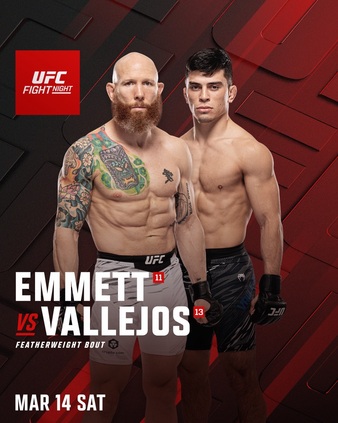
Men's Lightweight Bout Bout • UFC Fight Night: Emmett vs. Vallejos
Saturday, March 14, 2026 • UFC Apex, Las Vegas (Small Cage)
Explore Detailed Fighter Profiles
Click on either the fighter's name or profile image for each fighter to access comprehensive UFC statistics including striking metrics, grappling data, clinch performance, complete fight history, offensive & defensive analytics, and round-by-round breakdowns.

Bolaji Oki
Fighter Metrics
Victory Methods
Win Round Distribution
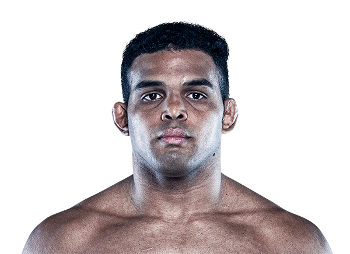
Manoel Sousa
Fighter Metrics
Victory Methods
Win Round Distribution
📋 Last 5 Fights - Bolaji Oki
| Date | Opponent | Result | Method |
|---|---|---|---|
| Sep 6, 2025 | Mason Jones | L | KO/TKO (Elbows from Mount) (R2, 3:18) |
| May 31, 2025 | Michael Aswell Jr. | W | Decision (Unanimous) (3, 5:00) |
| Sep 28, 2024 | Chris Duncan | L | SUB (Guillotine Choke) (R1, 3:34) |
| Feb 10, 2024 | Timmy Cuamba | W | Decision (Split) (3, 5:00) |
| Aug 29, 2023 | Dylan Salvador | W | KO/TKO (Punches) (R1, 2:46) |
📋 Last 5 Fights - Manoel Sousa
| Date | Opponent | Result | Method |
|---|---|---|---|
| Aug 26, 2025 | Cristian Pérez | W | KO/TKO (Punches) (R3, 3:00) |
| Mar 28, 2025 | Lucas Barros | W | Decision (Unanimous) (3, 5:00) |
| Sep 14, 2024 | Archie Colgan | W | Decision (Unanimous) (3, 5:00) |
| Mar 22, 2024 | Tim Wilde | W | KO/TKO (Left Hook) (R1, 4:48) |
| Feb 17, 2023 | Paulo Henrique Laia | W | Decision (Split) (3, 5:00) |
Technical Analysis
Technical Score
Cardio Score
Overall Rating
📊 Technical Score
Calculated as the average of Striking Composite (66.0 vs 66.0) and Grappling Composite (78.0 vs 55.0). Balances overall striking effectiveness with grappling ability to measure complete technical skills.
💪 Cardio Score
Based on average fight duration, striking rate per minute, takedown rate, and finish rate. Measures cardiovascular endurance and ability to maintain pace throughout fights.
🎯 Overall Rating
Simple average of Technical Score and Cardio Score. Provides a holistic view of fighter capabilities combining skill level with physical conditioning and fight performance.
Striking Composite
Grappling Composite
Technical Radar Comparison
Visual comparison of key performance metrics between both fighters
📊 Detailed Statistical Comparison
🥊 Fight Analysis Breakdown
🧩 Bolaji Oki Key Advantages
Oki's near-6.6 significant strikes per minute is one of the highest rates in the entire lightweight division, placing him in the top 5% of UFC fighters for raw output. In his unanimous decision over Aswell, he landed 136 significant strikes across 15 minutes. Against Sousa's 55% striking defense, Oki would theoretically land approximately 2.96 significant strikes per minute. His 0.67 knockdown average per fight confirms that his volume isn't empty — meaningful power lurks behind the output.
This 3-inch reach differential (73" vs. 70") is meaningful in an orthodox-vs-orthodox matchup. Oki can establish his jab at a distance where Sousa's return fire falls short, creating a range where he can score without risk. His 94% standing strike distribution tells us he's built his entire game around maximizing this distance-fighting approach. His 61% striking defense — 6 percentage points higher than Sousa's — gives him an additional edge in exchanges.
Oki has four UFC fights under his belt — he's been submitted, knocked out, and won decisions at the highest level. He knows the UFC Apex cage dimensions, the pacing of UFC events, and the pressure of performing under the brightest lights. Sousa, making his official UFC debut, will experience all of this for the first time. Statistical research consistently shows that UFC debutants underperform their career baselines in their first fight.
⚠️ Unfavorable Scenarios
If Sousa successfully changes levels, clinches against the cage, or drags the fight to the mat, Oki enters a dimension where he has demonstrated zero offensive capability and has been finished twice in 4 UFC fights. His 66% TDD (below average) means roughly 1 in 3 takedown attempts will succeed, and once grounded, his lack of submission defense against a fighter with 4 career submission wins and 2.31 SubPer15 is a catastrophic vulnerability.
Oki's 44% striking accuracy means 56% of his strikes miss. Against a patient counter-striking specialist like Sousa (58% accuracy), those misses create openings for clean counter shots. Sousa's left hook KO of Wilde demonstrates he can time a counter against a forward-pressing striker — and Oki's high-volume, forward-pressure style creates exactly the kind of entries that counter punchers exploit.
📋 Likely Gameplan
Oki needs to come out guns blazing, establishing his jab immediately and building striking volume that overwhelms Sousa's UFC debut nerves. His primary objective will be maintaining the fight at the end of his 73" reach — keeping Sousa at distance where his volume punching can accumulate rounds without risk of grappling exchanges. Body work early targeting Sousa's midsection serves dual purposes: visible damage for judges and sapping the cardio Sousa needs for sustained grappling.
Oki must circle constantly, using the full circumference of the small cage to avoid getting pinned against the fence where clinch entries become available. When Sousa closes distance, Oki's gameplan centers on his 61% striking defense and framing to create separation rather than engaging in clinch battles. If he can discourage Sousa's level changes with uppercuts or knee timing on entries, the fight stays in his world.
🚀 Manoel Sousa Key Advantages
Sousa has finished opponents via punches, left hook, ground-and-pound, kimura (x2), americana, and arm triangle choke. This variety prevents Oki from preparing for a single threat — he must simultaneously defend against knockout power on the feet, takedowns, and a diversified submission game on the mat. Oki, conversely, only threatens with striking. The asymmetry in finishing versatility is the central dynamic of this fight.
Both of Oki's UFC losses came when the fight hit the ground — Duncan submitted him with a guillotine (R1 3:34), and Jones finished him with elbows from mount (R2 3:18). This is not coincidence; it's a structural deficiency. Sousa's 4 career submission wins — including 2 kimuras that require side control — map directly onto this exploitable weakness. In the 25-ft small cage, Sousa can cut off the ring more efficiently and initiate the grappling exchanges where he's clearly superior.
While Oki throws more volume, Sousa lands with significantly higher accuracy (58% vs. 44%) while absorbing far fewer clean strikes (1.31 vs. 5.15 SApM). His left hook KO of Tim Wilde in Bellator (R1 4:48) demonstrates genuine one-punch stopping power. Sousa enters on the longest win streak on the card at 8 consecutive victories across multiple promotions, while Oki is coming off a R2 TKO defeat to Mason Jones.
⚠️ Unfavorable Scenarios
If Sousa fails to close distance and the fight becomes a sustained 15-minute striking contest at range, Oki's 2:1 volume advantage becomes overwhelming. 6.59 vs. 3.23 SLpM over 15 minutes projects to a ~50 significant strike differential in Oki's favor — a gap that judges notice and that produces cumulative damage. Sousa hasn't faced a volume striker of Oki's caliber in his career.
Making your official UFC debut is a significant step up in every dimension — judging, pace expectations, cage dimensions, broadcast pressure, and quality of opposition. Sousa has competed in Bellator, PFL, LFA, and CFFC — all major promotions — but none carry the psychological weight of fighting in the UFC cage for the first time. Historical data shows UFC debutants from DWCS have a slightly elevated rate of first-fight underperformance.
📋 Likely Gameplan
Sousa should open with measured striking to establish respect for his power — particularly his left hook — which creates the threat matrix that makes his level changes effective. If Oki is worried about the left hook, he tightens his guard high, opening the path for Sousa to change levels underneath. Mix 2-3 striking exchanges at range with clinch entries against the cage where he can work underhooks, body lock, and drag the fight to the mat.
The DWCS fight against Pérez provides the template: fight patient, stay defensively responsible, let the opponent tire from his own output, then close the show in R2-R3 when the opponent's defense deteriorates. Against Oki's 6.59 SLpM, Sousa doesn't need to match volume — he needs to let Oki tire himself out while intermittently threatening takedowns that sap Oki's mental energy and force him to fight defensively rather than offensively. Once on the ground, prioritize side control to deploy his signature kimura.
🎯 Fight Prediction Analysis
Data-driven prediction model based on statistical analysis
📊Detailed Analysis Summary
🏟️Cage Dynamics
The UFC Apex small cage (25-foot octagon) significantly influences this matchup, compressing the available space in a way that creates both opportunities and dangers for both fighters. For Oki, the smaller cage limits his ability to maintain the range where his 73" reach and 6.59 SLpM volume are most effective. For Sousa, the reduced space allows him to close distance more efficiently and initiate the grappling exchanges where he holds a decisive advantage. However, the small cage also means Sousa has less room to circle away from Oki's volume when on the feet. The cage dynamics slightly favor Sousa overall, as his path to victory through clinch entries and takedowns benefits from the compressed fighting area.
🎯Technical Breakdown
This matchup pits a pure volume striker against a well-rounded finisher with clear grappling superiority. Oki's 6.59 SLpM at 44% accuracy generates massive output, but Sousa's 58% accuracy and dramatically lower absorption rate (1.31 vs. 5.15 SApM) means he's far more efficient per exchange. The critical battleground is dimension control — if the fight stays standing at range, Oki's volume overwhelms; if Sousa can initiate clinch work and takedowns, his 2.31 submissions per 15 minutes against Oki's proven grappling vulnerability creates finish opportunities. With 94% of Oki's strikes coming from standing and zero offensive grappling, he's essentially a one-dimensional threat facing a fighter who can attack from every position.
🧩Key Battle Areas
Three critical battle areas determine the outcome: (1) Distance management — can Oki maintain striking range or will Sousa consistently close to clinch range? Oki's 3" reach advantage and footwork versus Sousa's pressure and cage cutting. (2) Takedown defense — Oki's 66% TDD against Sousa's level changes is below average and represents the fight's most exploitable vulnerability. (3) Ground scrambles — if/when the fight hits the mat, Sousa's 4 career submission wins and 2.31 SubPer15 against Oki's demonstrated grappling weakness (submitted by Duncan, TKO'd on ground by Jones) creates catastrophic finish scenarios that Oki simply cannot afford to enter.
🏁Final Prediction
The most likely outcome is Manoel Sousa by Submission (25% probability), achieved through patient pressure, clinch entries against the cage, and exploiting Oki's proven grappling vulnerability with his signature kimura or arm triangle. Sousa's KO/TKO path (18%) becomes viable if his left hook timing catches Oki's forward momentum. Oki's best path to victory is by Decision (25%) through sustained volume striking that overwhelms Sousa in rounds where he maintains distance. Oki's KO/TKO path (12%) requires accumulating damage through volume before Sousa can initiate grappling exchanges. The 3-round format slightly benefits Oki, as less time means fewer opportunities for Sousa to establish his grappling game.
💰 Betting Analysis: Model vs Market
Detailed value assessment in the betting market
📊Market Odds
🤖Analytical Model
💎Value Opportunities
MAXIMUM VALUE
Model: 25% | Exploits Oki's grappling weakness
GOOD VALUE
Model: 18% | Left hook counter power
SLIGHT VALUE
Model: 25% | Volume outwork over 3 rounds
⚠️Key Market Discrepancies
- • Undervalues grappling dimension – Oki's 66% TDD and two grappling-related losses create finish paths.
- • Volume ≠ effectiveness – Oki's 44% accuracy means over half his shots miss, creating counter openings.
- • Small cage impact – 25-ft octagon compresses distance, favoring Sousa's clinch-heavy approach.
🎯 Comprehensive Probabilistic Analysis
100 hypothetical fight simulation based on statistical data
🏆Outcome Distribution - Bolaji Oki
Primary path via sustained volume output over 3 rounds
Early-round explosiveness and knockdown power
Functionally negligible — zero career submission attempts
💥Outcome Distribution - Manoel Sousa
Left hook counter and power striking
Grappling control and takedown-based scoring
Elite submission game exploits Oki's grappling weakness
⏰Fight Timeline Analysis
⚡Window of Opportunity - Manoel Sousa
- • First 5 minutes: Highest volume striking equity before grappling initiates.
- • Range control: Jab + combinations to maintain distance and score.
- • Anti-wrestling: Circle off cage; avoid extended clinch and fence positions.
🎯Progressive Dominance - Manoel Sousa
- • Clinch entries: Close distance against cage and initiate grappling.
- • Submission threats: Exploit Oki's grappling weakness with kimura/arm triangle.
- • Late rounds: Accumulated grappling pressure creates finish opportunities.
🎯 Final Confidence Assessment
Confidence level and uncertainty factors
Confidence Level
Moderate edge via grappling dimension against limited data
✅Supporting Factors
- • Sousa's multi-dimensional offense vs. Oki's one-dimensional striking
- • Oki's 66% TDD and two grappling-related losses
- • Sousa's 2.31 SubPer15 creates clear finish paths
- • Sousa's dramatically better damage economy (1.31 vs 5.15 SApM)
⚠️Risk Factors
- • Oki's 6.59 SLpM volume can overwhelm early
- • Small UFC sample (4 fights each) limits confidence
- • 3-round format gives Oki more viable path via volume
🏁Executive Summary
Manoel Sousa's multi-dimensional finishing ability should overcome Bolaji Oki's volume striking advantage in a fight where dimension control is paramount. Sousa's elite submission game (2.31 SubPer15, 4 career sub wins) directly exploits Oki's demonstrated grappling weakness (66% TDD, submitted by Duncan, TKO'd on ground by Jones). While Oki's 6.59 SLpM volume is impressive, his 44% accuracy and massive 5.15 SApM absorption rate expose him to counter opportunities. The UFC Apex small cage compresses the fighting area, favoring Sousa's clinch entries and takedown attempts over Oki's preferred range striking. The 3-round format is the primary moderating factor, as it limits the number of grappling sequences Sousa can initiate.
Prediction: Sousa by Submission most likely (25% probability) through clinch entries and exploiting Oki's grappling weakness; Oki's best path is a Decision (25%) via sustained volume striking that keeps the fight standing. The fight's outcome hinges on whether Oki can maintain distance and avoid the grappling exchanges where Sousa holds a decisive advantage.