

Chris Curtis vs Myktybek Orolbai
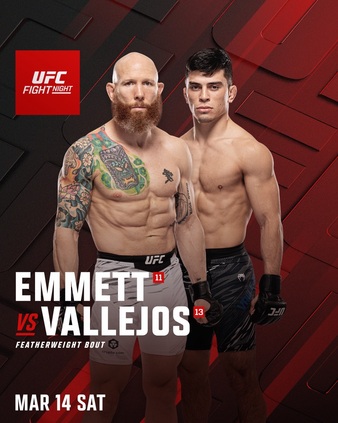
Men's Welterweight Bout Bout • UFC Fight Night: Emmett vs. Vallejos
Saturday, March 14, 2026 • 25ft Octagon (Small Cage)
Explore Detailed Fighter Profiles
Click on either the fighter's name or profile image for each fighter to access comprehensive UFC statistics including striking metrics, grappling data, clinch performance, complete fight history, offensive & defensive analytics, and round-by-round breakdowns.

Chris Curtis
Fighter Metrics
Victory Methods
Win Round Distribution

Myktybek Orolbai
15-2-1
Myktybek Orolbai
Fighter Metrics
Victory Methods
Win Round Distribution
📋 Last 5 Fights - Chris Curtis
| Date | Opponent | Result | Method |
|---|---|---|---|
| Jul 12, 2025 | Max Griffin | W | Decision (Split) (3, 5:00) |
| Jan 11, 2025 | Roman Kopylov | L | KO/TKO (Head Kick) (3, 4:59) |
| Apr 6, 2024 | Brendan Allen | L | Decision (Split) (5, 5:00) |
| Jan 20, 2024 | Marc-André Barriault | W | Decision (Split) (3, 5:00) |
| Jun 10, 2023 | Nassourdine Imavov | NC | CNC (Doctor Stoppage) (2, 3:04) |
📋 Last 5 Fights - Myktybek Orolbai
| Date | Opponent | Result | Method |
|---|---|---|---|
| Nov 22, 2025 | Jack Hermansson | W | KO/TKO (Overhand Right) (1, 2:46) |
| Jun 21, 2025 | Tofiq Musayev | W | SUB (Kimura) (1, 4:35) |
| Oct 26, 2024 | Mateusz Rebecki | L | Decision (Split) (3, 5:00) |
| May 4, 2024 | Elves Brener | W | Decision (Unanimous) (3, 5:00) |
| Nov 18, 2023 | Uros Medic | W | SUB (Neck Crank) (2, 4:12) |
Technical Analysis
Technical Score
Cardio Score
Overall Rating
📊 Technical Score
Calculated as the average of Striking Composite (66.0 vs 66.0) and Grappling Composite (78.0 vs 55.0). Balances overall striking effectiveness with grappling ability to measure complete technical skills.
💪 Cardio Score
Based on average fight duration, striking rate per minute, takedown rate, and finish rate. Measures cardiovascular endurance and ability to maintain pace throughout fights.
🎯 Overall Rating
Simple average of Technical Score and Cardio Score. Provides a holistic view of fighter capabilities combining skill level with physical conditioning and fight performance.
Striking Composite
Grappling Composite
Technical Radar Comparison
Visual comparison of key performance metrics between both fighters
📊 Detailed Statistical Comparison
🥊 Fight Analysis Breakdown
🧩 Chris Curtis Key Advantages
Curtis's near-6 significant strikes per minute is a genuine weapon — among the highest in the entire UFC regardless of weight class. Against Orolbai's 50% striking defense, Curtis would theoretically land approximately 3.0 significant strikes per minute if the fight stays standing. Over 15 minutes, that's ~45 clean significant strikes — a volume that judges reward and that accumulates damage. His 4 UFC bonuses confirm what the eye test shows: Curtis fights create action.
An 82% takedown defense rate across 11 UFC bouts is genuinely strong and reflects legitimate defensive wrestling fundamentals — hip positioning, hand fighting, cage work, and underhooks. Against Jack Hermansson, a capable wrestler who grappled him for 15 minutes, Curtis showed he can survive extended grappling sequences even when outpositioned. If Curtis can maintain an 80%+ stuff rate against Orolbai's volume, he can keep this fight in his world long enough to accumulate striking damage.
Curtis can fight at an uncommonly high pace for 15 full minutes. His 12:50 average fight duration — nearly 13 full minutes — confirms elite cardiovascular endurance. He maintains his high striking rate deep into fights, and his output in R3 against Griffin was comparable to R1. With 11 UFC bouts against quality opposition including Brendan Allen, Kelvin Gastelum, and Jack Hermansson, Curtis brings superior fight IQ, cage awareness, and the ability to make in-fight adjustments. If Orolbai's takedowns are stuffed in R1-R2 and he burns energy, Curtis's R3 cardio advantage becomes a potentially fight-winning factor.
⚠️ Unfavorable Scenarios
If Orolbai maintains his typical 12+ takedown attempt rate and Curtis's defense even slightly dips below his career 82%, the fight quickly becomes a smothering grappling contest where Curtis has zero offensive tools. On his back, Curtis has shown no submission threat, no ability to generate offense, and no scrambling ability to return to his feet quickly.
Curtis's striking game relies on maintaining distance, circling, and resetting between exchanges. The 25-ft cage removes approximately 30% of the real estate he'd have in a standard cage, making it significantly harder to establish and maintain his preferred range. If Orolbai can close distance and pin Curtis against the fence, the fight becomes a clinch battle where wrestling skills dominate.
📋 Likely Gameplan
Curtis should come out with his trademark high-volume striking from the opening bell, looking to establish his jab and straight right to create separation and scoring. His primary objective will be maintaining distance — keeping Orolbai at the end of his 75" reach where his combination striking is most effective. He needs to circle off the cage constantly, never allowing his back to touch the fence where Orolbai's takedown entries become most dangerous.
Curtis's body work should be deployed aggressively early to sap Orolbai's wrestling energy — a tired wrestler is a wrestler who stops shooting. When Orolbai closes distance and shoots, Curtis's gameplan centers on his 82% TDD — stuffing singles and doubles with hip positioning, hand fighting, and headlock re-pummelings. In an ideal Curtis fight, he stuffs early takedowns, punishes Orolbai on the break with combinations, and builds a scoreboard lead through sheer volume.
🚀 Myktybek Orolbai Key Advantages
Orolbai averages 5.48 takedowns attempted per 15 minutes— among the most aggressive wrestling rates in the UFC. Against Curtis, who has 0.00 offensive takedowns and no grappling offense whatsoever, the fight becomes a one-way grappling battle whenever Orolbai initiates. His 45% TDAcc combined with Curtis's 82% TDDef suggests a pure volume war where Orolbai shoots 12+ times and converts 2-3 into significant control sequences. In the small Apex cage, the fence is always close.
Orolbai's 73% finish rate across 15 wins shows a legitimate finisher. His KO of Jack Hermansson via overhand right in R1 proves real one-punch power, and his submission of Tofiq Musayev via kimura proves ground-finishing ability. Against Curtis, who absorbs 6.19 strikes per minute, Orolbai has a live KO threat every time he throws his hands. Curtis's defensive vulnerability compounds over 15 minutes — a career 6.19 SApM means Curtis is getting hit constantly.
⚠️ Unfavorable Scenarios
If Curtis successfully stuffs takedowns and the fight remains standing for extended periods, Orolbai's 3.24 SLpM is outgunned nearly 2:1 by Curtis's 5.98 SLpM. In a pure striking fight, Curtis's volume, accuracy, and combination work will overwhelm Orolbai, who has never faced a striker of this caliber. Every minute on the feet is a minute Curtis is outsscoring Orolbai on the cards.
Orolbai's 4:50 average fight duration raises legitimate questions about his ability to sustain his wrestling-heavy approach for 15 minutes. His only decision loss came against Rebecki where he faded late. If Curtis's 82% TDDef forces Orolbai to chain multiple attempts per takedown, the energy cost becomes exponential. A tired Orolbai in R3 is facing a volume striker who only gets stronger as fights go on.
📋 Likely Gameplan
Orolbai should look to close distance immediately and pin Curtis against the cage where his wrestling entries are most effective. In the 25-ft Apex cage, Curtis has limited space to circle and maintain distance. Orolbai should utilize body locks, single legs off the fence, and reactive takedowns when Curtis throws combinations. The priority is getting Curtis to the mat and accumulating control time — even brief rides win rounds over pure striking activity.
Orolbai should avoid sustained boxing exchanges but should capitalize on Curtis's 6.19 SApM defensive vulnerability with well-timed power shots — particularly the overhand right that KO'd Hermansson. Curtis absorbs far too many strikes for his own good, and a well-placed power shot early could end this fight. The blend of wrestling pressure with opportunistic power punching keeps Curtis guessing and prevents him from settling into his volume-striking rhythm.
🎯 Fight Prediction Analysis
Data-driven prediction model based on statistical analysis
📊Detailed Analysis Summary
🏟️Cage Dynamics
The small 25-ft Apex cage fundamentally shapes this matchup — reducing Curtis's circling room and increasing Orolbai's cage-based wrestling opportunities. Curtis needs space to fire his 5.98 SLpM volume and maintain distance, but the compact cage means the fence is always one step away. Orolbai's 5.48 TD15 rate generates approximately 12 takedown attempts per 15-minute fight, and the small cage amplifies the success rate of each attempt. When the fight stays standing, Curtis dominates — but the cage geometry favors the wrestler, shifting win probability 5-8% toward Orolbai over what aggregate stats suggest.
🎯Technical Breakdown
The statistical analysis reveals two primary battlefields: wrestling control vs. striking volume. Orolbai's 5.48 TD15 vs Curtis's 0.00 represents an infinite takedown volume differential — Curtis has zero offensive grappling tools. However, Curtis's 82% TDDef and 5.98 SLpM (vs 3.24) create a nearly 2:1 striking volume advantage when the fight stays standing. The key differentiator is fight location control: in striking-dominant simulations (~35%), Curtis wins ~65% of the time. In grappling-dominant simulations (~40%), Orolbai wins ~85%. The mixed-phase simulations (~25%) split roughly 55-45 in Orolbai's favor due to the scoring value of takedowns and top control.
🧩Key Battle Areas
Three critical battle areas determine the outcome: Curtis's 82% TDDef vs Orolbai's 5.48 TD15 volume, Curtis's striking output vs Orolbai's power threat, and late-round cardio management. Curtis's TDDef is genuinely elite — he's maintained 82% across 11 UFC bouts. But no TDDef metric is immune to Orolbai's volume: 12+ attempts per fight means 2-3 completions on average. Each completed takedown shifts the fight into a dimension where Curtis cannot score. Orolbai's overhand right serves dual purpose — as a KO weapon AND a takedown set-up that masks level changes.
🏁Final Prediction
The most likely single outcome is Curtis by Decision (27%), but Orolbai's combined win probability of 62% across multiple methods makes him the clear favorite. Orolbai's three paths — Decision (24%), Submission (20%), and KO/TKO (18%) — are all viable, creating a difficult fighter to bet against. Curtis's upset lane centers on his proven Decision path (27%) via elite volume striking and stuffing takedowns to keep the fight standing. The fight hinges on whether Curtis's 82% TDDef can withstand Orolbai's 12+ takedown attempts across 15 minutes.
💰 Betting Analysis: Model vs Market
Detailed value assessment in the betting market
📊Market Odds
🤖Analytical Model
💎Value Opportunities
MAXIMUM VALUE
Model: 20% | Fair: +400
GOOD VALUE
Model: 27% | Fair: +270
SLIGHT VALUE
Model: 51% decision probability | Curtis durability
⚠️Key Market Discrepancies
- • Wrestler vs pure striker dynamic – Market may overweight Curtis's volume without accounting for grappling nullification.
- • Small cage amplifier – Apex cage reduces circling room, increasing wrestling success rate 5-8% over aggregate stats.
- • Orolbai submission upside – Curtis has zero sub defense; any sustained top time creates finish opportunities.
🎯 Comprehensive Probabilistic Analysis
100 hypothetical fight simulation based on statistical data
🏆Outcome Distribution - Chris Curtis
Primary path via elite volume and 82% TDD
Counter timing on level changes
Effectively negligible — zero submission history
💥Outcome Distribution - Myktybek Orolbai
Grinding wrestling control, 3-4 TDs per round
Kimura/neck crank from dominant position
Overhand right + GnP vs Curtis's 6.19 SApM
⏰Fight Timeline Analysis
⚡Window of Opportunity - Chris Curtis
- • Rounds 1-2: Highest striking volume equity before wrestling drains energy.
- • TDD stuffs: Each stuffed takedown burns Orolbai's gas tank and creates counter opportunities.
- • Volume accumulation: Outwork on feet with 5.98 SLpM to build scoring lead.
🎯Progressive Dominance - Myktybek Orolbai
- • Cage pressure: Pin Curtis on fence for wrestling entries and body locks.
- • Takedown volume: 5+ attempts per round overwhelm even elite TDD.
- • Ground control: Any sustained top time creates sub/GnP finish opportunities.
🎯 Final Confidence Assessment
Confidence level and uncertainty factors
Confidence Level
Lean Orolbai via wrestling volume but exercise restraint
✅Supporting Factors
- • Elite wrestling volume (5.48 TD15) vs pure striker with 0.00 TDs
- • Small cage amplifies wrestling advantage 5-8%
- • 73% finish rate with proven KO and submission ability
- • Age and trajectory advantage (28 vs 37)
⚠️Risk Factors
- • Curtis's 82% TDD is genuinely elite across 11 UFC bouts
- • Curtis 5.98 SLpM with 50% accuracy dominates on feet
- • Orolbai's lone loss came in a 3-round decision (Rebecki)
🏁Executive Summary
Orolbai's elite wrestling volume (5.48 TD15) against a pure striker with zero offensive grappling creates a clear directional advantage in the small Apex cage. Curtis's 82% TDD and 5.98 SLpM volume provide legitimate upset equity, but the fundamental matchup equation favors the wrestler: when Orolbai gets Curtis down (and he will, at least 2-3 times per fight), Curtis has no answers. Orolbai's 73% finish rate with proven KO power (Hermansson) and submission ability (Musayev kimura) creates multiple win paths, while Curtis is essentially one-dimensional — he needs to keep this fight standing for 15 minutes against a wrestler who fires 12+ takedown attempts per fight.
Prediction: Orolbai wins at 62% combined probability across Decision (24%), Submission (20%), and KO/TKO (18%). Curtis's best path is Decision (27%) via elite volume striking and TDD stuffing. Best value: Orolbai by Submission (+400) and Curtis by Decision (+270) as the primary upset play. The fight hinges on whether Curtis's 82% TDD can withstand Orolbai's relentless wrestling volume in the small cage.