
Vitor Petrino vs Steven Asplund
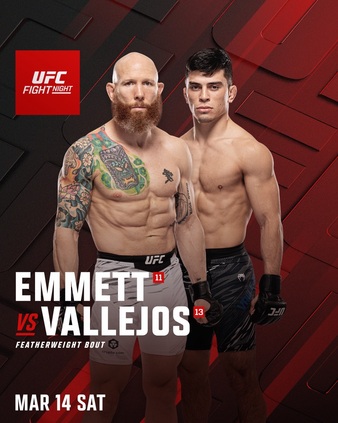
Men's Heavyweight Bout • UFC Fight Night: Emmett vs. Vallejos
Saturday, March 14, 2026 • 25ft Cage (Small) • UFC Apex, Las Vegas
Explore Detailed Fighter Profiles
Click on either the fighter's name or profile image for each fighter to access comprehensive UFC statistics including striking metrics, grappling data, clinch performance, complete fight history, offensive & defensive analytics, and round-by-round breakdowns.
Vitor Petrino
Fighter Metrics
Victory Methods
Win Round Distribution

Steven Asplund
Fighter Metrics
Victory Methods
Win Round Distribution
📋 Last 5 Fights - Vitor Petrino
| Date | Opponent | Result | Method |
|---|---|---|---|
| Oct 11, 2025 | Thomas Petersen | W | TKO (R3, 0:26) |
| Jul 12, 2025 | Austen Lane | W | SUB (RNC) (R1, 4:16) |
| Dec 14, 2024 | Dustin Jacoby | L | TKO (R3, 3:44) |
| May 4, 2024 | Anthony Smith | L | SUB (Guillotine) (R1, 2:00) |
| Mar 2, 2024 | Tyson Pedro | W | Decision (UD) (—, ) |
📋 Last 5 Fights - Steven Asplund
| Date | Opponent | Result | Method |
|---|---|---|---|
| Dec 13, 2025 | Sean Sharaf | W | TKO (R2, 3:49) |
| Sep 9, 2025 | Anthony Guarascio | W | TKO (R1, 0:16) |
| Apr 11, 2025 | Raiden Kovacs | W | TKO (R2, 1:53) |
| Jan 25, 2025 | Hammer Morton | W | TKO (R3, 1:29) |
| Sep 20, 2024 | Denzel Freeman | L | SUB (RNC) (R2, 1:17) |
Technical Analysis
Technical Score
Cardio Score
Overall Rating
📊 Technical Score
Calculated as the average of Striking Composite (66.0 vs 66.0) and Grappling Composite (78.0 vs 55.0). Balances overall striking effectiveness with grappling ability to measure complete technical skills.
💪 Cardio Score
Based on average fight duration, striking rate per minute, takedown rate, and finish rate. Measures cardiovascular endurance and ability to maintain pace throughout fights.
🎯 Overall Rating
Simple average of Technical Score and Cardio Score. Provides a holistic view of fighter capabilities combining skill level with physical conditioning and fight performance.
Striking Composite
Grappling Composite
Technical Radar Comparison
Visual comparison of key performance metrics between both fighters
📊 Detailed Statistical Comparison
🥊 Fight Analysis Breakdown
🧩 Vitor Petrino Key Advantages
Petrino has faced ranked-caliber competition including Anthony Smith and Dustin Jacoby, navigating adversity across 8 UFC appearances. He's gone the distance, finished late, and been finished himself — he knows the landscape. Asplund is still one fight into his UFC career with a massive step up in competition level from Sean Sharaf. This experience differential is the most reliable predictor in this matchup, as Petrino has proven he can adapt mid-fight and capitalize on fatigue-induced openings.
Petrino averages 3.25 takedowns per 15 minutes at 59% accuracy, with 2 submission wins in the UFC (RNC and arm-triangle). Asplund has zero takedown offense, zero submission attempts, and his only professional loss came via submission. This is the primary stylistic exploit — the alignment of Petrino's offensive grappling weapon to Asplund's defensive weakness is the single most actionable data point in this matchup. The small cage further enhances Petrino's ability to close distance and implement his wrestling.
Petrino can win standing (8 KO/TKOs career), on the mat (2 subs), and by outpointing opponents (3 decisions). Asplund is almost exclusively a power striker with 86% of his wins by KO/TKO. In MMA, one-dimensional fighters are more predictable and easier to game-plan against. The 25-foot cage at the UFC Apex compresses distance and enhances clinch work and takedown opportunities — both favor Petrino. His fight IQ and late-round finishing ability (2 UFC finishes in Round 3) suggest he reads opponents and capitalizes on fatigue-induced openings.
⚠️ Unfavorable Scenarios
If Petrino stands in the pocket trading with a bigger, more accurate striker, he risks walking into fight-ending power. His 47% striking defense means he gets hit too often, and at heavyweight, every clean shot from Asplund's 261-lb frame carries knockout potential. Asplund's 58% striking accuracy is 13 points higher than Petrino's 45%, making extended pocket exchanges a losing proposition.
Petrino has shown he can be caught — Jacoby KO'd him in R3 and Smith submitted him in R1. If he underestimates the rookie's pop and fails to respect Asplund's heavyweight knockout power, the upset path is clear. Asplund's 86% KO/TKO win rate at heavyweight represents genuine fight-ending artillery that demands respect in every exchange.
📋 Likely Gameplan
Petrino should start at range, testing Asplund's reactions with low kicks and jabs, then begin mixing in takedown attempts from Round 1 onward. The small cage should help him close distance. His 45% striking accuracy suggests he can land setup strikes while maintaining defensive positioning before changing levels for takedowns. By varying his approach, Petrino can exploit Asplund's inexperience with multi-dimensional attacks.
Once Petrino secures takedowns, he should prioritize establishing dominant positions and hunting submissions. With 0.96 sub attempts per 15 minutes and proven finishing ability (RNC vs Lane, arm-triangle vs Prachnio), his top game creates dual threats — ground-and-pound damage and submission finishes. In later rounds, as Asplund's gas tank enters uncharted territory, Petrino should increase grappling pressure to exploit the submission vulnerability that defines Asplund's career weakness.
🚀 Steven Asplund Key Advantages
At 6'5", 261 lbs with a 78" reach, Asplund is the bigger man in every dimension. He carries fight-changing knockout power — 86% of his wins come by KO/TKO. One clean shot can end anyone's night at heavyweight. His natural size advantage creates leverage benefits in the clinch and frames that can prevent takedowns. The 12-pound weight differential and 3-inch height advantage become significant when absorbing shots and maintaining balance against takedown attempts.
Even with the small sample caveat, Asplund's 58% striking accuracy is 13 points higher than Petrino's 45%. If this fight stays on the feet and Asplund lands first, his power at heavyweight makes every exchange dangerous. His record-breaking UFC debut (170 sig strikes vs Sharaf) showed explosive volume and accuracy that could overwhelm Petrino if the fight remains standing. Momentum and confidence from that debut performance give Asplund nothing to lose as the underdog.
⚠️ Unfavorable Scenarios
Against Sean Sharaf, nobody tested Asplund's grappling. Petrino's 3.25 TDs per 15 minutes at 59% accuracy and submission arsenal could expose Asplund in an area where we have zero evidence of competency. Once on the mat, Asplund's striking output drops to near zero while Petrino accumulates control time and submission opportunities — this is the nightmare scenario.
If this fight goes into the second half of Round 2 and beyond without a finish, we enter complete unknown territory regarding Asplund's cardio and composure against a seasoned opponent pressuring back. His only professional loss came by submission — and Petrino has 2 UFC submission wins. The alignment of offensive weapon to defensive weakness is a critical handicapping factor that becomes more dangerous as the fight progresses and Asplund potentially fatigues.
📋 Likely Gameplan
Asplund needs to keep this fight standing and close the show early. He should use his jab to establish range, throw power combinations when Petrino closes distance, and stuff takedown attempts aggressively. His 3-inch height and 0.5-inch reach advantages allow him to maintain distance while threatening with power shots. The key is staying active and using his size to create frames against clinch entries and takedown attempts.
Asplund's best path to victory is an early KO/TKO before Petrino can implement his wrestling and before the fight moves into deeper rounds where Asplund's conditioning and composure remain unproven. His 86% career KO rate and explosive debut suggest front-loading damage is his optimal strategy. By establishing early momentum and potentially scoring knockdowns, Asplund can force Petrino into a more cautious approach and prevent him from settling into his wrestling rhythm.
🎯 Fight Prediction Analysis
Data-driven prediction model based on statistical analysis
📊Detailed Analysis Summary
🏟️Cage Dynamics
The 25-foot small cage at the UFC Apex is a significant environmental factor that favors Petrino's wrestling-heavy approach. Compressed distance limits Asplund's ability to maintain range and circle away from takedown entries. Petrino's chain-wrestling sequences become more effective with less space to cover, and clinch exchanges against the fence become more frequent. For Asplund, the small cage means less room to establish his power striking at range but also concentrates the action — if he connects clean early, the smaller space amplifies the chaos that favors his knockout power.
🎯Technical Breakdown
The statistical analysis reveals a classic experience vs. raw power matchup. Petrino's 3.25 TD/15min at 59% accuracy creates overwhelming grappling pressure against Asplund's zero takedown offense. The experience gap (8 vs 1 UFC fights) compounds this — Petrino has faced adversity, been finished, and bounced back. His 45% striking accuracy vs Asplund's 58% suggests the standing exchanges slightly favor the bigger man, but Petrino's 47% striking defense and multi-dimensional attack (KO, Sub, Decision paths) give him more strategic options to navigate the fight.
🧩Key Battle Areas
Two critical battle areas will determine the outcome: takedown success rate and early power exchanges. If Petrino can establish his wrestling early and take this fight to the mat, the data strongly suggests he controls time, position, and the scorecards. Asplund's only real path requires landing fight-ending power in the first 5-7 minutes before Petrino fully implements his grappling gameplan. The submission vulnerability (Asplund's only loss by sub, Petrino with 2 UFC sub wins) adds a late-fight dimension that compounds the underdog's defensive liabilities as fatigue accumulates.
🏁Final Prediction
The most likely outcome is Vitor Petrino by KO/TKO (25% probability), achieved through ground-and-pound after securing takedowns or late-round pressure as Asplund fatigues. Petrino's Decision path (20%) becomes viable through consistent takedown control and grappling dominance. His Submission path (15%) exploits Asplund's career weakness. Asplund's best upset lane is early KO/TKO (24%) via his heavyweight power and 86% career knockout rate — a genuine threat that demands respect in every standing exchange. The 8% Asplund Decision path requires sustained range control through all 3 rounds.
💰 Betting Analysis: Model vs Market
Detailed value assessment in the betting market
📊Market Odds
🤖Analytical Model
💎Value Opportunities
MAXIMUM VALUE
Model: 15% | Exploits Asplund's sub vulnerability
GOOD VALUE
Model: 24% | Power + 86% career KO rate
SLIGHT VALUE
Model: 28% combined | If Asplund survives early
⚠️Key Market Discrepancies
- • Experience gap undervalued – 8 vs 1 UFC fights is the most reliable predictor.
- • Submission vulnerability – Asplund's only loss by sub aligns with Petrino's grappling arsenal.
- • Small cage factor – 25-foot cage amplifies Petrino's wrestling and clinch advantages.
🎯 Comprehensive Probabilistic Analysis
100 hypothetical fight simulation based on statistical data
🏆Outcome Distribution - Vitor Petrino
GnP after takedowns or late-round pressure finish
Takedown control and grappling dominance over 3 rounds
RNC or arm-triangle exploiting Asplund's sub vulnerability
💥Outcome Distribution - Steven Asplund
Best lane via heavyweight power and early aggression
Requires sustained range control for 3 rounds
Zero historical submission profile
⏰Fight Timeline Analysis
⚡Window of Opportunity - Steven Asplund
- • First 5-7 minutes: Highest KO equity before wrestling takes hold.
- • Power exchanges: Use size and accuracy to land clean before Petrino changes levels.
- • Avoid clinch: Break away from fence quickly; deny control time.
🎯Progressive Dominance - Vitor Petrino
- • Takedown chains: Secure early TDs to establish mat control and sap energy.
- • Submissions late: Hunt RNC and arm-triangle as Asplund fatigues in R2-R3.
- • Fight IQ: Avoid unnecessary power exchanges; dictate where fight takes place.
🎯 Final Confidence Assessment
Confidence level and uncertainty factors
Confidence Level
Strong edge via grappling and experience, tempered by HW KO volatility
✅Supporting Factors
- • Massive experience gap (8 vs 1 UFC fights)
- • 3.25 TD/15min vs zero takedown offense
- • Multi-dimensional finishing ability (KO, Sub, Dec)
- • Asplund's career sub loss aligns with Petrino's grappling
⚠️Risk Factors
- • Heavyweight KO volatility — one punch can end it
- • Asplund's size/power advantage (6'2", +3" reach)
- • Petrino's 53% striking defense leaves openings
🏁Executive Summary
Vitor Petrino's multi-dimensional offense and significant experience edge make him the clear favorite against a dangerous but raw Steven Asplund. The Brazilian's 3.25 TD/15min at 59% accuracy creates constant grappling pressure that Asplund — with zero takedown offense and a career submission loss — is poorly equipped to counter. In the small 25-foot cage, Petrino's ability to close distance, chain takedowns, and hunt submissions compounds as the rounds progress. However, Asplund's 86% career KO rate and size advantage (6'2", +3" reach) represent genuine early-round volatility at heavyweight, where a single clean shot can override statistical advantages.
Prediction: Petrino by KO/TKO most likely (25% probability) through ground-and-pound after securing takedowns; Submission (15%) via RNC or arm-triangle exploiting Asplund's grappling weakness is the secondary path. Asplund's upset lane is early KO/TKO (24%) via raw power before Petrino establishes his wrestling gameplan. The fight hinges on whether Asplund can land fight-ending power in the first round before Petrino's grappling and experience become decisive factors.