

Brad Tavares vs Eryk Anders
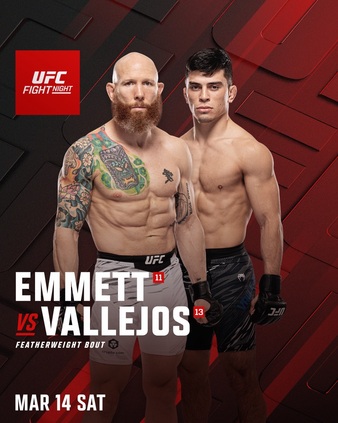
Men's Middleweight Bout • UFC Fight Night: Emmett vs. Vallejos
Saturday, March 14, 2026 • 25ft Cage (Small)
Explore Detailed Fighter Profiles
Click on either the fighter's name or profile image for each fighter to access comprehensive UFC statistics including striking metrics, grappling data, clinch performance, complete fight history, offensive & defensive analytics, and round-by-round breakdowns.

Brad Tavares
21-12-0
Brad Tavares
Fighter Metrics
Victory Methods
Win Round Distribution

Eryk Anders
Fighter Metrics
Victory Methods
Win Round Distribution
📋 Last 5 Fights - Brad Tavares
| Date | Opponent | Result | Method |
|---|---|---|---|
| 2025-09-06 | Robert Bryczek | Loss | Decision (Unanimous) (3, 5:00) |
| 2025-04-05 | Gerald Meerschaert | Win | Decision (Unanimous) (3, 5:00) |
| 2024-10-12 | JunYong Park | Loss | Decision (Unanimous) (3, 5:00) |
| 2024-02-10 | Gregory Rodrigues | Loss | KO/TKO (Punches) (2, 4:52) |
| 2023-08-19 | Chris Weidman | Win | Decision (Unanimous) (3, 5:00) |
📋 Last 5 Fights - Eryk Anders
| Date | Opponent | Result | Method |
|---|---|---|---|
| 2025-08-09 | Christian Leroy Duncan | Loss | KO/TKO (Punches) (1, 3:47) |
| 2024-12-07 | Chris Weidman | Win | Decision (Unanimous) (3, 5:00) |
| 2024-03-02 | Jamie Pickett | Win | Decision (Unanimous) (3, 5:00) |
| 2023-06-10 | Marc-André Barriault | Loss | Decision (Unanimous) (3, 5:00) |
| 2022-12-03 | Kyle Daukaus | Win | KO/TKO (Punches) (1, 4:38) |
Technical Analysis
Technical Score
Cardio Score
Overall Rating
📊 Technical Score
Calculated as the average of Striking Composite (66.0 vs 66.0) and Grappling Composite (78.0 vs 55.0). Balances overall striking effectiveness with grappling ability to measure complete technical skills.
💪 Cardio Score
Based on average fight duration, striking rate per minute, takedown rate, and finish rate. Measures cardiovascular endurance and ability to maintain pace throughout fights.
🎯 Overall Rating
Simple average of Technical Score and Cardio Score. Provides a holistic view of fighter capabilities combining skill level with physical conditioning and fight performance.
Striking Composite
Grappling Composite
Technical Radar Comparison
Visual comparison of key performance metrics between both fighters
📊 Detailed Statistical Comparison
🥊 Fight Analysis Breakdown
🧩 Brad Tavares Key Advantages
With 27 UFC fights and 14 decision victories, Tavares possesses an encyclopedic understanding of how to manage 15-minute contests. He knows when to press, when to circle, when to score, and when to rest. His 85% standing striking rate tells us he's extremely comfortable at range, and his low 3.36 SApM confirms he avoids damage while maintaining output. Against a pressure fighter like Anders, Tavares'ability to fight off the back foot while scoring clean counters is his primary weapon.
Tavares' 55% striking defense and low absorption rate mean he keeps himself out of danger more effectively than Anders. Against a power puncher with a 0.47 KD average, not being in harm's way is the most important skill Tavares can deploy. His 81% TDD also ensures Anders can't easily bypass the striking battle to find success in the clinch or on the ground.
Tavares' 24% leg strike rate gives him a weapon that Anders lacks entirely (5% leg strikes). In a fight against a pressure fighter coming forward, well-timed calf kicks and leg kicks can slow Anders' entry, compromise his power base, and accumulate damage that makes late-round surges more difficult. This is a smart, technical weapon that decision fighters use to steal rounds.
Tavares' 12:56 average fight time with consistent output means he'll outlast Anders if this goes deep. His ability to maintain pace in round 3 — where Anders historically fades — gives him a significant structural advantage in a fight where survival and accumulation are the primary strategy. With 14 UFC decision wins, the man knows how to pace himself.
⚠️ Unfavorable Scenarios
If Anders pressures effectively and forces prolonged clinch exchanges, Tavares loses his primary weapon (distance management). Tavares absorbing Anders' power shots at close range — where his 55% striking defense is less effective — dramatically increases his KO risk.
If Tavares' chin fails him again, this fight could be over quickly. He's been KO'd 6 times in his career, including by Gregory Rodrigues just over two years ago. Against a fighter with Anders' power (0.47 KD avg), one clean shot could be the beginning of the end.
If the fight becomes a brawl, Tavares loses. He's a point fighter without finishing power — his 0.17 KD average means he won't hurt Anders in exchanges, while Anders absolutely can hurt him. Tavares needs this to be a technical, measured fight, not a firefight.
📋 Likely Gameplan
Tavares will look to establish range immediately with his jab and utilize lateral movement to keep the fight in the center of the cage. He'll employ his 24% leg kick rate early — chopping at Anders' lead leg to slow pressure entries and compromise his power base. When Anders closes distance, Tavares will look to frame, create separation, and reset at range.
His exit strategy is clear: avoid the big shot, accumulate volume, win rounds 2 and 3 as Anders' cardio flags. His 81% TDD gives him confidence to deny any takedown attempts and immediately return to striking. He'll aim to out-point Anders in all three rounds by maintaining a steady 3.4+ SLpM output while staying defensively responsible (55% StrDef). He won't go for a finish — he never does — but he'll aim to make it an ugly, frustrating fight for the power puncher who needs chaos to win.
🚀 Eryk Anders Key Advantages
Anders' 0.47 KD average is his defining weapon, and his 59% career KO rate tells us he's a natural finisher. Against a fighter with Tavares' declining chin (6 career KO losses, including the recent Rodrigues finish), Anders carries fight-ending power in every exchange. The power differential between these two fighters is enormous — Tavares' 0.17 KD average means he almost never hurts opponents, while Anders regularly does.
Anders' 24% clinch striking rate (vs Tavares' 11%) shows he's far more comfortable in the phone booth. In the small 25-foot Apex cage, Anders can pressure Tavares against the fence and force clinch engagements where his power translates into short hooks, uppercuts, and knees. Against a fighter who wants to maintain distance, the clinch is the great equalizer — and Anders excels there.
Unlike Tavares who is 85% standing-focused, Anders attacks from standing (55%), clinch (24%), and ground (20%). This diversity forces Tavares to defend at all ranges. Even if Anders' takedowns rarely convert, the threat alone forces Tavares to alter his stance and commit mental bandwidth to wrestling defense — which opens striking opportunities.
Anders' 25% body targeting vs Tavares' 16% gives him a degradation weapon. Sustained body shots to a 38-year-old fighter over 15 minutes can break even the most disciplined point fighters. If Anders can dig body shots in the clinch and at mid-range, Tavares' famous cardio advantage could be neutralized by late-fight fatigue from accumulated body damage.
⚠️ Unfavorable Scenarios
If Tavares maintains distance for 15 minutes, Anders' power becomes irrelevant. Tavares' 24% leg kick rate will chop at Anders' lead leg, his 3.42 SLpM will accumulate volume, and the fight will go to the scorecards where Tavares has won 14 times in the UFC. Anders' 6 decision losses prove he cannot win the longer, tactical fight.
If Anders' takedowns fail (as they usually do at 25% accuracy) against Tavares' exceptional 81% TDD, he'll burn significant energy on wrestling that produces nothing — and each failed attempt resets the fight at range where Tavares is superior.
If the fight goes into round 3 with Tavares ahead on the scorecards, Anders faces desperation. His cardio (11:45 avg fight time vs 12:56) historically fades in championship rounds, and chasing a point deficit against a distance management specialist is a losing proposition.
📋 Likely Gameplan
Anders will come forward with measured aggression, looking to close distance and force clinch engagements against the cage. In the 25-foot Apex cage, he has less ground to cover before trapping Tavares. Once in the clinch, he'll work short power shots — hooks, uppercuts, and elbows — while mixing in takedown attempts to keep Tavares guessing.
His body work (25% targeting) will be a deliberate strategic investment designed to erode Tavares' cardio advantage over 15 minutes. On the feet, Anders will look to time Tavares'entries and exits with power counters, targeting the head (70% of his strikes go to the head) and looking for the one clean shot that can change the fight. His win condition is clear: land the knockout in rounds 1 or 2 before Tavares can accumulate an insurmountable points lead.
🎯 Fight Prediction Analysis
Data-driven prediction model based on statistical analysis
📊Detailed Analysis Summary
ðŸŸ️Cage Dynamics
The 25-foot small cage at the UFC Apex creates a fascinating dynamic — initially challenging for Tavares' distance game but Anders needs less ground to cover before trapping the Hawaiian. Tavares controls approximately 65% of the time spent at distance, using jabs, leg kicks, and lateral movement. Anders wins approximately 60% of clinch exchanges with his 24% clinch distribution vs Tavares' 11%. The small cage amplifies Anders' pressure advantage but limits his room to build momentum on failed attacks.
🎯Critical Matchup Factor
This fight distills to a simple question: Can Tavares maintain distance long enough to accumulate a decision-winning lead before Anders lands the fight-changing power shot? The answer is "yes, most of the time" — but the margin is thin because Anders' power (0.47 KD avg) against Tavares' declining chin (6 career KO losses, recent KO by Rodrigues) creates a constant latent threat that any single exchange could end the fight. Power is often the last thing to go — and Anders still possesses fight-ending power at 38.
🧩The Decision Fighter Paradox
Tavares' 14 UFC decision wins make him the statistically likely winner in any fight that goes the distance — but it also means he can never pull away. He won't hurt Anders. He won't finish Anders. He'll win rounds 2 and 3 by slim margins while constantly being one punch away from losing. This creates a high-variance dynamic where Tavares "should"win but Anders has realistic upset potential through any single power exchange.
ðŸFinal Prediction
The most likely outcome is Brad Tavares by Decision (54% probability), achieved through superior distance management, lower damage absorption, and proven decision-fighting ability over three rounds. Tavares' KO/TKO path (3%) is essentially non-existent given his 0.17 KD average. Anders' primary path is KO/TKO (28%) via his 0.47 KD average against Tavares'declining chin — particularly in the first two rounds before Tavares' distance management and cardio advantages fully take hold. Anders' decision path (14%) requires outworking Tavares for 15 minutes, which his 6 decision losses and inferior cardio profile suggest is unlikely.
💰 Betting Analysis: Model vs Market
Detailed value assessment in the betting market
📊Market Odds
🤖Analytical Model
💎Value Opportunities
MAXIMUM VALUE
Model: 54% | Fair: -117
GOOD VALUE
Model: 28% | Fair: +257
SLIGHT VALUE
Model: 68% | Fair: -213
⚠️Key Market Discrepancies
- • Overweights KO volatility — Market may overprice Anders' KO threat while undervaluing Tavares' 14 UFC decision wins and proven distance management.
- • Undervalues defensive metrics — Tavares' 55% striking defense and 3.36 SApM create a damage economy edge that compounds over 15 minutes.
- • Small cage factor — The 25-foot Apex cage limits Tavares' escape angles but also compresses Anders' room to build momentum on failed pressure attempts.
🎯 Comprehensive Probabilistic Analysis
100 hypothetical fight simulation based on statistical data
ðŸ†Outcome Distribution - Brad Tavares
Primary path via distance management and 14 UFC decision wins
Near-zero finish probability — 0.17 KD avg
Zero UFC submission wins, 0.00 sub attempt rate
💥Outcome Distribution - Eryk Anders
Primary path via 0.47 KD avg against declining chin
Requires outworking Tavares for 15 minutes — unlikely given 6 decision losses
Low historical submission profile
⏰Fight Timeline Analysis
⚡Window of Opportunity - Eryk Anders
- • First 5–7 minutes: Highest KO equity — 0.47 KD avg vs declining chin.
- • Clinch pressure: Close distance early, land short power shots — hooks and uppercuts.
- • Avoid range battle: Extended range exchanges favor Tavares' volume and accuracy.
🎯Progressive Dominance - Brad Tavares
- • Distance management: Control range with jabs and volume to outpoint Anders over 15 minutes.
- • Damage economy: 55% striking defense limits damage absorbed while landing at range.
- • Late rounds: Cardio advantage widens as Anders' output drops — own R2 and R3.
🎯 Final Confidence Assessment
Confidence level and uncertainty factors
Confidence Level
Moderate edge via distance management and cardio; undermined by declining chin
✅Supporting Factors
- • Distance management advantage — 3.42 SLpM at 47% accuracy
- • Superior cardio profile and 12:56 avg fight duration
- • 14 career UFC decision wins demonstrate scoring consistency
- • 55% striking defense creates favorable damage economy
⚠️Risk Factors
- • Tavares absorbed a KD in recent Bryczek loss — declining chin
- • Anders carries 0.47 KD avg — legitimate early KO threat
- • Small cage limits Tavares escape angles from clinch pressure
📝Executive Summary
Brad Tavares' path to victory centers on his distance management and cardio advantage — controlling range with 3.42 SLpM at 47% accuracy while limiting damage with 55% striking defense. His 14 career UFC decision wins demonstrate the consistent scoring ability needed to outwork Anders over three rounds. However, Tavares' recent trajectory is concerning — absorbing a KD against Bryczek, getting overwhelmed by JunYong Park' volume, and being finished by Rodrigues'accumulative pressure. Against Anders' 0.47 KD average, the declining chin represents a real threat, particularly in the first two rounds before cardio separation takes effect.
Prediction: Tavares by Decision most likely (54% probability) through distance control and volume scoring over 15 minutes; Anders' upset lane is early KO/TKO (28%) via close-range power shots against a declining chin. The fight' outcome hinges on whether Anders can close distance and land flush in rounds 1-2 before Tavares' superior cardio and range management become decisive.