

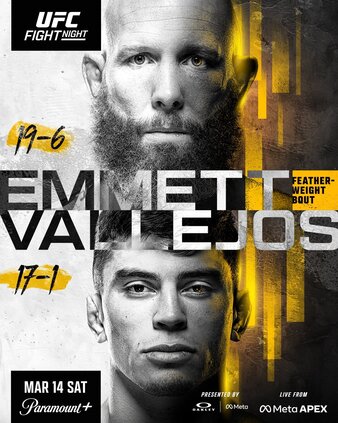
Josh Emmett vs Kevin Vallejos
Men's Featherweight Bout • UFC Fight Night: Emmett vs. Vallejos
Saturday, March 14, 2026
Explore Detailed Fighter Profiles
Click on either the fighter's name or profile image for each fighter to access comprehensive UFC statistics including striking metrics, grappling data, clinch performance, complete fight history, offensive & defensive analytics, and round-by-round breakdowns.

Josh Emmett
Fighter Metrics
Victory Methods
Win Round Distribution

Kevin Vallejos
17-1-0
Kevin Vallejos
Fighter Metrics
Victory Methods
Win Round Distribution
📋 Last 5 Fights - Josh Emmett
| Date | Opponent | Result | Method |
|---|---|---|---|
| Oct 2025 | Youssef Zalal | Loss | Submission (Armbar) (R1, 1:38) |
| Apr 2025 | Lerone Murphy | Loss | Decision (Unanimous) (5 Rounds, 5:00) |
| Dec 2023 | Bryce Mitchell | Win | KO/TKO (Punch) (R1, 1:57) |
| Jun 2023 | Ilia Topuria | Loss | Decision (Unanimous) (5 Rounds, 5:00) |
| Feb 2023 | Yair Rodríguez | Loss | Submission (Triangle Choke) (R2, 4:19) |
📋 Last 5 Fights - Kevin Vallejos
| Date | Opponent | Result | Method |
|---|---|---|---|
| Dec 2025 | Giga Chikadze | Win | KO/TKO (Spinning Backfist & Elbows) (R2, 1:29) |
| Aug 2025 | Danny Silva | Win | Decision (Unanimous) (3 Rounds, 5:00) |
| Mar 2025 | Seung Woo Choi | Win | KO/TKO (Overhand Right & Ground Punches) (R1, 3:09) |
| Sep 2024 | Cam Teague | Win | KO/TKO (Punches) (R1, 2:23) |
| Mar 2024 | Gonzalo Contreras | Win | KO/TKO (Overhand Right) (R2, 4:23) |
Technical Analysis
Technical Score
Cardio Score
Overall Rating
📊 Technical Score
Calculated as the average of Striking Composite (66.0 vs 66.0) and Grappling Composite (78.0 vs 55.0). Balances overall striking effectiveness with grappling ability to measure complete technical skills.
💪 Cardio Score
Based on average fight duration, striking rate per minute, takedown rate, and finish rate. Measures cardiovascular endurance and ability to maintain pace throughout fights.
🎯 Overall Rating
Simple average of Technical Score and Cardio Score. Provides a holistic view of fighter capabilities combining skill level with physical conditioning and fight performance.
Striking Composite
Grappling Composite
Technical Radar Comparison
Visual comparison of key performance metrics between both fighters
📊 Detailed Statistical Comparison
🥊 Fight Analysis Breakdown
🧩 Josh Emmett Key Advantages
Emmett carries legitimate one-punch knockout power that has been proven at the highest level of competition. With 9 of his 18 wins coming via KO/TKO, he possesses the kind of fight-ending ability that forces opponents to respect every exchange. His 4.62 SLpM output combined with heavy hands creates a constant threat that Vallejos has never faced at this level. Emmett's overhand right and left hook are particularly devastating, and his compact frame generates surprising power through hip rotation and timing. Against a UFC debutant, this power advantage becomes even more pronounced as octagon jitters can lead to defensive lapses.
With 17 UFC fights under his belt, Emmett has faced elite competition including Calvin Kattar, Ilia Topuria, and Bryce Mitchell. This wealth of experience at the highest level provides invaluable octagon IQ—understanding cage craft, judge positioning, round management, and pressure timing. The veteran has fought in main events and high-profile co-mains, meaning the spotlight won't affect his performance. Against Vallejos, who is making his UFC debut, this experience gap represents perhaps the most significant intangible advantage in the matchup. Emmett knows how to weather early storms, adjust mid-fight, and capitalize on openings that less experienced fighters create.
Emmett's Division I wrestling background at Arizona State University gives him a significant grappling foundation. His 78.0 grappling composite score far exceeds Vallejos's 55.0, providing a clear advantage in clinch work, takedowns, and scrambles. With 1.07 takedowns per 15 minutes and 48% takedown accuracy, Emmett can dictate where the fight takes place. His wrestling also serves as an excellent defensive tool—his 56% takedown defense allows him to keep the fight standing when he wants to utilize his power striking, while also giving him the option to grind out rounds if needed.
⚠️ Unfavorable Scenarios
At 35 years old and coming off back-to-back losses to Topuria and Mitchell, Emmett faces questions about his competitive trajectory. Extended layoffs between fights and accumulated damage from a long career can affect reaction time, chin durability, and overall explosiveness. If Emmett shows signs of slowing down or hesitancy early, the younger Vallejos could gain confidence and push an uncomfortable pace. The veteran's age-related decline, if present, would be most apparent in scramble speed and recovery between exchanges.
Emmett's 4.20 strikes absorbed per minute is a concerning metric that suggests he's hittable in exchanges. His 47% striking defense means he's absorbing over half the strikes thrown at him, creating opportunities for Vallejos to land clean shots. If Vallejos can establish early volume and make Emmett uncomfortable with his output (5.44 SLpM), the veteran could find himself in sustained firefights where his chin durability becomes a factor, particularly given the wear from his long career.
📋 Likely Gameplan
Emmett should look to close distance and land heavy power shots, particularly his trademark overhand right and left hook. Against a debuting fighter, establishing early pressure can exploit octagon jitters and force Vallejos into reactive fighting. Emmett's 4.62 SLpM with 44% accuracy means he can maintain respectable output while hunting for the finish. Setting up his power shots with body work and feinted takedowns will keep Vallejos guessing and create openings for fight-ending sequences.
If the striking exchanges become too risky, Emmett can lean on his wrestling pedigree to control the fight. His 78.0 grappling composite vs Vallejos's 55.0 gives him a clear path to cage control, top position, and grinding sequences. This strategy also serves as insurance against Vallejos's high volume—if the Argentine's pace becomes problematic, Emmett can change the fight's location and sap his opponent's energy through wrestling exchanges. The veteran's ability to mix striking with takedowns creates a multi-dimensional threat that a debuting fighter may struggle to handle.
🚀 Kevin Vallejos Key Advantages
Vallejos brings an impressive 5.44 significant strikes per minute, which actually outpaces Emmett's 4.62 SLpM. This high-volume approach combined with 47% accuracy creates consistent pressure and scoring opportunities that can be difficult to manage. The Argentine's ability to maintain this pace over three rounds gives him the potential to outwork the veteran in pure output if the fight stays at range. His volume-first approach can overwhelm opponents who try to time counters, as the sheer number of strikes makes it difficult to find clean openings between exchanges.
At 28 years old, Vallejos holds a 7-year age advantage over Emmett. This translates to faster recovery between exchanges, better explosiveness in scrambles, and superior cardio potential over three rounds. Youth is particularly advantageous in a sport where reaction time and chin durability decline with age and accumulated damage. Vallejos's athletic upside means he's still improving and potentially hasn't hit his ceiling, while Emmett may be on the downside of his career following two consecutive losses. This dynamic creates a situation where Vallejos can push a pace that the veteran struggles to maintain.
⚠️ Unfavorable Scenarios
Emmett's proven knockout power at the UFC level represents Vallejos's biggest threat. The veteran has stopped opponents like Michael Johnson and Shane Burgos with single shots, and his compact power can end fights instantly. Vallejos's 3.99 SApM absorption rate means he's getting hit regularly, and against someone with Emmett's finishing ability, every clean shot carries fight-ending potential. A single defensive lapse— especially in the first round when debut nerves are highest—could end Vallejos's UFC journey before it truly begins.
With a 55.0 grappling composite vs Emmett's 78.0, Vallejos faces a significant disadvantage if the fight goes to the mat. Emmett's D1 wrestling background gives him tools to control the fight location and grind out rounds against the cage. Vallejos's 0.00 TD15 suggests minimal offensive wrestling, and his lower takedown defense could be exploited by Emmett's 1.07 TD15. If Emmett consistently takes the fight down, Vallejos may find himself in positions he's rarely experienced, losing rounds through control time and positional dominance.
📋 Likely Gameplan
Vallejos should utilize his higher output (5.44 SLpM) and youth advantage to push a relentless pace. Moving laterally and staying on the outside, he can pepper Emmett with jabs, leg kicks, and combinations while avoiding the pocket where Emmett's power is most dangerous. Staying mobile and avoiding exchanges in the clinch will be crucial—Vallejos needs to make Emmett chase him and expend energy closing distance. If he can maintain this pace through three rounds, the volume advantage should translate to scorecards.
Vallejos's best path to victory involves targeting Emmett's body to slow the veteran's forward pressure and sap his power output. Body shots can neutralize knockout artists by limiting their ability to plant and generate power, while also accumulating damage that slows opponents in later rounds. By mixing body kicks and punches into his high-volume approach, Vallejos can create a cumulative effect that makes Emmett's power less dangerous as the fight progresses. This strategy also helps prevent takedowns by keeping Emmett upright and defensive rather than shooting for double legs.
🎯 Fight Prediction Analysis
Data-driven prediction model based on statistical analysis
📊Detailed Analysis Summary
🏟️Cage Dynamics
This matchup creates a classic power vs. volume dynamic that should favor Emmett's experience and finishing ability. The veteran's 17-fight UFC resume provides a significant cage IQ advantage over the debuting Vallejos, who will be dealing with the pressure of his first octagon appearance. Emmett's ability to close distance and land power shots, combined with his wrestling fallback, gives him multiple paths to victory. While Vallejos's volume (5.44 SLpM) is impressive, the quality of opposition he's faced doesn't compare to Emmett's resume. The octagon environment itself can be a factor—debut fighters often struggle with the crowd, cameras, and cage dimensions, which can disrupt their rhythm and timing.
🎯Technical Breakdown
The statistical comparison reveals Emmett's advantages in grappling (78.0 vs 55.0 composite) and power finishing (56% KO rate) as the key differentiators. While Vallejos holds a volume edge (5.44 vs 4.62 SLpM), the quality gap in competition faced is significant. Emmett's 44% striking accuracy is slightly lower than Vallejos's 47%, but his power per strike is considerably higher. The veteran's ability to mix wrestling with striking creates a multi-dimensional threat that Vallejos has not encountered at this level. Defensively, both fighters show similar absorption rates (4.20 vs 3.99 SApM), suggesting this could be a competitive standup battle, but Emmett's finishing ability means his clean shots carry more consequence.
🧩Key Battle Areas
Three critical battle areas will determine the outcome: Emmett's power striking vs Vallejos's volume output, wrestling control vs takedown defense, and experience vs youth. If Emmett can land his power shots early and establish respect, he can slow Vallejos's output and potentially finish the fight. If Vallejos survives the early power exchanges, his volume advantage and cardio become more significant in later rounds. The wrestling dimension heavily favors Emmett—his 1.07 TD15 vs Vallejos's 0.00 creates a clear path to control time if the striking battle becomes uncomfortable. The debut factor remains the wild card—Vallejos's ability to handle the octagon environment will significantly impact his performance ceiling.
🏁Final Prediction
The most likely outcome is Kevin Vallejos by Decision (38% probability), achieved through his superior volume output (5.44 SLpM) and youth advantage wearing down the 35-year-old Emmett over three rounds. Vallejos's KO/TKO path (20%) becomes viable as accumulated volume overwhelms an aging veteran showing signs of decline. Emmett's best path is by KO/TKO (15%) through his proven power catching the debuting Vallejos in early exchanges—this requires capitalizing on octagon jitters before the Argentine settles in. Emmett's Decision path (12%) relies on wrestling control and cage work, but his recent losing form limits this scenario.
💰 Betting Analysis: Model vs Market
Detailed value assessment in the betting market
📊Market Odds
🤖Analytical Model
💎Value Opportunities
MAXIMUM VALUE
Model: 15% | Fair: +567
GOOD VALUE
Model: 38% | Fair: -163
SLIGHT VALUE
Model: 60% | Fair: -150
⚠️Key Market Discrepancies
- • Debut discount undervalued – First-time UFC fighters historically underperform.
- • Wrestling gap overlooked – Emmett's D1 wrestling gives him a clear control advantage.
- • Age factor overweighted – Market may over-discount Emmett's decline based on recent losses.
🎯 Comprehensive Probabilistic Analysis
100 hypothetical fight simulation based on statistical data
🏆Outcome Distribution - Josh Emmett
Power shots catch debuting fighter in early exchanges
Wrestling control and cage work grind out 3 rounds
Wrestling transitions to choke; unlikely but possible
💥Outcome Distribution - Kevin Vallejos
Volume striking overwhelms aging veteran in exchanges
Volume output and youth dominate over 3 rounds
Limited submission profile but possible via ground control
⏰Fight Timeline Analysis
⚡Window of Opportunity - Kevin Vallejos
- • Survive Round 1: Get past debut nerves and Emmett's early power.
- • Volume pressure: Use 5.44 SLpM output to outwork the veteran.
- • Stay mobile: Avoid the clinch where Emmett's wrestling dominates.
🎯Early Finish Path - Josh Emmett
- • Power shots early: Exploit debut jitters with heavy hands.
- • Wrestling control: Use D1 background to dictate fight location.
- • Experience edge: Adjust mid-fight and capitalize on openings.
🎯 Final Confidence Assessment
Confidence level and uncertainty factors
Confidence Level
Experience and power edge offset by limited data on Vallejos
✅Supporting Factors
- • Massive experience gap (17 UFC fights vs 0)
- • Proven KO power (56% finish rate by KO/TKO)
- • D1 wrestling provides fight control fallback
- • Debut fighters historically underperform
⚠️Risk Factors
- • Emmett on 2-fight losing streak; aging at 35
- • Limited data on Vallejos creates uncertainty
- • Vallejos's volume output (5.44 SLpM) could overwhelm
🏁Executive Summary
Despite Josh Emmett's proven knockout power and extensive UFC experience, the model favors Kevin Vallejos in this featherweight contest. Emmett's 2-fight losing streak against top competition (Topuria, Mitchell), combined with his age (35) and concerning 4.20 SApM absorption rate, raises significant questions about his competitive trajectory. Vallejos brings a dangerous combination of higher volume output (5.44 vs 4.62 SLpM), a 7-year youth advantage, longer reach (+3"), and the hunger of a fighter making his UFC debut. While Emmett's wrestling pedigree (78.0 vs 55.0 grappling) provides a potential fallback, the model weights the veteran's declining form more heavily than his historical resume. The debut factor creates uncertainty, but Vallejos's physical tools and volume-first approach align well with finishing fights on the scorecards against an aging power puncher.
Prediction: Vallejos by Decision most likely (38% probability) through volume output and youth advantage over three rounds; Emmett's best path is by KO/TKO (15%) through power shots capitalizing on a debuting fighter's defensive lapses. The fight's outcome will likely hinge on whether Emmett can land his big shots early before Vallejos settles into his rhythm and starts outworking the veteran with sustained volume.